

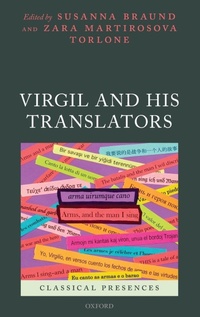
Virgil and his Translators
Published on 4. October 2018
Book
Hardback
532 pages
978-0-19-881081-0 (ISBN)
Description
This is the first volume to offer a critical overview of the long and complicated history of translations of Virgil from the early modern period to the present day, transcending traditional studies of single translations or particular national traditions in isolation to offer an insightful comparative perspective. The twenty-nine essays in the collection cover numerous European languages - from English, French, and German, to Greek, Irish, Italian, Norwegian, Slovenian, and Spanish - but also look well beyond Europe to include discussion of Brazilian, Chinese, Esperanto, Russian, and Turkish translations of Virgil. While the opening two contributions lay down a broad theoretical and comparative framework, the majority conduct comparisons within a particular language and combine detailed case studies with in-depth contextualization and theoretical background, showing how the translations discussed are embedded in their own cultures and historical moments. The final two essays are written from the perspective of contemporary translators, closing out the volume with a profound assessment not only of the influence exerted by the major Roman poet on later literature, but also why translation of a canonical author such as Virgil matters, not only as a national and transnational cultural phenomenon, but as a personal engagement with a literature of enduring power and relevance.
Reviews / Votes
this lucid and entertaining collection will serve as a helpful introduction to the complex ideological phenomena which motivate the translation of classical texts. * George Brocklehurst, International Journal of the Classical Tradition * This lively and thoughtful collection, a long overdue contribution to Virgilian studies, applies the ideological hermeneutics pioneered by Theodore Ziolkowski in Virgil and the Moderns (1993), emphasizing the complex aesthetic, moral and political concerns involved in translating the 'classic of all Europe'. * George Brocklehurst, International Journal of the Classical Tradition * This substantial volume will appeal to all Virgilians and reception studies scholars, evidencing as it does the many and varied permutations of three ancient source texts, and setting a new standard for breadth and depth in comparative surveys. The volume is also of use to students or those unfamiliar with any of the many languages treated: all quotations are translated, and a comprehensive bibliography is appended to the essays. * Holly Rangers, Institute of Classical Studies, Bryn Mawr Classical Review * Every chapter of the book contains data and observations that will doubtless be of interest to specialist scholars of particular European and Asian languages. * David Hopkins, University of Bristol, Translation and Literature * Braund and Torlone have produced an international tribute to Virgil, a polyglot paean for the considerable effort expended through the ages on the transmission of the poet's limpid hexameters into a dizzying array of vernaculars. A testament to the success of the arduous endeavor is the urge the individual chapters engender both to search out familiar chestnuts of Virgilian translation for reexamination, and to explore unknown versions (and indeed unfamiliar languages). If Virgil is the premiere Roman poet, this book ably illustrates the widespread influence and enduring power and charm of his works. * Lee Fratantuo, CJOnline * Braund and Torlone have produced an international tribute to Virgil, a polyglot paean for the considerable effort expended through the ages on the transmission of the poet's limpid hexameters into a dizzying array of vernaculars. A testament to the success of the arduous endeavor is the urge the individual chapters engender both to search out familiar chestnuts of Virgilian translation for reexamination, and to explore unknown versions (and indeed unfamiliar languages) ... This is one of the most valuable Virgilian titles of its year. It deserves to be on the shelves of all libraries that service a classics curriculum, and in the personal collections of Virgilians and devotees of classical verse. * Lee Fratantuono, Classical Journal Online * Virgil and his Translators needs no conceptual justification. It is a hugely rewarding collection of essays, full of analysis, perception and insights into the translation of Virgil over the ages. * Stuart Lyons, Classics for all *More details
Series
Language
English
Place of publication
Oxford
United Kingdom
Target group
College/higher education
Professional and scholarly
Dimensions
Height: 240 mm
Width: 161 mm
Thickness: 33 mm
Weight
957 gr
ISBN-13
978-0-19-881081-0 (9780198810810)
Copyright in bibliographic data and cover images is held by Nielsen Book Services Limited or by the publishers or by their respective licensors: all rights reserved.
Schweitzer Classification
Other editions
Additional editions
Susanna Braund | Zara Martirosova Torlone
Virgil and his Translators
E-Book
10/2018
1st Edition
OUP eBook
€76.49
Available for download
Susanna Braund | Zara Martirosova Torlone
Virgil and his Translators
E-Book
09/2018
1st Edition
OUP eBook
€76.49
Available for download
Persons
Susanna Braund moved to the University of British Columbia in 2007 to take up a Canada Research Chair in Latin Poetry and its Reception after teaching previously at Stanford, Yale, London, Bristol, and Exeter. She received her BA and PhD from the University of Cambridge. She has published extensively on Roman satire, Latin epic poetry, and the passions in Roman thought, and has translated Lucan for the Oxford World's Classics series, Persius and Juvenal for the Loeb Classical Library, and also three of Seneca's tragedies. She was a Visiting Scholar at the College de France in 2014 and won a Killam Research Fellowship in the 2016 national competition for her project 'Virgil Translated'.
Zara Martirosova Torlone is a Professor in the Department of Classics at Miami University, Ohio. She received her BA in Classical Philology from Moscow University and her PhD in Classics from Columbia University. She is the author of Russia and the Classics: Poetry's Foreign Muse (Duckworth, 2009), Latin Love Poetry (co-authored with Denise McCoskey; I.B. Tauris, 2014), and Vergil in Russia: National Identity and Classical Reception (OUP, 2015), as well as articles on Roman poetry and the novel, the Russian reception of antiquity, Roman games, and textual criticism. Her most recent publication is the co-edited volume A Handbook to Classical Reception in Eastern and Central Europe (with Dana LaCourse Munteanu and Dorota Dutsch; Wiley-Blackwell, 2017), to which she also contributed.
Zara Martirosova Torlone is a Professor in the Department of Classics at Miami University, Ohio. She received her BA in Classical Philology from Moscow University and her PhD in Classics from Columbia University. She is the author of Russia and the Classics: Poetry's Foreign Muse (Duckworth, 2009), Latin Love Poetry (co-authored with Denise McCoskey; I.B. Tauris, 2014), and Vergil in Russia: National Identity and Classical Reception (OUP, 2015), as well as articles on Roman poetry and the novel, the Russian reception of antiquity, Roman games, and textual criticism. Her most recent publication is the co-edited volume A Handbook to Classical Reception in Eastern and Central Europe (with Dana LaCourse Munteanu and Dorota Dutsch; Wiley-Blackwell, 2017), to which she also contributed.
Content
0: Susanna Braund and Zara Martirosova Torlone: Introduction. The Translation History of Virgil: The Elevator Version
Part 1: Virgil Translation as Cultural and Ideological Capital
1: Craig Kallendorf: Successes and Failures in Virgilian Translation
2: Richard Armstrong: Dante's Influence on Virgil: Italian Volgarizzamenti and Enrique de Villena's Eneida of 1428
3: Stephen Rupp: Epic and the Lexicon of Violence: Gregorio Hernandez de Velasco's Translation of Aeneid 2 and Cervantes's Numancia
4: Alison Keith: Love and War: Translations of Aeneid 7 into English (From Caxton to Today)
5: Gordon Braden: The Passion of Dido: Aeneid 4 in English Translation to 1700
6: Fiona Cox: An Amazon in the Renaissance: Marie de Gournay's Translation of Aeneid 2
7: Susanna Braund: Virgil after Vietnam
8: Geoffrey Greatrex: Translations of Virgil into Esperanto
9: Michael Paschalis: Translations of Virgil into Ancient Greek
10: Sophia Papaioannou: Sing it Like Homer: Evgenios Voulgaris' Translation of the Aeneid
11: Marko Marincic: Farming for the Few: Jozef Subic's Georgics and the Early Slovenian Reception of Virgil
12: Ekin OEyken and Ci&gdem Duerue,sken: Reviving Virgil in Turkish
13: Mathilde Skoie: Finding a Pastoral Idiom: Norwegian Translations of Virgil's Eclogues and the Politics of Language
14: Severine Clement-Tarantino: The Aeneid and 'Les Belles Lettres': Virgil's Epic in French between Fiction and Philology, from Veyne back to Perret
15: Jinyu Liu: Virgil in China
Part 2: Poets as Translators of Virgil: Cultural Competition, Appropriation, and Identification
16: Richard F. Thomas: Domesticating Aesthetic Effects: Virgilian Case Studies
17: Helene Gautier: The Translation of Books Four and Six of Du Bellay's Aeneid: Rewriting as Poetic Reinvention?
18: Stephen Scully: Aesthetic and Political Concerns in Dryden's Aeneis
19: Marco Romani Mistretta: Translation Theory into Practice: Jacques Delille's Georgiques de Virgile
20: Giampiero Scafoglio: 'Only a poet can translate true poetry': The Translation of Aeneid 2 by Giacomo Leopardi
21: Philip Hardie: Wordsworth's Translation of Aeneid 1 3 and the Earlier Tradition of English Translations of Virgil
22: Zara Martirosova Torlone: Epic Failures: Vasilii Zhukovskii's 'Destruction of Troy' and Russian Translations of the Aeneid
23: Paulo Sergio de Vasconcellos: Virgilio Brasileiro: A Brazilian Virgil in the Nineteenth Century
24: Ulrich Eigler: Between Voss and Schroeder: German Translations of Virgil's Aeneid
25: Jacqueline Fabre-Serris: Reflections on Two Verse Translations of the Eclogues in the Twentieth Century: Paul Valery and Marcel Pagnol
26: Ulrich Eigler: 'Come tradurre?': Pier Paolo Pasolini and the Tradition of Italian Translations of Virgil's Aeneid
27: Cillian O'Hogan: Irish Versions of Virgil's Eclogues and Georgics
28: Alessandro Fo: Cutting our Losses: A Translator's Journey through the Aeneid
29: Josephine Balmer: Afterword. Let Go Fear: Future Virgils
Endmatter
Bibliography
Notes on Contributors
Index
Part 1: Virgil Translation as Cultural and Ideological Capital
1: Craig Kallendorf: Successes and Failures in Virgilian Translation
2: Richard Armstrong: Dante's Influence on Virgil: Italian Volgarizzamenti and Enrique de Villena's Eneida of 1428
3: Stephen Rupp: Epic and the Lexicon of Violence: Gregorio Hernandez de Velasco's Translation of Aeneid 2 and Cervantes's Numancia
4: Alison Keith: Love and War: Translations of Aeneid 7 into English (From Caxton to Today)
5: Gordon Braden: The Passion of Dido: Aeneid 4 in English Translation to 1700
6: Fiona Cox: An Amazon in the Renaissance: Marie de Gournay's Translation of Aeneid 2
7: Susanna Braund: Virgil after Vietnam
8: Geoffrey Greatrex: Translations of Virgil into Esperanto
9: Michael Paschalis: Translations of Virgil into Ancient Greek
10: Sophia Papaioannou: Sing it Like Homer: Evgenios Voulgaris' Translation of the Aeneid
11: Marko Marincic: Farming for the Few: Jozef Subic's Georgics and the Early Slovenian Reception of Virgil
12: Ekin OEyken and Ci&gdem Duerue,sken: Reviving Virgil in Turkish
13: Mathilde Skoie: Finding a Pastoral Idiom: Norwegian Translations of Virgil's Eclogues and the Politics of Language
14: Severine Clement-Tarantino: The Aeneid and 'Les Belles Lettres': Virgil's Epic in French between Fiction and Philology, from Veyne back to Perret
15: Jinyu Liu: Virgil in China
Part 2: Poets as Translators of Virgil: Cultural Competition, Appropriation, and Identification
16: Richard F. Thomas: Domesticating Aesthetic Effects: Virgilian Case Studies
17: Helene Gautier: The Translation of Books Four and Six of Du Bellay's Aeneid: Rewriting as Poetic Reinvention?
18: Stephen Scully: Aesthetic and Political Concerns in Dryden's Aeneis
19: Marco Romani Mistretta: Translation Theory into Practice: Jacques Delille's Georgiques de Virgile
20: Giampiero Scafoglio: 'Only a poet can translate true poetry': The Translation of Aeneid 2 by Giacomo Leopardi
21: Philip Hardie: Wordsworth's Translation of Aeneid 1 3 and the Earlier Tradition of English Translations of Virgil
22: Zara Martirosova Torlone: Epic Failures: Vasilii Zhukovskii's 'Destruction of Troy' and Russian Translations of the Aeneid
23: Paulo Sergio de Vasconcellos: Virgilio Brasileiro: A Brazilian Virgil in the Nineteenth Century
24: Ulrich Eigler: Between Voss and Schroeder: German Translations of Virgil's Aeneid
25: Jacqueline Fabre-Serris: Reflections on Two Verse Translations of the Eclogues in the Twentieth Century: Paul Valery and Marcel Pagnol
26: Ulrich Eigler: 'Come tradurre?': Pier Paolo Pasolini and the Tradition of Italian Translations of Virgil's Aeneid
27: Cillian O'Hogan: Irish Versions of Virgil's Eclogues and Georgics
28: Alessandro Fo: Cutting our Losses: A Translator's Journey through the Aeneid
29: Josephine Balmer: Afterword. Let Go Fear: Future Virgils
Endmatter
Bibliography
Notes on Contributors
Index