

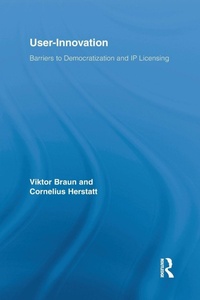
User-Innovation
Barriers to Democratization and IP Licensing
1st Edition
Published on 20. January 2016
Book
Paperback/Softback
274 pages
978-1-138-99400-3 (ISBN)
Description
Economic growth is highly dependent on technological progress and innovation, yet the sources from which these innovations originate are still largely misunderstood and untapped. Recent research has demonstrated that users, rather than manufacturers, are often a critical source of innovation in numerous fields from extreme sports to medical devices to software. This book systematically identifies the most important barriers to user-innovation and critically evaluates the democratization of innovation argument by critically assessing the main legal, economic, technological, and societal barriers to user-innovation for the first time and proposing alternative possibilities.
Through original research the author reveals the dynamics of user-innovation and offers strategies for minimizing those factors that inhibit and stifle the spread of this phenomenon. From this analysis it becomes clear that user-innovation has become more difficult over time and that the problem is now of how manufacturers can enable users to overcome the discussed barriers and simultaneously benefit from such consumer-driven activities. Arguing that licenses are not just an important technology commercialization instrument but are tools critical to generating innovations, the author explains how licenses can in certain situations be employed to help users overcome some of the barriers to user-innovation. User-Innovation: Barriers to Democratization and IP Licensing is a practical guidebook as well as a startlingly original work of scholarship that will be essential reading for years to come.
Through original research the author reveals the dynamics of user-innovation and offers strategies for minimizing those factors that inhibit and stifle the spread of this phenomenon. From this analysis it becomes clear that user-innovation has become more difficult over time and that the problem is now of how manufacturers can enable users to overcome the discussed barriers and simultaneously benefit from such consumer-driven activities. Arguing that licenses are not just an important technology commercialization instrument but are tools critical to generating innovations, the author explains how licenses can in certain situations be employed to help users overcome some of the barriers to user-innovation. User-Innovation: Barriers to Democratization and IP Licensing is a practical guidebook as well as a startlingly original work of scholarship that will be essential reading for years to come.
More details
Series
Language
English
Place of publication
London
United Kingdom
Publishing group
Taylor & Francis Ltd
Target group
College/higher education
Illustrations
14 s/w Abbildungen, 14 s/w Zeichnungen, 14 s/w Tabellen
14 Tables, black and white; 14 Line drawings, black and white; 14 Illustrations, black and white
Dimensions
Height: 229 mm
Width: 152 mm
Thickness: 15 mm
Weight
402 gr
ISBN-13
978-1-138-99400-3 (9781138994003)
Copyright in bibliographic data and cover images is held by Nielsen Book Services Limited or by the publishers or by their respective licensors: all rights reserved.
Schweitzer Classification
Other editions
Additional editions
E-Book
06/2009
1st Edition
Routledge
€94.89
Available for download
E-Book
06/2009
Routledge
€69.99
Available for download
E-Book
06/2009
Routledge
€69.99
Available for download
Book
04/2009
1st Edition
Routledge
€231.90
Shipment within 15-20 days
Persons
Viktor Braun, Cornelius Herstatt
Content
List of Diagrams
List of Tables
List of Frequently Used Abbreviations
Foreword
Acknowledgments
Introduction
Part A: The Democratization Potential
Part B: Barriers to Democratization
B.1 Exploring the Barriers to User-Innovation
B. 2 Empirical Analysis in the Field of Medical Devices
Part C: The Dynamics of User-Innovation
Part D: The Paradigm of Licensing to Innovate
D. 1 The Permission to Innovate
D. 2 Licenses as Sources of Innovation
D. 3 Licensing to Innovate: An Alternate Instrument for User-Manufacturer Co-Operation
Appendix
Notes
Bibliography
Index
List of Tables
List of Frequently Used Abbreviations
Foreword
Acknowledgments
Introduction
Part A: The Democratization Potential
Part B: Barriers to Democratization
B.1 Exploring the Barriers to User-Innovation
B. 2 Empirical Analysis in the Field of Medical Devices
Part C: The Dynamics of User-Innovation
Part D: The Paradigm of Licensing to Innovate
D. 1 The Permission to Innovate
D. 2 Licenses as Sources of Innovation
D. 3 Licensing to Innovate: An Alternate Instrument for User-Manufacturer Co-Operation
Appendix
Notes
Bibliography
Index