

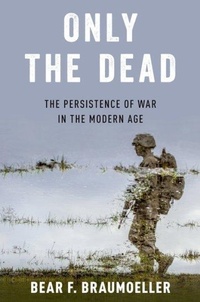
Only the Dead
The Persistence of War in the Modern Age
Published on 4. April 2022
Book
Paperback/Softback
352 pages
978-0-19-762427-2 (ISBN)
Description
A unique assessment that challenges humanity's quest to abolish warfare.
The idea that war is going out of style has become the conventional wisdom in recent years. But in Only the Dead, award-winning author Bear Braumoeller demonstrates that it shouldn't have. With a rare combination of historical expertise, statistical acumen, and accessible prose, Braumoeller shows that the evidence simply doesn't support the decline-of-war thesis propounded by scholars like Steven Pinker. He argues that the key to understanding trends in warfare lies, not in the spread of humanitarian values, but rather in the formation of international orders--sets of expectations about behavior that allow countries to work in concert, as they did in the Concert of Europe and have done in the postwar Western liberal order. With a nod toward the American sociologist Charles Tilly, who argued that "war made the state and the state made war," Braumoeller argues that the same is true of international orders: while they reduce conflict within their borders, they can also clash violently with one another, as the Western and communist orders did throughout the Cold War.
Both highly readable and rigorous, Only the Dead offers a realistic assessment of humanity's quest to abolish warfare. While pessimists have been too quick to discount the successes of our attempts to reduce international conflict, optimists are prone to put too much faith in human nature. Reality lies somewhere in between: While the aspirations of humankind to govern its behavior with reason and justice have had shocking success in moderating the harsh dictates of realpolitik, the institutions that we have created to prevent war are unlikely to achieve anything like total success--as evidenced by the multitude of conflicts in recent decades. As the old adage advises us, only the dead have seen the end of war.
The idea that war is going out of style has become the conventional wisdom in recent years. But in Only the Dead, award-winning author Bear Braumoeller demonstrates that it shouldn't have. With a rare combination of historical expertise, statistical acumen, and accessible prose, Braumoeller shows that the evidence simply doesn't support the decline-of-war thesis propounded by scholars like Steven Pinker. He argues that the key to understanding trends in warfare lies, not in the spread of humanitarian values, but rather in the formation of international orders--sets of expectations about behavior that allow countries to work in concert, as they did in the Concert of Europe and have done in the postwar Western liberal order. With a nod toward the American sociologist Charles Tilly, who argued that "war made the state and the state made war," Braumoeller argues that the same is true of international orders: while they reduce conflict within their borders, they can also clash violently with one another, as the Western and communist orders did throughout the Cold War.
Both highly readable and rigorous, Only the Dead offers a realistic assessment of humanity's quest to abolish warfare. While pessimists have been too quick to discount the successes of our attempts to reduce international conflict, optimists are prone to put too much faith in human nature. Reality lies somewhere in between: While the aspirations of humankind to govern its behavior with reason and justice have had shocking success in moderating the harsh dictates of realpolitik, the institutions that we have created to prevent war are unlikely to achieve anything like total success--as evidenced by the multitude of conflicts in recent decades. As the old adage advises us, only the dead have seen the end of war.
Reviews / Votes
Braumoeller's analysis of the data is thoughtful and convincing...Today, with the conditions for a regional war in the Middle East riper than they have been for years, the liberal international order under strain, and the deterioration of U.S.-Chinese relations, Only the Dead makes for sobering reading. * Nikita Lalwani, Yale Law School and Sam Winter-Levy, Princeton University, Foreign Policy * Overall, the arguments in this book are strong, and the discussion of data issues is subtle throughout. Its arguments seem fundamentally correct to me. * Tyler Cowen, Marginal Revolution University *More details
Language
English
Place of publication
New York
United States
Target group
Professional and scholarly
Product notice
Paperback (trade)
Unsewn / adhesive bound
Illustrations
47 color figures
Dimensions
Height: 233 mm
Width: 157 mm
Thickness: 20 mm
Weight
600 gr
ISBN-13
978-0-19-762427-2 (9780197624272)
Copyright in bibliographic data and cover images is held by Nielsen Book Services Limited or by the publishers or by their respective licensors: all rights reserved.
Schweitzer Classification
Other editions
Additional editions
E-Book
07/2019
OUP eBook
€9.99
Available for download
E-Book
07/2019
OUP eBook
€9.99
Available for download
Person
Bear F. Braumoeller is a professor in the Department of Political Science at The Ohio State University who studies Great Power politics, international conflict, complex systems, and statistical methodology. He earned his Bachelor's degree at the University of Chicago and his Ph.D. at the University of Michigan. He has previously been a faculty member at Harvard University and the University of Illinois and has been a Fellow at the Norwegian Nobel Institute. His first book, The Great Powers and the International System, won the Best Book Award from the International Studies Association as well as the J. David Singer Award.
Content
Preface
1 Introduction
2 Empirical Reasons for Skepticism
3 Theoretical Reasons for Skepticism
4 A Conventional View of War
5 Measuring War
6 A Few Handy Tools
7 Trends in Warfare, 1815-present
Notes
Index
1 Introduction
2 Empirical Reasons for Skepticism
3 Theoretical Reasons for Skepticism
4 A Conventional View of War
5 Measuring War
6 A Few Handy Tools
7 Trends in Warfare, 1815-present
Notes
Index