

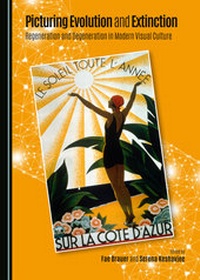
Picturing Evolution and Extinction
Regeneration and Degeneration in Modern Visual Culture
Published on 28. September 2015
Book
Paperback/Softback
302 pages
978-1-4438-7253-9 (ISBN)
Description
With the increasing loss of biological diversity in this Sixth Age of Mass Extinction, it is timely to show that devolutionary paranoia is not new, but rather stretches back to the time of Charles Darwin. It is also an opportune moment to show how human-driven extinction, as designated by the term, Anthropocene, has long been acknowledged. The halcyon days of European industrial progress, colonial expansion and scientific revolution trumpeted from the Great Exhibition of 1851 until the Dresden International Hygiene Exhibition of 1930 were constantly marred by fears of rampant degeneration, depopulation, national decline, environmental devastation and racial extinction. This is demonstrated by the discourses of catastrophism charted in this book that percolated across Europe in response to the theories of Darwin and Jean Baptiste Lamarck, as well as Marcellin Berthelot, Camille Flammarion, Ernst Haeckel, Louis Landouzy, Felix Le Dantec, Cesare Lombroso, Thomas Huxley, Benedite-Augustin Morel, Louis Pasteur, Elisee Reclus, Rudolf Steiner and Wilhelm Wundt, among others. This book presents pioneering explorations of the interrelationship between these discourses and modern visual cultures and the ways in which the "picturing of evolution and extinction" by artists as diverse as Roger Broders, Albert Besnard, Fernand Cormon, Helene Dufau, Emile Galle, Frantisek Kupka, Pablo Picasso, Carles Mani y Roig, Sophie Taeuber and Vasilii Vatagin betrayed anxieties subliminally festering over degeneration alongside latent hopes of regeneration.Following Darwin's concept of evolution as Janus-faced, the dialectical interplay of evolution and extinction and degeneration and regeneration is explored in modern visual cultures in Australia, America, Britain, France, Germany, Russia, Spain and Switzerland at significant spatio-temporal junctures between 1860 and 1930. By unravelling the "picturing" of the dread of alcoholism, cholera, dysentery, tuberculosis, typhoid and rabies, alongside phobias of animalism, criminality, hysteria, impotency and ecological disaster, each chapter makes an original contribution to this new field of scholarship. By locating these discourses and visual cultures within the "golden age of Neo-Lamarckism", they also reveal how regeneration was pictured as the Janus-face of degeneration able to facilitate evolution through the inheritance of beneficial characteristics in propitious environments.In striking such an uplifting note amidst the dissonant cacophony of catastrophism, this book reveals why the art and science of Transformism proved so appealing in France as elsewhere, and why visual cultures of regeneration became as dominant in the twentieth century as the picturing of degeneration had been in the nineteenth century. It also illuminates the paradoxical inversion that occurred in the twentieth century when devolution became equivalent to evolution for many Modernists. Hence, whilst this book opens with the picturing of indigenous people in Australia and North America as "doomed races" by the first publication of Darwin's On The Origin of Species, it closes with the quest by 1930 for a regenerative suntan as dark as the skin of those indigenous people.
Reviews / Votes
Fae Brauer is Professor of Art and Visual Culture at the University of East London Centre for Cultural Studies Research, and Associate Professor of Art History and Cultural Theory at The University of New South Wales National Institute of Experimental Arts. Her books include Rivals and Conspirators: The Paris Salons and the Modern Art Centre; Radical Space: Exploring Politics and Practice; The Art of Evolution: Darwin, Darwinisms and Visual Culture and Art, Sex and Eugenics, Corpus Delecti. Serena Keshavjee is an Associate Professor in the History Department at the University of Winnipeg, Canada. In 2009, she edited a special issue of Canadian Art Review (RACAR) onMore details
Edition
Unabridged edition
Language
English
Place of publication
Newcastle upon Tyne
United Kingdom
Target group
College/higher education
Professional and scholarly
Edition type
Unabridged edition
Product notice
With dust jacket
Dimensions
Height: 212 mm
Width: 148 mm
ISBN-13
978-1-4438-7253-9 (9781443872539)
Copyright in bibliographic data and cover images is held by Nielsen Book Services Limited or by the publishers or by their respective licensors: all rights reserved.
Schweitzer Classification
Other editions
Additional editions
Unknown | Fae Brauer
Picturing Evolution and Extinction
Regeneration and Degeneration in Modern Visual Culture
E-Book
10/2015
1st Edition
Cambridge Scholars Publishing
€202.99
Available for download
Persons
Fae Brauer is Professor of Art and Visual Culture at the University of East London Centre for Cultural Studies Research, and Associate Professor of Art History and Cultural Theory at The University of New South Wales National Institute of Experimental Arts. Her books include Rivals and Conspirators: The Paris Salons and the Modern Art Centre; The Art of Evolution: Darwin, Darwinisms and Visual Culture and Art, Sex and Eugenics, Corpus Delecti.Serena Keshavjee is an Associate Professor in the History Department at the University of Winnipeg, Canada. In 2009, she edited a special issue of Canadian Art Review (RACAR) on "Science, Symbolism and Fin-de-Siecle Visual Culture". She is the recipient of a Social Sciences and Humanities Council Grant to study evolutionary theory and art, and has published articles in Aries and Nineteenth-Century Art Worldwide on how artists articulated the visual culture of marginal religious philosophies and new evolutionary theories, including Spiritualism and Transformism.