

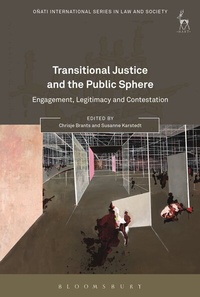
Transitional Justice and the Public Sphere
Engagement, Legitimacy and Contestation
Published on 2. November 2017
Book
Hardback
360 pages
978-1-5099-0016-9 (ISBN)
Description
Transparency is a fundamental principle of justice. A cornerstone of the rule of law, it allows for public engagement and for democratic control of the decisions and actions of both the judiciary and the justice authorities. This book looks at the question of transparency within the framework of transitional justice. Bringing together scholars from across the disciplinary spectrum, the collection analyses the issue from socio-legal, cultural studies and practitioner perspectives. Taking a three-part approach, it firstly discusses basic principles guiding justice globally before exploring courts and how they make justice visible. Finally, the collection reviews the interface between law, transitional justice institutions and the public sphere.
Reviews / Votes
... the multitude of perspectives and experiences that scholars and practitioners brought to this book make is outstanding. Legal scholars of criminal law and procedure, criminologists, political scientists, anthropologists, victimologists, communications specialists - they all add to this book their unique perspectives, emphasising once again that transitional justice is an interdisciplinary field. -- Iva Vukusic, Department of History and Art History, Utrecht University * International Criminal Law Review * This collection brings together an impressive range of scholars from different geographical contexts and career stages to explore the role of the public sphere in understanding 'justice' within a transitional justice framework, with a particular focus on legal justice. It will be of use to legal scholars, and to those interested in the role of the public sphere who would like a more nuanced understanding of the role of criminal courts within transitional justice frameworks. -- Alison Atkinson-Phillips, Newcastle University * Historical Dialogues, Justice, And Memory Network *More details
Series
Language
English
Place of publication
Oxford
United Kingdom
Publishing group
Bloomsbury Publishing PLC
Target group
College/higher education
Professional and scholarly
Product notice
Hardback (stationery)
Dimensions
Height: 234 mm
Width: 156 mm
Weight
687 gr
ISBN-13
978-1-5099-0016-9 (9781509900169)
Copyright in bibliographic data and cover images is held by Nielsen Book Services Limited or by the publishers or by their respective licensors: all rights reserved.
Schweitzer Classification
Other editions
Additional editions
Chrisje Brants | Susanne Karstedt
Transitional Justice and the Public Sphere
Engagement, Legitimacy and Contestation
Book
03/2020
Hart Publishing
€69.51
Shipment within 15-20 days
Chrisje Brants | Susanne Karstedt
Transitional Justice and the Public Sphere
Engagement, Legitimacy and Contestation
E-Book
11/2017
1st Edition
Hart Publishing
€46.49
Available for download
Persons
Chrisje Brants is Professor of Criminal Law at Northumbria University, United Kingdom; and Professor Emeritus of Criminal Law and Procedure at Utrecht University, Netherlands.
Susanne Karstedt is Professor in the School of Criminology and Criminal Justice at Griffith University, Australia.
Susanne Karstedt is Professor in the School of Criminology and Criminal Justice at Griffith University, Australia.
Content
1. Introduction: The Rational and the Emotional: Issues of Transparency and Legitimacy in Transitional Justice
Chrisje Brants and Susanne Karstedt
Part I: Transitional Justice and its Public Spheres: Principles of Justice
2. Justice as the Art of Muddling through: The Importance of Nyaya in the Aftermath of International Crimes
Antony Pemberton and Rianne Letschert
3. Emotional Discourse in a Rational Public Sphere: The Victim and the International Criminal Trial
Chrisje Brants
4. Credible Justice and Incredible Crimes
Susanne Karstedt
5. Globalisation, Crime and Governance: Transparency, Accountability and Participation as Principles for Global Criminal Law
Paul De Hert
Part II: Justice Seen to Be Done: Courts and the Public
6. International Judicial Institutions: (Re)Defining 'Public' Proceedings?
Olga Kavran
7. The Contestation of Complementarity in Uganda: The Case of Thomas Kwoyelo
Lauren Gould
8. Discursive Proceedings and the Transitional Trial: A View from the Extraordinary Chambers in the Courts of Cambodia
Cheryl White
9. Unmet Expectations and the Legitimacy of Transitional Justice Institutions: The International Criminal Tribunal for the Former Yugoslavia and the Extraordinary Chambers in the Courts of Cambodia
Ray Nickson
Part III: Beyond the Courts: Creating Public Spheres of Testimony
10. Witness Testimony and the Incommensurability of Truth in Argentina
Antonius CGM Robben
11. Faces of Truth: Journalism, Justice and War
Kees Brants and Chrisje Brants
12. Memory Laws: Regulating Memory and the Policing of Acknowledgement and Denial
Marloes van Noorloos
13. Challenges to the Movement to Exhume the Missing Victims of the Spanish Civil War and Francoist Dictatorship
Natalia Maystorovich Chulio
14. Portraits of the Dead and the Living: Bosnia and Rwanda 20 Years on
Olivera Simic
Chrisje Brants and Susanne Karstedt
Part I: Transitional Justice and its Public Spheres: Principles of Justice
2. Justice as the Art of Muddling through: The Importance of Nyaya in the Aftermath of International Crimes
Antony Pemberton and Rianne Letschert
3. Emotional Discourse in a Rational Public Sphere: The Victim and the International Criminal Trial
Chrisje Brants
4. Credible Justice and Incredible Crimes
Susanne Karstedt
5. Globalisation, Crime and Governance: Transparency, Accountability and Participation as Principles for Global Criminal Law
Paul De Hert
Part II: Justice Seen to Be Done: Courts and the Public
6. International Judicial Institutions: (Re)Defining 'Public' Proceedings?
Olga Kavran
7. The Contestation of Complementarity in Uganda: The Case of Thomas Kwoyelo
Lauren Gould
8. Discursive Proceedings and the Transitional Trial: A View from the Extraordinary Chambers in the Courts of Cambodia
Cheryl White
9. Unmet Expectations and the Legitimacy of Transitional Justice Institutions: The International Criminal Tribunal for the Former Yugoslavia and the Extraordinary Chambers in the Courts of Cambodia
Ray Nickson
Part III: Beyond the Courts: Creating Public Spheres of Testimony
10. Witness Testimony and the Incommensurability of Truth in Argentina
Antonius CGM Robben
11. Faces of Truth: Journalism, Justice and War
Kees Brants and Chrisje Brants
12. Memory Laws: Regulating Memory and the Policing of Acknowledgement and Denial
Marloes van Noorloos
13. Challenges to the Movement to Exhume the Missing Victims of the Spanish Civil War and Francoist Dictatorship
Natalia Maystorovich Chulio
14. Portraits of the Dead and the Living: Bosnia and Rwanda 20 Years on
Olivera Simic