

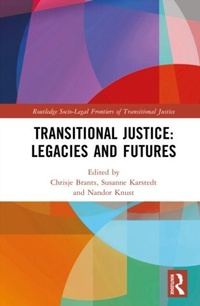
Transitional Justice: Legacies and Futures
1st Edition
Will be published approx. on 15. July 2026
Book
Hardback
282 pages
978-0-367-67910-1 (ISBN)
Description
This volume explores the futures of transitional justice by presenting its multiple pasts and presents across nearly half a century. It canvasses the legacies of achievements and failures, of high hopes and expectations, and equally of disappointment and disillusion across a range of institutions, including the International Criminal Court, global regions, and local settings. The authors critically assess a range of different transitional justice mechanisms including prosecutions, reparations, truth-seeking, and institutional reform, as well as individual and public apologies for grave breaches of human rights. Their focus on local conditions foregrounds actors and networks, politics, and the political in transitional justice processes. The book presents evidence, critical facts and analyses through a multidisciplinary lens, featuring criminologists, international criminal law scholars, political scientists, sociologists, social psychologists, and anthropologists. It combines theoretical and empirical contributions to achieve fresh perspectives on transitional justice. The first part interrogates transitional justice's impact. The second examines how transitional justice mechanisms are embedded within social and political structures. The third explores voice and participation in transitional justice discourses and practices, identifying key lessons for the future. By integrating diverse disciplinary perspectives with both theoretical frameworks and empirical evidence, this comprehensive volume offers valuable insights into how societies address past traumas and (re)gain a future. The book serves as an essential resource for researchers, practitioners, and students seeking to explore innovative research avenues in transitional justice and understand the complex dynamics of post-conflict and post-authoritarian justice processes.
Reviews / Votes
'This timely volume highlights the enduring importance of transitional justice in an era where the rule-based international order faces increasing political pressure. The authors assess its established architecture and enforcement mechanisms and powerfully remind readers that political action must operate within international law-and that these shared values deserve vigilant protection today.'Philipp Ambach, Victims Participation and Reparations Section, International Criminal Court
'Written by leading experts in the field, the volume adopts a broad, interdisciplinary approach to examining the key challenges confronting scholars and practitioners of transitional justice. Drawing on a range of case studies, the volume illustrates central controversies and developments and provides a valuable resource for both students and practitioners.'
Olivera Simic, Griffith University, Australia
More details
Series
Language
English
Place of publication
London
United Kingdom
Publishing group
Taylor & Francis Ltd
Target group
College/higher education
Postgraduate
Illustrations
8 s/w Tabellen
8 Tables, black and white
Dimensions
Height: 234 mm
Width: 156 mm
Weight
453 gr
ISBN-13
978-0-367-67910-1 (9780367679101)
Copyright in bibliographic data and cover images is held by Nielsen Book Services Limited or by the publishers or by their respective licensors: all rights reserved.
Schweitzer Classification
Other editions
Additional editions
Chrisje Brants | Susanne Karstedt | Nandor Knust
Transitional Justice: Legacies and Futures
E-Book
approx. 07/2026
1st Edition
Routledge
€60.49
Available for download
Chrisje Brants | Susanne Karstedt | Nandor Knust
Transitional Justice: Legacies and Futures
E-Book
approx. 07/2026
1st Edition
Routledge
€60.49
Available for download
Persons
Chrisje Brants is Professor Emeritus of Law at Northumbria University, Newcastle, UK and Professor Emeritus of Criminal Law and Procedure at Utrecht University, the Netherlands. She is a member of the Association for International Criminal Justice and a Fellow of the European Law Institute
Susanne Karstedt is Professor in the School of Criminology and Criminal Justice at Griffith University, Australia, and Visiting Professor in the Faculty of Law of Hamburg University, Germany. She is a Fellow of the Academy of the Social Sciences in Australia.
Nandor Knust is Associate Professor at the Arctic University of Norway with a focus on environmental and international crimes, and presently has an appointment as Professor of Law and Society at Fulda University of Applied Sciences. He leads ECO-CRIM-NET, a network dedicated to investigating environmental crimes.
Susanne Karstedt is Professor in the School of Criminology and Criminal Justice at Griffith University, Australia, and Visiting Professor in the Faculty of Law of Hamburg University, Germany. She is a Fellow of the Academy of the Social Sciences in Australia.
Nandor Knust is Associate Professor at the Arctic University of Norway with a focus on environmental and international crimes, and presently has an appointment as Professor of Law and Society at Fulda University of Applied Sciences. He leads ECO-CRIM-NET, a network dedicated to investigating environmental crimes.
Content
1. Introduction (Susanne Karstedt, Chrisje Brants and Nandor Knust) Part 1: Interrogating the Impact of Transitional Justice 2. The Social Construction of Effectiveness and Legitimacy in Transitional Justice (Chrisje Brants) 3. Divided Societies and Reconciliation: The Legitimacy of International Criminal Prosecutions (Birju Kotecha) 4. Transformative Justice and the Need for a Multi-Dimensional Understanding of Impact (Tine Destrooper) 5. Structural Legal Components of Transitional Justice (Nandor Knust) Part II: The Political in Transitional Justice: Networks, Actors, and Discourse 6. The Political in Transitional Justice (Line Engbo Gissel) 7. Transitional Justice between the Individual and the State: Reading Societal Responsibility for Atrocity into the Archives of the International Criminal Tribunal for the Former Yugoslavia (Andy Aydin-Aitchison) 8. Human Rights Advocacy in International Criminal Justice: Whose Rights? Whose Justice? (Kjersti Lohne) 9. Narratives on Child Soldiers in Transitional Justice Discourses (Leonie Steinl) 10. Commissions in Transitional Justice: The Transnational Elites in the Engine Room (Mikkel Jarle Christensen) Part III: Lessons Learned for Transitional Justice? 11. Mainstreaming Transitional Justice in Africa: What South Sudan's Experience Teaches (Kerstin Bree Carlson) 12. Security Forces' Responses to Transitional Justice: From Violence to Diversion (Valerie Arnould) 13. Can All Types of Apologies Deliver Justice and Reconciliation? (Roman David and Victoria Wai-Lan Yeung) 14. Group Apologies in the Context of Transitional Justice: A Review of the Evidence (Magdalena Bobowik, Mirjana Rupar and Borja Martinovic) 15. Effects of Testifying in Truth and Reconciliation Commissions in South America (Anderson Mathias, Dario Alexander Paez, Agustin Espinosa and Bernard Rime)