

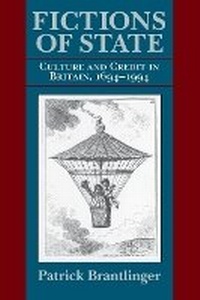
Fictions of State
Culture and Credit in Britain, 1694-1994
Published on 2. May 1996
Book
Hardback
304 pages
978-0-8014-3190-6 (ISBN)
Description
In this ambitious book, Patrick Brantlinger offers a cultural history of Great Britain focused on the concept of "public credit," from the 1694 founding of the Bank of England to the present. He draws on literary texts ranging from Augustan satire such as Gulliver's Travels to postmodern satire such as Martin Amis's Money: A Suicide Note. All critique the misrecognition of public credit as wealth.
The economic foundations of modern nation-states involved national debt, public credit, and paper money. Brantlinger traces the emergence of modern, imperial Great Britain from those foundations. He analyzes the process whereby nationalism, both the cause and the result of wars and imperial expansion, multiplied national debt and produced crises of public credit resolved only through more nationalism and war. During the first half of the eighteenth century, conservatives attacked public credit as fetishistic and characterized national debt as alchemical. From the 1850s, the stabilizing theories of public credit authored by David Hume, Adam Smith, Henry Thornton, and others, helped initiate the first "social science" economics.
In the nineteenth century, literary criticism both paralleled and questioned early capitalist discourse on public credit and nationalism, while the Victorian novel refigured debt as the individual, private credit and debt. During the era of high modernism and Keynesian economics, the notion of high culture as genuine value recast the debate over money and national indebtedness. Brantlinger relates this cultural-historical trajectory to Marxist, poststructuralist, and postcolonial theories about the decline of the European empires after World War II, the global debt crisis, and the weakening of western nation-states in the postmodern era.
The economic foundations of modern nation-states involved national debt, public credit, and paper money. Brantlinger traces the emergence of modern, imperial Great Britain from those foundations. He analyzes the process whereby nationalism, both the cause and the result of wars and imperial expansion, multiplied national debt and produced crises of public credit resolved only through more nationalism and war. During the first half of the eighteenth century, conservatives attacked public credit as fetishistic and characterized national debt as alchemical. From the 1850s, the stabilizing theories of public credit authored by David Hume, Adam Smith, Henry Thornton, and others, helped initiate the first "social science" economics.
In the nineteenth century, literary criticism both paralleled and questioned early capitalist discourse on public credit and nationalism, while the Victorian novel refigured debt as the individual, private credit and debt. During the era of high modernism and Keynesian economics, the notion of high culture as genuine value recast the debate over money and national indebtedness. Brantlinger relates this cultural-historical trajectory to Marxist, poststructuralist, and postcolonial theories about the decline of the European empires after World War II, the global debt crisis, and the weakening of western nation-states in the postmodern era.
Reviews / Votes
Brantlinger's immensely learned third book carries on the current fashion in literary criticism of culture critique, employing both Marxist and postmodern categories.(Choice)
More details
Language
English
Place of publication
Ithaca
United States
Target group
College/higher education
Product notice
Paper over boards
Dimensions
Height: 229 mm
Width: 152 mm
Thickness: 27 mm
Weight
907 gr
ISBN-13
978-0-8014-3190-6 (9780801431906)
Copyright in bibliographic data and cover images is held by Nielsen Book Services Limited or by the publishers or by their respective licensors: all rights reserved.
Schweitzer Classification
Other editions
Additional editions
E-Book
06/2019
1st Edition
Cornell University Press
€163.99
Available for download
Person
Patrick Brantlinger is Professor of English and Cultural Studies at Indiana University. He is also the author of Bread and Circuses: Theories of Mass Cultures as Social Decay and Rule of Darkness: British Literature and Imperialism, both from Cornell.