

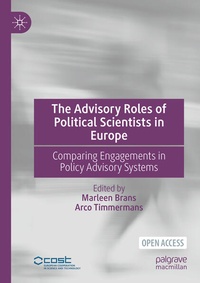
The Advisory Roles of Political Scientists in Europe
Description
Reviews / Votes
"How do academic experts try to influence public policy in an anti-intellectual age? This landmark study identifies four key approaches and reveals how one group of experts-political scientists-navigate their particular national contexts to promote evidence-based policy and enlarge public debates. The book spotlights key differences across European nations (as well as sadly predictable differences by gender), with important implications for democratic voice and governance." (Kristin A. Goss, Duke University, USA)"Political scientists are concerned with the exercise of power, with special attention to responsibility, accountability and equitable outcomes. This systematic comparative study, based on detailed surveys, shows that political scientists are actively concerned to influence decision-makers and the general public. But their motivations, opportunities and constraints vary greatly across institutions and countries. This path-breaking book will ignite the debates about relevance and impact." (Brian Head, University of Queensland, Australia)
"Do political scientists matter? The policy advisory systems of many countries have now become quite structured and sophisticated providing many opening points for scientific advice. This volume shows how, when and why political scientist engagements with the political sphere can have ramifications for the direction of development of democracy and power. The boundary lines between experts and policy makers are not clearly marked out for all to see. Instead, not only do these lines move from political culture to another, the contributors also reveal that when these lines are drawn this is inherently normative. The advice of political scientists emanates not only from personal conviction but is also shaped by the character of policy advisory system and broader developments in politics and society. This volume provides solid evidence that few political scientists are sequestered in the'ivory tower' and that most do matter with their motivations to challenge power, shape society and change policy through their 'entrepreneurial relevance' and advice." (Diane Stone, School of Transnational Governance, European University Institute, Italy)
"This remarkable volume shows the diversity of social and public contributions made by political scientists across Europe. The range of advisory roles is impressive and encouraging for colleagues concerned about the difference they can make in the world. It deserves to be used by academics and practitioners who seek to praise and defend the importance of political science research." (Claire A. Dunlop, University of Exeter, UK)"This book provides unique insights into how political scientists engage in policy advice and how their advisory roles vary across Europe. This variation reflects variations and trends in European policy advisory systems-a must-read for every political scientist and anyone interested in better understanding policy advisory systems." (Thurid Hustedt, Hertie School of Governance, Berlin)
"Political scientists usually observe policymaking, but this book demonstrates that they also become involved in that process. Using qualitative and quantitative data the authors provide an interesting and timely account of the role of political scientists in advising governments and shaping policy. This is a very welcome addition to the literature on policy advice." (B. Guy Peters, University of Pittsburgh, USA)
More details
Other editions
Additional editions
Persons
Marleen Brans is Professor at the KU Leuven Public Governance Institute, Belgium.
Arco Timmermans is Professor of Public Affairs at Leiden University, the Netherlands.
Content
Part I From Theory to Empirical Analysis of Advisory Roles.- 1. Introduction, Arco Timmermans and Marleen Brans.- 2. A Theoretical Perspective on the Roles of Political Scientists in Policy Advisory Systems, Marleen Brans, Arco Timmermans, and Athanassios Gouglas.- 3.Strategy of Data Collection and Analysis for Comparing Policy Advisory Roles, Marleen Brans, Arco Timmermans, and José Real-Dato.- Part II Country Studies of Advisory Roles.- 4. Removing Political Barriers to Engagement: The Advisory Roles of Political Scientists in Albania, Nevila Xhindi and Blerjana Bino.- 5. Resisting Devolution? The Advisory Roles of Political Scientists in Belgium, Marleen Brans, David Aubin, and Ellen Fobé.- 6. Restrained Wisdom or Not? The Advisory Roles of Political Scientists in Denmark, Morten Kallestrup.- 7. A Small Discipline, Scarce Publicity, and Compromised Outward Reach: The Advisory Roles of Political Scientists in France, Pierre Squevin and David Aubin.- 8. Driven by Academic Norms and Status of Employment: The Advisory Roles of Political Scientists in Germany, Sonja Blum and Jens Jungblut.- 9. Coping with a Closed and Politicized System: The Advisory Roles of Political Scientists in Hungary, Gábor Tamás Molnár.- 10. Of Pure Academics and Advice Debutants: The Policy Advisory Roles of Political Scientists in Italy, Andrea Pritoni and Maria Tullia Galanti.- 11. The New Abundance of Policy Advice: The Advisory Roles of Political Scientists in Norway, Ivar Bleiklie and Svein Michelsen.- 12. In Search of Relevance: The Advisory Roles of Political Scientists in Spain, José Real-Dato.- 13. Polder Politics Under Pressure: The Advisory Roles of Political Scientists in the Netherlands, Valérie Pattyn and Arco Timmermans.- 14. Changing Policy Advisory Dynamics in the 2000s: The Advisory Roles of Political Scientists in Turkey, Caner Bakir and H. Tolga Bolukbasi.- 15. Making Political Science Matter: The Advisory Roles of Political Scientists in the United Kingdom, Matthew Flinders, Justyna Bandola-Gill, and Alexandra Anderson.- Part III Patterns Across Countries in Europe.- 16. The Advisory Roles of Political Scientists in Comparative Perspective, Arco Timmermans, Marleen Brans, and José Real-Dato.