

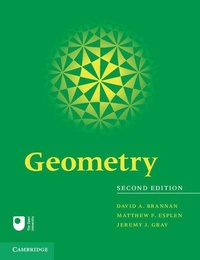
Geometry
2nd Edition
Published on 22. December 2011
Book
Paperback/Softback
602 pages
978-1-107-64783-1 (ISBN)
Description
This richly illustrated and clearly written undergraduate textbook captures the excitement and beauty of geometry. The approach is that of Klein in his Erlangen programme: a geometry is a space together with a set of transformations of the space. The authors explore various geometries: affine, projective, inversive, hyperbolic and elliptic. In each case they carefully explain the key results and discuss the relationships between the geometries. New features in this second edition include concise end-of-chapter summaries to aid student revision, a list of further reading and a list of special symbols. The authors have also revised many of the end-of-chapter exercises to make them more challenging and to include some interesting new results. Full solutions to the 200 problems are included in the text, while complete solutions to all of the end-of-chapter exercises are available in a new Instructors' Manual, which can be downloaded from www.cambridge.org/9781107647831.
Reviews / Votes
'This is a textbook that demonstrates the excitement and beauty of geometry ... richly illustrated and clearly written.' L'Enseignement Mathematique '... this is a remarkable and nicely written introduction to classical geometry.' Zentralblatt MATH '... could form the basis of courses in geometry for mathematics undergraduates. It will also appeal to the general mathematical reader.' John Stone, The Times Higher Education Supplement 'It conveys the beauty and excitement of the subject, avoiding the dryness of many geometry texts.' J. I. Hall, Mathematical Association of America 'To my mind, this is the best introductory book ever written on introductory university geometry ... readers are introduced to the notions of Euclidean congruence, affine congruence, projective congruence and certain versions of non-Euclidean geometry (hyperbolic, spherical and inversive). Not only are students introduced to a wide range of algebraic methods, but they will encounter a most pleasing combination of process and product.' P. N. Ruane, MAA Focus '... an excellent and precisely written textbook that should be studied in depth by all would-be mathematicians.' Hans Sachs, American Mathematical SocietyMore details
Edition
2nd Revised edition
Language
English
Place of publication
Cambridge
United Kingdom
Target group
College/higher education
Edition type
Revised edition
Product notice
Paperback (trade)
Illustrations
Worked examples or Exercises; 50 Halftones, unspecified; 700 Line drawings, unspecified
Dimensions
Height: 246 mm
Width: 189 mm
Thickness: 33 mm
Weight
1147 gr
ISBN-13
978-1-107-64783-1 (9781107647831)
Copyright in bibliographic data and cover images is held by Nielsen Book Services Limited or by the publishers or by their respective licensors: all rights reserved.
Schweitzer Classification
Other editions
Additional editions
David A. Brannan | Matthew F. Esplen | Jeremy J. Gray
Geometry
E-Book
02/2012
2nd Edition
Cambridge University Press
€54.49
Available for download
Previous edition
David A. Brannan | Matthew F. Esplen | Jeremy J. Gray
Geometry
Book
04/1999
Cambridge University Press
€42.09
Article exhausted; check for reprint
Persons
David A. Brannan is Emeritus Professor in the Department of Mathematics and Computing at The Open University, Milton Keynes. Matthew F. Esplen is a Lecturer in the Department of Mathematics and Statistics at The Open University, Milton Keynes. Jeremy J. Gray is a Professor of the History of Mathematics at The Open University, Milton Keynes and Honorary Professor at the University of Warwick.
Content
Preface; Introduction: geometry and geometries; 1. Conics; 2. Affine geometry; 3. Projective geometry: lines; 4. Projective geometry: conics; 5. Inversive geometry; 6. Hyperbolic geometry: the disc model; 7. Elliptic geometry: the spherical model; 8. The Kleinian view of geometry; Special symbols; Further reading; Appendix 1. A primer of group theory; Appendix 2. A primer of vectors and vector spaces; Appendix 3. Solutions to the problems; Index.