

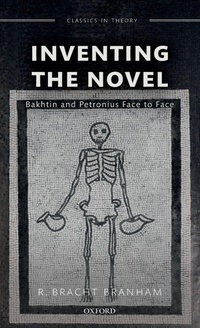
Inventing the Novel
Bakhtin and Petronius Face to Face
Published on 27. November 2019
Book
Hardback
242 pages
978-0-19-884126-5 (ISBN)
Description
Inventing the Novel uses the work of the Russian philosopher Mikhail Bakhtin (1895-1975) to explore the ancient origins of the modern novel. The analysis focuses on one of the most elusive works of classical antiquity, the Satyrica, written by Nero's courtier, Petronius Arbiter (whose singular suicide, described by Tacitus, is as famous as his novel). Petronius was the most lauded ancient novelist of the twentieth century and the Satyrica served as the original model for F. Scott Fitzgerald's The Great Gatsby (1925), as well as providing the epigraph for T. S. Eliot's The Waste Land (1922), and the basis for Fellini Satyricon (1969). Bakhtin's work on the novel was deeply informed by his philosophical views: if, as a phenomenologist, he is a philosopher of consciousness, as a student of the novel, he is a philosopher of the history of consciousness, and it is the role of the novel in this history that held his attention. This volume seeks to lay out an argument in four parts that supports Bakhtin's sweeping assertion that the Satyrica plays an "immense" role in the history of the novel, beginning in Chapter 1 with his equally striking claim that the novel originates as a new way of representing time and proceeding to the question of polyphony in Petronius and the ancient novel.
Reviews / Votes
Nonetheless, the study is an inspiring contribution to research on the ancient novel in general and Petronius in particular. * Ellen Soederblom Saarela, The Classical Review * This volume is much more than a dynamic reassessment of Bakhtin's explicit and implicit references to Petronius. It is a philosophical and literary-theoretical book in its own right, which will shed light not only on Bakhtinian and Petronian studies but also on the history of the novel, interspersed with brilliant close-readings and amusing and cunning reflections. May the reader enjoy its elegant and concise exposition as much as I did. * Tomas Fernandez, Universidad de Buenos Aires - Conicet, Bryn Mawr Classical Review *More details
Series
Language
English
Place of publication
Oxford
United Kingdom
Target group
Professional and scholarly
Dimensions
Height: 222 mm
Width: 145 mm
Thickness: 17 mm
Weight
458 gr
ISBN-13
978-0-19-884126-5 (9780198841265)
Copyright in bibliographic data and cover images is held by Nielsen Book Services Limited or by the publishers or by their respective licensors: all rights reserved.
Schweitzer Classification
Other editions
Additional editions
E-Book
11/2019
1st Edition
OUP eBook
€52.49
Available for download
E-Book
11/2019
1st Edition
OUP eBook
€60.99
Available for download
Person
R. Bracht Branham is the editor of Bakhtin and the Classics (Northwestern University Press, 2002) and The Bakhtin Circle and Ancient Narrative (Barkhuis, 2005), and translator (with Daniel Kinney) of Petronius' Satyrica (University of California Press, 1996). He teaches classics, philosophy, and comparative literature at Emory University.
Content
Frontmatter
Prologue: The Argument
0: Introduction: Bakhtin and Petronius
1: Inventing the Novel: The Bakhtinian Model
2: Mapping Time and Space in Ancient Fiction: Toward An Historical Poetics
3: The Poetics of Genre: Bakhtin/Menippus/Petronius
4: Discourse in a Novel
Toward a Typology of Narrative Discourse: Plato and Bakhtin
Trimalchio's Last Words
Appellation d'Origine Controlee
Trimalchio's Double-Voiced Discourse: The Riddle of the Sibyl
Fortunata's Voice: On the Boundaries of Discourse
What does Polyphony Sound Like?
Ancient Examples?
5: Epilogue: The Last Word
Appendices
I. Bakhtin and the Collapse of the Fact/Value Dichotomy
II. The Wrath of Hermeros
III. Nomen Omen: Eumolpus' Name and Discourse
IV. Petronius' Title as Discourse
Endmatter
Works Cited
Index
Prologue: The Argument
0: Introduction: Bakhtin and Petronius
1: Inventing the Novel: The Bakhtinian Model
2: Mapping Time and Space in Ancient Fiction: Toward An Historical Poetics
3: The Poetics of Genre: Bakhtin/Menippus/Petronius
4: Discourse in a Novel
Toward a Typology of Narrative Discourse: Plato and Bakhtin
Trimalchio's Last Words
Appellation d'Origine Controlee
Trimalchio's Double-Voiced Discourse: The Riddle of the Sibyl
Fortunata's Voice: On the Boundaries of Discourse
What does Polyphony Sound Like?
Ancient Examples?
5: Epilogue: The Last Word
Appendices
I. Bakhtin and the Collapse of the Fact/Value Dichotomy
II. The Wrath of Hermeros
III. Nomen Omen: Eumolpus' Name and Discourse
IV. Petronius' Title as Discourse
Endmatter
Works Cited
Index