

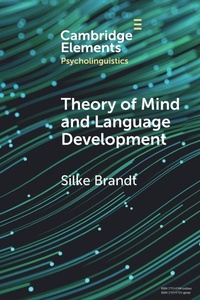
Theory of Mind and Language Development
Will be published approx. on 31. July 2026
Book
Paperback/Softback
75 pages
978-1-009-49624-7 (ISBN)
Description
This Elements presents a series of studies investigating the relationship between language, Theory of Mind, and other cognitive skills, across different languages and cultures. The first set of studies focuses on longitudinal relationships between English-speaking children's understanding of complement-clause constructions (e.g., The cow knows the sticker is in the red box), mental verbs (e.g., know vs. think), modal verbs (e.g., must vs. might), and Theory of Mind. The second set of studies investigates links between complement-clause constructions, mental verbs, and Theory of Mind in Mandarin Chinese and English. The last study looks at English- and Turkish-speaking children's knowledge of evidentiality, source monitoring, and Theory of Mind. Together, these studies suggest that there are different linguistic tools that enable children to represent and acquire Theory of Mind, and that the availability and choice of these linguistic tools differ across languages and cultures.
More details
Series
Language
English
Place of publication
Cambridge
United Kingdom
Product notice
Paperback (trade)
Illustrations
Worked examples or Exercises
ISBN-13
978-1-009-49624-7 (9781009496247)
Copyright in bibliographic data and cover images is held by Nielsen Book Services Limited or by the publishers or by their respective licensors: all rights reserved.
Schweitzer Classification
Other editions
Additional editions
Silke Brandt
Theory of Mind and Language Development
Book
approx. 07/2026
Cambridge University Press
€68.50
Not yet published
Person
Content
1. General introduction; 2. Theory of mind and language; 3. Longitudinal and causal relationships; 4. Language and theory of mind in English and mandarin Chinese; 5. Evidentiality, theory of mind, and source monitoring in English and Turkish; 6. Conclusions and future directions; References.