

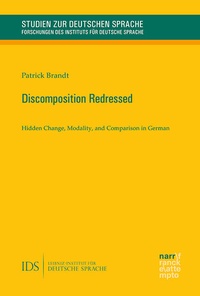
Discomposition Redressed
Hidden Change, Modality, and Comparison in German
1st Edition
Published on 9. December 2019
Book
Paperback/Softback
304 pages
978-3-8233-8243-0 (ISBN)
Description
Modern theoretical linguistics lives by the insight that the meanings of complex expressions derive from the meanings of their parts and the way these are composed. However, the currently dominating theories of the syntax-semantics interface hastily relegate important aspects of meaning which cannot readily be aligned with visible structure to empty projecting heads non-reductively (mainstream Generative Grammar) or to the syntactic construction holistically (Construction Grammar). This book develops an alternative, compositional analysis of the hidden aspectual-temporal, modal and comparative meanings of a range of productive constructions of which pseudorefl exive, excessive and directional complement constructions take center stage. Accordingly, a contradiction-inducing hence semantically problematic part of literally coded meaning is locally ignored and systematically realized "expatriately" with respect to parts of structure that achieve the indexical anchoring of propositional contents in terms of times, worlds and standards of comparison, thus yielding the observed hidden meanings.
More details
Other editions
Additional editions
E-Book
11/2019
Narr Francke Attempto
€0.00
Available for download
Person
Dr. Patrick Brandt arbeitet am Insititut für Deutsche Sprache in der Abteilung Grammatik und lehrt als Privatdozent im Bereich Germanistische Linguistik an der Universität Mannheim.
Content
1 Introduction
2 Weaker construction
2.1 Hiding modality
2.2 Strengthening and weakening
2.3 Plural matters
3 Wrenches and nails
3.1 Phenomenal and ordinary individuals
3.2 Weak theories of comparatives
3.3 Transitivity vs. inclusion semantics
4 Bound to contradict
4.1 llegal reflexivization
4.2 Infinite mis-construction
4.3 Mostly up, or sideways
5 Summary