

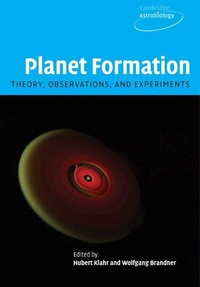
Planet Formation
Theory, Observations, and Experiments
Published on 17. February 2011
Book
Paperback/Softback
320 pages
978-0-521-18074-0 (ISBN)
Description
When this book was published in 2006, it had been just over ten years since the first planet outside our solar system was detected. Since then, much work has focused on understanding how extrasolar planets may form, and discovering the frequency of potentially habitable Earth-like planets. This volume addresses fundamental questions concerning the formation of planetary systems in general, and of our solar system in particular. Drawing from advances in observational, experimental and theoretical research, it summarises our understanding of the planet formation processes, and addresses major open questions and research issues. Chapters are written by leading experts in the field of planet formation and extrasolar planet studies. The book is based on a meeting held at Ringberg Castle in Bavaria, where experts gathered together to present and exchange their ideas and findings. It is a comprehensive resource for graduate students and researchers, and is written to be accessible to newcomers to the field.
Reviews / Votes
Review of the hardback: ' ... carefully organized text ... represents a snapshot of the state of the art of the modern quest for the origins of the worlds. ... a definitive text for the shelves of researchers, students, and interested bystanders that should prove to be of considerable longevity. Even Slartibartfast and Douglas Adams, to whom this volume is dedicated, might find it handy.' Science Review of the hardback: 'This book brings together a wide range of planet-formation papers ... written by some of the leading academics in planet-formation research. ... the book covers the main research areas one would expect ... as a concise reference and introduction to planet-formation research.' The Observatory Review of the hardback: ' ... a very welcome contribution, helping the dynamicist understand the hazy limit between low-mass stars and planets, as well as discussing their differences in observational characteristics and probable formation process ... this book is recommended for those researchers who, although fluent in Celestial Mechanics, wish to expand their knowledge on the physical aspects of cosmogony before embarking in this multi-disciplinary field.' Celestial Mechanics and Dynamical AstronomyMore details
Series
Language
English
Place of publication
Cambridge
United Kingdom
Target group
Professional and scholarly
Product notice
Paperback (trade)
Illustrations
Worked examples or Exercises
Dimensions
Height: 244 mm
Width: 170 mm
Thickness: 17 mm
Weight
555 gr
ISBN-13
978-0-521-18074-0 (9780521180740)
Copyright in bibliographic data and cover images is held by Nielsen Book Services Limited or by the publishers or by their respective licensors: all rights reserved.
Schweitzer Classification
Other editions
Additional editions
E-Book
06/2006
1st Edition
Cambridge University Press
€42.99
Available for download
Book
06/2006
Cambridge University Press
€108.94
Article exhausted; check for reprint
Previous edition
Book
06/2006
Cambridge University Press
€108.94
Article exhausted; check for reprint
Persons
Content
1. Historical notes on planet formation Bodenheimer; 2. The formation and evolution of planetary systems Bouwman et al.; 3. Destruction of protoplanetary disks by photoevaporation Richling, Hollenbach and Yorke; 4. Turbulence in protoplanetary accretion disks Klahr, Rozyczka, Dziourkevitch, Wunsch and Johansen; 5. The origin of solids in the early solar system Trieloff and Palme; 6. Experiments on planetesimal formation Wurm and Blum; 7. Dust coagulation in protoplanetary disks Henning, Dullemond, Wolf and Dominik; 8. The accretion of giant planet cores Thommes and Duncan; 9. Planetary transits: direct vision of extrasolar planets Lecavelier des Etangs and Vidal-Madjar; 10. The core accretion - gas capture model Hubickyj; 11. Properties of exoplanets Marcy, Fischer, Butler and Vogt; 12. Giant planet formation: theories meet observations Boss; 13. From hot Jupiters to hot Neptures ... and below Lovis, Mayor and Udry; 14. Disk-planet interaction and migration Masset and Kley; 15. The Brown Dwarf - planet relation Bate; 16. From astronomy to astrobiology Brandner; 17. Overview and prospective Lin.