

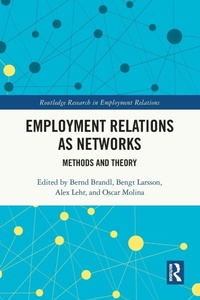
Employment Relations as Networks
Methods and Theory
1st Edition
Published on 29. January 2024
Book
Paperback/Softback
258 pages
978-0-367-64667-7 (ISBN)
Description
Traditional approaches in the wide field of employment relations focused on a small and clearly delineated set of actors, such as trade unions and employers' organizations, operating within the constraints given by formal, nationally confined institutions. It is becoming increasingly clear that traditional approaches are insufficiently able to account for employment relations processes and outcomes in a world wherein formal institutions are being rapidly transformed and partially dissolved, national boundaries become porous, and the sheer number of actors involved is increasing substantially. A shift in perspective is necessary, past the nationally bounded actor-institution dichotomy, towards an understanding of employment relations as fundamentally mediated by complex and emergent networks that connect a multitude of actors within and between countries.
This volume provides a seminal starting point for such a paradigm shift by applying theories and methodologies from social network analysis to the study of employment relations. It develops a theoretical toolkit of mechanisms that operate within networks and shape employment relations processes and outcomes, such as wages, labour market policies and labour conflicts. It brings together insights from various projects that investigate the structure, functioning and impact of networks in employment relations through quantitative and qualitative methods. It will be of particular interest to students and scholars of employment relations across business and management, economics, political science, and sociology disciplines, as well as those interested in social networks. Managers, trade unions, employers' organizations and state authorities at national and international levels will find it helpful in understanding how networks shape their world.
This volume provides a seminal starting point for such a paradigm shift by applying theories and methodologies from social network analysis to the study of employment relations. It develops a theoretical toolkit of mechanisms that operate within networks and shape employment relations processes and outcomes, such as wages, labour market policies and labour conflicts. It brings together insights from various projects that investigate the structure, functioning and impact of networks in employment relations through quantitative and qualitative methods. It will be of particular interest to students and scholars of employment relations across business and management, economics, political science, and sociology disciplines, as well as those interested in social networks. Managers, trade unions, employers' organizations and state authorities at national and international levels will find it helpful in understanding how networks shape their world.
More details
Series
Language
English
Place of publication
London
United Kingdom
Publishing group
Taylor & Francis Ltd
Target group
College/higher education
Postgraduate
Illustrations
17 s/w Tabellen, 39 s/w Abbildungen, 39 s/w Zeichnungen
17 Tables, black and white; 39 Line drawings, black and white; 39 Illustrations, black and white
Dimensions
Height: 229 mm
Width: 152 mm
Thickness: 15 mm
Weight
407 gr
ISBN-13
978-0-367-64667-7 (9780367646677)
Copyright in bibliographic data and cover images is held by Nielsen Book Services Limited or by the publishers or by their respective licensors: all rights reserved.
Schweitzer Classification
Other editions
Additional editions
Book
07/2022
1st Edition
Routledge
€206.60
Shipment within 15-20 days
E-Book
07/2022
1st Edition
Routledge
€69.99
Available for download
E-Book
07/2022
1st Edition
Routledge
€69.99
Available for download
Persons
Bernd Brandl is Professor at Durham University Business School. In his research he is dealing with methodological, empirical and theoretical research questions in the fields of employment relations and international HRM. In particular, much of his thematic and theoretical research focused on comparative cross-country analyses of different employment relations and labour market systems, institutions and policies. Professor Brandl is also engaging in policy making debates and worked as an advisor/expert for international organizations such as the European Commission and the International Labour Organization (ILO).
Bengt Larsson is a professor of sociology at Linnaeus University and University of Gothenburg in Sweden. His research focuses on industrial relations and transnational trade union cooperation. Larsson has published several papers in journals such as European Journal of Industrial Relations, British Journal of Industrial relations, Economic and Industrial Democracy, and Industrial Relations Journal. Together with Professor Bengt Furaker, Larsson recently published a book entitled Trade Union Cooperation in Europe: Patterns, Conditions, Issues (Palgrave Pivot, 2020).
Alex Lehr is an assistant professor in empirical political science at Radboud University. His research is at the intersection of sociology, economics and political science, and focuses on economic inequality, employment relations and labour market representation. He specializes in the development and synthesis of micro-level theories, and the collection and statistical analyses of novel micro-level data, e.g., via surveys and experiments. Lehr has published papers in journals such as Work, Employment and Society, Economic and Industrial Democracy, Employee Relations, Journal of Behavioural and Experimental Economics, and Rationality and Society.
Oscar Molina is associate professor at the Department of Sociology and researcher at Centre d'Estudis Sociologics QUIT - Institute for Labour Studies, Universitat Autonoma de Barcelona. He holds a degree in Economics (Pompeu Fabra University) and a PhD in Social and Political Science at the European University Institute (EUI-Florence). He has been post-doctoral researcher at the Industrial Relations and Human Resources Group, University College Dublin (2005-2007) and ICREA Researcher at QUIT, Universitat Autonoma de Barcelona, and currently coordinator of Eurofound's national correspondent team in Spain. His main research interests include comparative industrial relations, labour market policies, neo-corporatism.
Bengt Larsson is a professor of sociology at Linnaeus University and University of Gothenburg in Sweden. His research focuses on industrial relations and transnational trade union cooperation. Larsson has published several papers in journals such as European Journal of Industrial Relations, British Journal of Industrial relations, Economic and Industrial Democracy, and Industrial Relations Journal. Together with Professor Bengt Furaker, Larsson recently published a book entitled Trade Union Cooperation in Europe: Patterns, Conditions, Issues (Palgrave Pivot, 2020).
Alex Lehr is an assistant professor in empirical political science at Radboud University. His research is at the intersection of sociology, economics and political science, and focuses on economic inequality, employment relations and labour market representation. He specializes in the development and synthesis of micro-level theories, and the collection and statistical analyses of novel micro-level data, e.g., via surveys and experiments. Lehr has published papers in journals such as Work, Employment and Society, Economic and Industrial Democracy, Employee Relations, Journal of Behavioural and Experimental Economics, and Rationality and Society.
Oscar Molina is associate professor at the Department of Sociology and researcher at Centre d'Estudis Sociologics QUIT - Institute for Labour Studies, Universitat Autonoma de Barcelona. He holds a degree in Economics (Pompeu Fabra University) and a PhD in Social and Political Science at the European University Institute (EUI-Florence). He has been post-doctoral researcher at the Industrial Relations and Human Resources Group, University College Dublin (2005-2007) and ICREA Researcher at QUIT, Universitat Autonoma de Barcelona, and currently coordinator of Eurofound's national correspondent team in Spain. His main research interests include comparative industrial relations, labour market policies, neo-corporatism.
Content
Table of Contents
List of Contributors
1. Introduction
PART 1 Methodological and conceptual issues
Brandl, Larsson, Lehr, Molina
2. Social Network Employment Research: Tracing New Horizons in the Field of Work and Labour,
Pulignano
3. SNA in Employment Relations Research: Concept and methodologies
Marti, Vacchiano, Molina
4. Multilevelness and Multiplexity in Trade Union Cooperation Networks in Europe
Larsson
5. From Structures to Outcomes: Network Mechanisms and Network Effects in Collective Bargaining
Lehr
6. From Factors to Actors: Networks and Network Theory in Comparative Industrial Relations
Brandl
PART 2. Case studies and applications
7. The Impact of Network Ties on Worker Voice
Sluiter, Manevska, Akkerman
8. Losing what you never had. How a strike changed management's (perception of) their network position,
Akkerman, Manevska, Thommes, Sluiter
9. Articulation of Interests: A Network Perspective on Employee Representation in Multinational Companies
Haipeter, Hertwig, Rosenbohm
10. Forms of Network Governance for the European Trade Union Federation
Nordin
11. International Networks and the Activities of Peak Employer's Associations: Do as I Do?
Lehr, Brandl
12. Towards an Extension of the Employer's Role in Networked Employment Relations? Food for Thought from Collective Bargaining with the Property of Outlet Malls in Italy
Gasparri
13. Collective Bargaining Networks and Relational Coordination. A Comparative Analysis
Molina, Marti, Godino
14. Conclusions and outlook: structures, actors and mechanisms in employment relations
Brandl, Larsson, Lehr, Molina
List of Contributors
1. Introduction
PART 1 Methodological and conceptual issues
Brandl, Larsson, Lehr, Molina
2. Social Network Employment Research: Tracing New Horizons in the Field of Work and Labour,
Pulignano
3. SNA in Employment Relations Research: Concept and methodologies
Marti, Vacchiano, Molina
4. Multilevelness and Multiplexity in Trade Union Cooperation Networks in Europe
Larsson
5. From Structures to Outcomes: Network Mechanisms and Network Effects in Collective Bargaining
Lehr
6. From Factors to Actors: Networks and Network Theory in Comparative Industrial Relations
Brandl
PART 2. Case studies and applications
7. The Impact of Network Ties on Worker Voice
Sluiter, Manevska, Akkerman
8. Losing what you never had. How a strike changed management's (perception of) their network position,
Akkerman, Manevska, Thommes, Sluiter
9. Articulation of Interests: A Network Perspective on Employee Representation in Multinational Companies
Haipeter, Hertwig, Rosenbohm
10. Forms of Network Governance for the European Trade Union Federation
Nordin
11. International Networks and the Activities of Peak Employer's Associations: Do as I Do?
Lehr, Brandl
12. Towards an Extension of the Employer's Role in Networked Employment Relations? Food for Thought from Collective Bargaining with the Property of Outlet Malls in Italy
Gasparri
13. Collective Bargaining Networks and Relational Coordination. A Comparative Analysis
Molina, Marti, Godino
14. Conclusions and outlook: structures, actors and mechanisms in employment relations
Brandl, Larsson, Lehr, Molina