

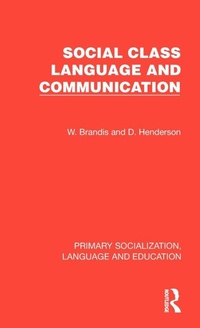
Social Class, Language and Communication
1st Edition
Published on 9. May 2025
Book
Hardback
154 pages
978-1-032-99393-5 (ISBN)
Description
Originally published in 1970, Social Class, Language and Communication explores the different effects of parental social class, the ability and sex of the child and a measure of the mother's reported communication to her child, upon aspects of five-year-old children's speech. The study shows the relationship between a measure of linguistic flexibility in children and their family's social class position and includes the construction and application of an index of maternal communication and control. Today it can be read in its historical context.
Reviews / Votes
Review for the original edition:'The mixture of competent research and sensitive comment is indeed outstanding. The book should join the early Bernstein papers as compulsory reading for all students of education.' - The Times Educational Supplement
More details
Series
Language
English
Place of publication
London
United Kingdom
Publishing group
Taylor & Francis Ltd
Target group
College/higher education
Adult education, General, and Postgraduate
Dimensions
Height: 222 mm
Width: 145 mm
Thickness: 13 mm
Weight
346 gr
ISBN-13
978-1-032-99393-5 (9781032993935)
Copyright in bibliographic data and cover images is held by Nielsen Book Services Limited or by the publishers or by their respective licensors: all rights reserved.
Schweitzer Classification
Other editions
Additional editions
W. Brandis | D. Henderson
Social Class, Language and Communication
Book
approx. 07/2026
1st Edition
Routledge
€37.50
Not yet published
W. Brandis | D. Henderson
Social Class, Language and Communication
E-Book
05/2025
Routledge
€73.99
Available for download
W. Brandis | D. Henderson
Social Class, Language and Communication
E-Book
05/2025
Routledge
€73.99
Available for download
Persons
Walter Brandis
Dorothy Henderson
Dorothy Henderson
Content
Introduction. History of the Research. 1. Social Class Differences in Form-Class Usage among Five-Year-Old Children 2. Social Class Differences in Form-Class Switching among Five-Year-Old Children 3. Social Class Differences in Communication and Control. Appendixes.