

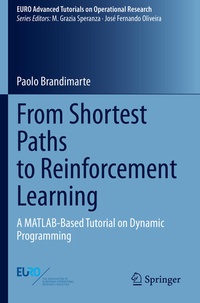
From Shortest Paths to Reinforcement Learning
A MATLAB-Based Tutorial on Dynamic Programming
Published on 12. January 2022
Book
Paperback/Softback
XI, 207 pages
978-3-030-61869-8 (ISBN)
Description
Dynamic programming (DP) has a relevant history as a powerful and flexible optimization principle, but has a bad reputation as a computationally impractical tool. This book fills a gap between the statement of DP principles and their actual software implementation. Using MATLAB throughout, this tutorial gently gets the reader acquainted with DP and its potential applications, offering the possibility of actual experimentation and hands-on experience. The book assumes basic familiarity with probability and optimization, and is suitable to both practitioners and graduate students in engineering, applied mathematics, management, finance and economics.
More details
Series
Edition
2021 ed.
Language
English
Place of publication
Cham
Switzerland
Publishing group
Springer International Publishing
Target group
Primary & secondary/elementary & high school
Illustrations
67 s/w Abbildungen
XI, 207 p. 67 illus.
Dimensions
Height: 235 mm
Width: 155 mm
Thickness: 13 mm
Weight
341 gr
ISBN-13
978-3-030-61869-8 (9783030618698)
DOI
10.1007/978-3-030-61867-4
Schweitzer Classification
Other editions
Additional editions
Paolo Brandimarte
From Shortest Paths to Reinforcement Learning
A MATLAB-Based Tutorial on Dynamic Programming
Book
01/2021
1st Edition
Springer
€117.69
Shipment within 7-9 days
Person
Paolo Brandimarte is full professor at the Department of Mathematical Sciences of Politecnico di Torino, Italy, where he teaches courses on Business Analytics, Risk Management, and Operations Research. He is the author of more than ten books on the application of optimization and simulation methods to problems ranging from quantitative finance to production and supply chain management.
Content
The dynamic programming principle.- Implementing dynamic programming.- Modeling for dynamic programming.- Numerical dynamic programming for discrete states.- Approximate dynamic programming and reinforcement learning for discrete states.- Numerical dynamic programming for continuous states.- Approximate dynamic programming and reinforcement learning for continuous states.