

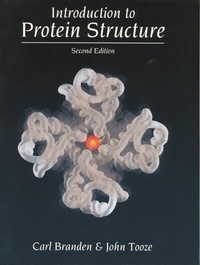
Introduction to Protein Structure
2nd Edition
Published on 1. January 1999
Book
Paperback/Softback
424 pages
978-0-8153-2305-1 (ISBN)
Description
Introduction to Protein Structure provides an account of the principles of protein structure, with examples of key proteins in their biological context generously illustrated in full-color to illuminate the structural principles described in the text. The first few chapters introduce the general principles of protein structure both for novices and for non-specialists needing a primer. Subsequent chapters use specific examples of proteins to show how they fulfill a wide variety of biological functions. The book ends with chapters on the experimental approach to determining and predicting protein structure, as well as engineering new proteins to modify their functions.
Reviews / Votes
"The strength of the book lies in its beautiful art work and its logical dissection of the baffling complexities of protein structures...admirably concise, lucid and accurate presentations of difficult concepts...invaluable for students..." Nature"As an introduction to what proteins look like, how they fold up and how they interact with other molecules, large and small this book has no peer. It will be invaluable to students and research workers." Trends in Biotechnical Sciences
"As usual, the distillation is authoritative and breathtaking." Tom Alber, University of California, Berkeley
"It is superb. It gives a terrific overview, with great breadth and a proper and fair weight to the subject it treats." Ken Dill, University of California, San Francisco
More details
Edition
2nd edition
Language
English
Place of publication
Bosa Roca
United States
Publishing group
Taylor & Francis Inc
Target group
College/higher education
Academic
Dimensions
Height: 276 mm
Width: 219 mm
Weight
1640 gr
ISBN-13
978-0-8153-2305-1 (9780815323051)
Copyright in bibliographic data and cover images is held by Nielsen Book Services Limited or by the publishers or by their respective licensors: all rights reserved.
Schweitzer Classification
Other editions
Additional editions
Carl Ivar Branden | John Tooze
Introduction to Protein Structure
E-Book
03/2012
2nd Edition
Garland Science
€111.99
Available for download
Carl Ivar Branden | John Tooze
Introduction to Protein Structure
E-Book
03/2012
2nd Edition
Garland Science
€111.99
Available for download

Carl-Ivar Branden | John Tooze
Introduction to Protein Structure
Book
12/1998
2nd Edition
Garland Publishing Inc
€130.94
Article exhausted; check different version
Previous edition
Carl Branden | John Tooze | Carl Brandon
Introduction to Protein Structure
Book
07/1991
CRC Press
€52.24
Article exhausted; check for reprint
Persons
Carl Branden
was educated at Uppsala University (PhD) and the MRC Laboratory for Molecular Biology, Cambridge, where he was a postdoctoral fellow in the laboratory of J.C. Kendrew. He has pursued a career in basic research, science administration (as science advisor to the Swedish Government), and biotechnology. Formerly Research Director of the European Synchrotron Radiation Facility in Grenoble, France, he is now at the Microbiology and Tumor Biology Center at the Karolinska Institute in Stockholm. A protein crystallographer with a distinguished academic career in research and teaching, he has made major contributions to the understanding of many biological structures, and is an editor of Structure.
John Tooze
was educated at Cambridge University (MA), London University (PhD) and Harvard University (where he was a postdoctoral fellow in the laboratory of J.D. Watson). After several years in basic research, he moved principally into science administration and science publishing, notably as the executive secretary of the European Molecular Biology Organisation, Heidelberg, Germany. He is currently Director of Support Services at the Imperial Cancer Research Fund Laboratories, London, and editor of EMBO Journal. A molecular biologist, his previous books include Molecular Biology of Tumor Viruses, The DNA Story (with J.D. Watson) and the very successful first edition of Recombinant DNA: A Short Course (with J.D. Watson and D.T. Kurtz).
was educated at Uppsala University (PhD) and the MRC Laboratory for Molecular Biology, Cambridge, where he was a postdoctoral fellow in the laboratory of J.C. Kendrew. He has pursued a career in basic research, science administration (as science advisor to the Swedish Government), and biotechnology. Formerly Research Director of the European Synchrotron Radiation Facility in Grenoble, France, he is now at the Microbiology and Tumor Biology Center at the Karolinska Institute in Stockholm. A protein crystallographer with a distinguished academic career in research and teaching, he has made major contributions to the understanding of many biological structures, and is an editor of Structure.
John Tooze
was educated at Cambridge University (MA), London University (PhD) and Harvard University (where he was a postdoctoral fellow in the laboratory of J.D. Watson). After several years in basic research, he moved principally into science administration and science publishing, notably as the executive secretary of the European Molecular Biology Organisation, Heidelberg, Germany. He is currently Director of Support Services at the Imperial Cancer Research Fund Laboratories, London, and editor of EMBO Journal. A molecular biologist, his previous books include Molecular Biology of Tumor Viruses, The DNA Story (with J.D. Watson) and the very successful first edition of Recombinant DNA: A Short Course (with J.D. Watson and D.T. Kurtz).
Content
PART 1 BASIC STRUCTURAL PRINCIPLES
1. The Building Blocks
2. Motifs of Protein Structure
3. ?-Domain Structures
4. ?/? Structures
5. ? Structures
6. Folding and Flexibility
7. DNA Structures
PART 2 STRUCTURE, FUNCTION AND ENGINEERING
8. DNA Recognition in Procaryotes by Helix-Turn-Helix Motifs
9. DNA Recognition by Eukaryotic Transcription Factors
10. Specific Transcription Factors Belong to a Few Families
11. An Example of Enzyme Catalysis: Serine Proteinases
12. Membrane Proteins
13. Signal Transduction
14. Fibrous Proteins
15. Recognition of Foreign Molecules by the Immune System
16. The Structure of Spherical Viruses
17. Prediction, Engineering, and Design of Protein Structures
18. Determination of Protein Structures
1. The Building Blocks
2. Motifs of Protein Structure
3. ?-Domain Structures
4. ?/? Structures
5. ? Structures
6. Folding and Flexibility
7. DNA Structures
PART 2 STRUCTURE, FUNCTION AND ENGINEERING
8. DNA Recognition in Procaryotes by Helix-Turn-Helix Motifs
9. DNA Recognition by Eukaryotic Transcription Factors
10. Specific Transcription Factors Belong to a Few Families
11. An Example of Enzyme Catalysis: Serine Proteinases
12. Membrane Proteins
13. Signal Transduction
14. Fibrous Proteins
15. Recognition of Foreign Molecules by the Immune System
16. The Structure of Spherical Viruses
17. Prediction, Engineering, and Design of Protein Structures
18. Determination of Protein Structures