

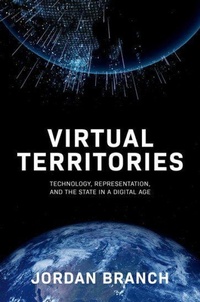
Virtual Territories
Technology, Representation, and the State in a Digital Age
Published on 13. October 2025
Book
Hardback
240 pages
978-0-19-006361-0 (ISBN)
Description
As technology continues to evolve and advance, new weapons, communication media, surveillance systems, and more are increasingly interwoven into warfare, diplomacy, trade, and every other aspect of international relations. To make sense of the shifting grounds of international politics, it has become essential to understand how technological and political change interact.
Virtual Territories examines this relationship by focusing on the mechanism of representation, which encompasses both how technologies and their capabilities are represented and how technologies produce or alter representations of the world. Through a series of case studies, Jordan Branch demonstrates how these representations are involved in producing novel ideas and concepts, making particular political arguments tenable or convincing, and foreclosing certain political choices or outcomes. The book explores these consequences in four empirical areas: the technologies of nineteenth-century state-building and imperial expansion, digital geospatial technologies and territorial borders, cybersecurity threats and how states address them, and remote and possibly autonomous warfare through drones. Branch's analysis of the representational dynamics between technology and politics presents implications for the core features of international relations, including the future of the territorial state and the international system itself.
Virtual Territories examines this relationship by focusing on the mechanism of representation, which encompasses both how technologies and their capabilities are represented and how technologies produce or alter representations of the world. Through a series of case studies, Jordan Branch demonstrates how these representations are involved in producing novel ideas and concepts, making particular political arguments tenable or convincing, and foreclosing certain political choices or outcomes. The book explores these consequences in four empirical areas: the technologies of nineteenth-century state-building and imperial expansion, digital geospatial technologies and territorial borders, cybersecurity threats and how states address them, and remote and possibly autonomous warfare through drones. Branch's analysis of the representational dynamics between technology and politics presents implications for the core features of international relations, including the future of the territorial state and the international system itself.
Reviews / Votes
...this book makes the compelling case that technology not only enhances perception but also influences and distorts it, thereby making negotiations between sovereign states difficult. ... Highly Recommended. * J. A. Stever, CHOICE *More details
Language
English
Place of publication
New York
United States
Target group
Professional and scholarly
Dimensions
Height: 240 mm
Width: 161 mm
Thickness: 19 mm
Weight
569 gr
ISBN-13
978-0-19-006361-0 (9780190063610)
Copyright in bibliographic data and cover images is held by Nielsen Book Services Limited or by the publishers or by their respective licensors: all rights reserved.
Schweitzer Classification
Other editions
Additional editions
Book
10/2025
Oxford University Press Inc
€32.60
Shipment within 15-20 days
Person
Jordan Branch is Associate Professor of Government at Claremont McKenna College. He was a fellow at the American Council of Learned Societies, and has held positions at Brown University and the University of Southern California. His research focuses on the origins, features, and consequences of the territorial state and the role of technology and technological change in international politics. His publications include The Cartographic State: Maps, Territory, and the Origins of Sovereignty (2014) and articles in International Organization, International Studies Quarterly, the European Journal of International Relations, International Theory, Dialogues in Human Geography, and Territory, Politics, Governance.
Content
Introduction: Technology, Politics, and Representation Information Technology, State-Building, and Imperialism in the Nineteenth Century From Dayton to Google: Digital Mapping and Negotiation Metaphors and the Internet: The Cyberspace Domain Drone Warfare: Representing Remote Operations Conclusion: Representing the State