

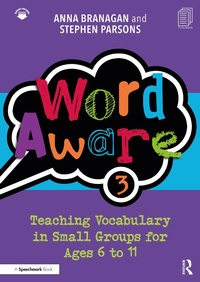
Word Aware 3
Teaching Vocabulary in Small Groups for Ages 6 to 11
1st Edition
Published on 22. October 2021
Book
Paperback/Softback
168 pages
978-0-367-74755-8 (ISBN)
Description
Word Aware 3 is a comprehensive, practical and engaging resource that focuses on teaching vocabulary and word learning skills to children aged 6 to 11 years who have vocabulary learning needs.
For many children, particularly those with Special Educational Needs and Disabilities (SEND) or those whose home language isn't English (ELL or EAL learners), the vocabulary of the classroom can be a barrier to learning. This book outlines how to best support these children who require extra help, offering concrete, easy-to-implement activities and resources for use in small groups, to maximise the impact on learning and open up access to the curriculum.
Word Aware 3:
Takes a highly practical, evidence-based and curriculum-focused approach to vocabulary learning that supports a broad range of learners
Includes photocopiable and downloadable planning, intervention and evaluation resources
Provides staff training resources and an overview video presented by the authors
This book can be used as an adjunct to Word Aware 1, or as an intervention on its own. Although it is most suited to children aged 6 to 11 years, it may be adapted for older students with significant learning needs. It is an essential resource for teaching assistants and learning support assistants and will also save time for special educational needs co-ordinators (SENCOs) and speech and language therapists (SaLTs) who are keen to establish effective vocabulary interventions.
For many children, particularly those with Special Educational Needs and Disabilities (SEND) or those whose home language isn't English (ELL or EAL learners), the vocabulary of the classroom can be a barrier to learning. This book outlines how to best support these children who require extra help, offering concrete, easy-to-implement activities and resources for use in small groups, to maximise the impact on learning and open up access to the curriculum.
Word Aware 3:
Takes a highly practical, evidence-based and curriculum-focused approach to vocabulary learning that supports a broad range of learners
Includes photocopiable and downloadable planning, intervention and evaluation resources
Provides staff training resources and an overview video presented by the authors
This book can be used as an adjunct to Word Aware 1, or as an intervention on its own. Although it is most suited to children aged 6 to 11 years, it may be adapted for older students with significant learning needs. It is an essential resource for teaching assistants and learning support assistants and will also save time for special educational needs co-ordinators (SENCOs) and speech and language therapists (SaLTs) who are keen to establish effective vocabulary interventions.
Reviews / Votes
"I think it's a fantastic resource and an important part of a whole school approach to vocabulary teaching; it has strengthened my SLT toolkit and been well received in schools" - Julia Henly, Senior SLT, Children's Speech and Language Therapy Service, Coventry and Warwickshire Partnership NHS Trust (RCSLT Bulletin)More details
Language
English
Place of publication
London
United Kingdom
Publishing group
Taylor & Francis Ltd
Target group
Professional and scholarly
Professional and Professional Practice & Development
Illustrations
85 farbige Tabellen, 3 Farbfotos bzw. farbige Rasterbilder, 90 farbige Zeichnungen, 93 farbige Abbildungen
85 Tables, color; 90 Line drawings, color; 3 Halftones, color; 93 Illustrations, color
Dimensions
Height: 298 mm
Width: 218 mm
Thickness: 16 mm
Weight
532 gr
ISBN-13
978-0-367-74755-8 (9780367747558)
Copyright in bibliographic data and cover images is held by Nielsen Book Services Limited or by the publishers or by their respective licensors: all rights reserved.
Schweitzer Classification
Other editions
Additional editions

Book
10/2021
1st Edition
Routledge
€179.51
Shipment within 15-20 days
E-Book
10/2021
1st Edition
Routledge
€49.99
Available for download
E-Book
10/2021
1st Edition
Routledge
€49.99
Available for download
Persons
Anna Branagan is a Speech and Language Therapist. In Gloucestershire, Anna works within a Youth Support Team supporting vulnerable young people. In Worcestershire, she works within mainstream schools supporting inclusive practice. Anna trained at Leeds Metropolitan University 25 years ago. She is the co-author of bestselling Speechmark resources Language for Thinking (second edition, 2017), Word Aware 1 (second edition, 2022) Word Aware 2 (2017) and Language for Behaviour and Emotions (2020).
Stephen Parsons is a Speech and Language Therapist, trainer and author of practical language development resources for teachers and Speech and Language Therapists (SaLTs). From 1996-2017, Stephen worked as a Speech and Language Therapy Service Manager in Hackney and the City of London. With over 30 years' experience in the field, he is co-author of bestselling Speechmark resources Language for Thinking (second edition, 2017), Word Aware 1 (second edition, 2022), Word Aware 2 (2017) and Language for Behaviour and Emotions (2020). Stephen graduated in Speech Pathology from Flinders University before attaining an MSc in Speech and Language Therapy from City University, London, in 2000. He currently serves as Chair of NAPLIC, the UK association for professionals working with children and young people with developmental language disorder.
Stephen Parsons is a Speech and Language Therapist, trainer and author of practical language development resources for teachers and Speech and Language Therapists (SaLTs). From 1996-2017, Stephen worked as a Speech and Language Therapy Service Manager in Hackney and the City of London. With over 30 years' experience in the field, he is co-author of bestselling Speechmark resources Language for Thinking (second edition, 2017), Word Aware 1 (second edition, 2022), Word Aware 2 (2017) and Language for Behaviour and Emotions (2020). Stephen graduated in Speech Pathology from Flinders University before attaining an MSc in Speech and Language Therapy from City University, London, in 2000. He currently serves as Chair of NAPLIC, the UK association for professionals working with children and young people with developmental language disorder.
Content
Preface Principles of vocabulary teaching Supporting children with vocabulary learning needs in the classroom Running a vocabulary intervention Intervention resources Staff training Vocabulary research and references