

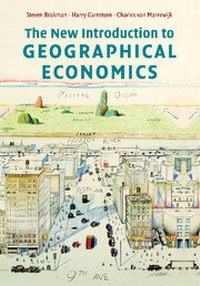
The New Introduction to Geographical Economics
2nd Edition
Published on 9. April 2009
Book
Paperback/Softback
598 pages
978-0-521-69803-0 (ISBN)
Description
Geographical economics starts from the observation that economic activity is clearly not randomly distributed across space. This revised and updated introduction to geographical economics uses the modern tools of economic theory to explain the who, why and where of the location of economic activity. The text provides an integrated, first-principles introduction to geographical economics for advanced undergraduate students and first-year graduate students, and has been thoroughly revised and updated to reflect important developments in the field, including new chapters on alternative core models and policy implications. It presents a truly global analysis of issues in geographical economics using case studies from all over the world, including North America, Europe, Africa and Australasia, and contains many computer simulations and end-of chapter exercises to encourage learning and understanding through application.
Reviews / Votes
'Geographical economics is a broad field which encompasses or connects with the economics of region, cities, location, trade, development, and growth. Academic research in these areas has gone in many directions and made lots of progress in recent years. The first accomplishment of this New Introduction to Geographical Economics was to digest this diverse and fast growing body of knowledge. The second achievement of this great book is to be able to present everything in a clear, comprehensive, and accessible manner.' Gilles Duranton, University of Toronto 'In recent years geographical economics has gained momentum, in both academic and policy circles. This has happened thanks to a series of remarkably original contributions pioneered by the Nobel Prize Winner Paul Krugman. The combination of imperfect competition, increasing returns to scale, and transport technologies in new and powerful ways have helped to clarify the microeconomic foundations of both urban and regional imbalances at the national and the international levels. Steven Brakman, Harry Garretsen and Charles van Marrewijk provide students and fellow researchers with a timely and accurate introduction to the state-of-the-art of this vibrant field of research.' Gianmarco I. P. Ottaviano, Bocconi University, Milan 'The authors provide a very nice and clear overview of what has been accomplished in this new field. Undergraduate students and teachers have no excuse anymore for ignoring the theoretical and empirical material uncovered by geographical economists. They now have a great text handy.' Jacques Thisse, CORE, Universite Louvain-la-Neuve 'The authors' 2001 graduate textbook was a masterful combination of theory, facts and examples - the book made it easy to interest students in this difficult but essential topic. With the 2008 Nobel going to Paul Krugman, in part for his contribution to Economic Geography, this second edition could not come at a better time. This edition keeps the excellent pedagogical style of the first edition and applies it to the substantial theoretical and empirical advancements that have occurred in the New Century. I would also recommend it to professional economists who would like an accessible introduction to this vast literature.' Richard Baldwin, Graduate Institute, Geneva 'Since Paul Krugman's initial explorations into what he called the 'new economic geography' barely two decades ago, an increasing number of mainstream economists have recognised the importance of geography - of space and location - for understanding how economies develop and function, and a large literature now exists in this field. The first edition of Brakman, Garretsen and Marrewijk's, Introduction to Geographical Economics was one of the most successful books on this subject. This new, updated, edition builds on this success, and provides a rigorous yet highly readable introduction to the new economic geography. The clarity of theoretical exposition and the copious use of real world applications set this book apart from others in the field. Not only does it advance the subject in its own right, its accessible style and its willingness to engage with the views of geographers will do much to encourage positive dialogue with the latter.' Ron Martin, University of Cambridge '... very versatile ... while ... an ideal textbook for undergraduates ... it still provides a good review of applications of the models for graduate students, policymakers, and early career researchers.' www.EGRG.com (Economic Geography Research Group)More details
Edition
2nd Revised edition
Language
English
Place of publication
Cambridge
United Kingdom
Target group
Professional and scholarly
College/higher education
Edition type
Revised edition
Product notice
Paperback (trade)
Illustrations
58 Tables, unspecified; 17 Maps
Dimensions
Height: 247 mm
Width: 173 mm
Thickness: 27 mm
Weight
1160 gr
ISBN-13
978-0-521-69803-0 (9780521698030)
Copyright in bibliographic data and cover images is held by Nielsen Book Services Limited or by the publishers or by their respective licensors: all rights reserved.
Schweitzer Classification
Other editions
New editions
Steven Brakman | Harry Garretsen | Charles van Marrewijk
An Introduction to Geographical and Urban Economics
A Spiky World
Book
12/2019
3rd Edition
Cambridge University Press
€125.90
Shipment within 15-20 days
Additional editions
Steven Brakman | Harry Garretsen | Charles van Marrewijk
The New Introduction to Geographical Economics
E-Book
05/2009
2nd Edition
Cambridge University Press
€58.99
Available for download
Previous edition
Steven Brakman | Harry Garretsen | Charles van Marrewijk
An Introduction to Geographical Economics
Trade, Location and Growth
Book
12/2001
Cambridge University Press
€33.41
Article exhausted; check for reprint
Persons
Steven Brakman is Professor of Economics at the University of Groningen, The Netherlands. Harry Garretsen is Professor of International Economics and Business at the University of Groningen, The Netherlands. Charles van Marrewijk is Professor of International Macroeconomics at Utrecht University School of Economics (since 2008) and Director of the Tjalling Charles Koopmans Institute (since 2009). He studied horticulture and worked as a grower before studying economics in Holland at Erasmus University Rotterdam (1981-5, BA and MA) and in the United States at Purdue University (1985-8, M.Sc. and Ph.D.). He worked at the University of Groningen (1987-90) and at Erasmus University Rotterdam (1990-2008), where he was also Academic Director of the Institute of Housing and Urban Development Studies (2007-8). His research focuses on international economics, geographical economics, economic growth, development economics, and urban economics. He is currently the European editor of The Journal of International Trade and Economic Development and associate editor of the Journal of Regional Science. He has organized several international conferences and served as a guest editor for various special issues of the above two journals. His research output is widely cited and has appeared in many top (field) journals, including the Journal of International Economics, the Journal of Development Economics, the Journal of Economic Geography, the International Economic Review, the Journal of Economics and Management Strategy, Oxford Economic Papers, Economica, the International Journal of Industrial Organization, the Journal of Population Economics, and the Journal of Regional Science. He has also (co-)authored ten books, eight of which were published either by Cambridge University Press or Oxford University Press (of which two were translated into Chinese).
Content
List of figures; List of tables; List of boxes; List of technical notes; Preface to the new edition; Part I. Introduction: 1. A first look at geography, trade, and development; 2. Geography and economic theory; Part II. Core Models and Empirical Evidence: 3. The core model of geographical economics; 4. Beyond the core model: solutions, simulations and extensions; 5. Agglomeration, the home market effect and spatial wages; 6. Shocks, free-ness of trade, and stability; Part III. Applications and Extensions: 7. Cities and congestion: economies of scale, urban systems and Zipf's Law; 8. Agglomeration and international business; 9. The structure of international trade; 10. Dynamics, growth and geography; Part IV. Policy and Evaluation: 11. The policy implications of geographical economics; 12. Criticism and the value added of geographical economics; References; Index.