

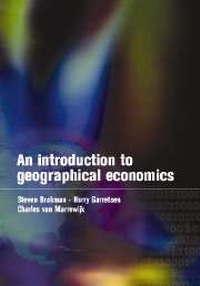
An Introduction to Geographical Economics
Trade, Location and Growth
Published on 6. December 2001
Book
Hardback
374 pages
978-0-521-77039-2 (ISBN)
Description
The need for a better understanding of the role location plays in economic life was first and most famously made explicit by Bertil Ohlin in 1933. However it is only recently, with the development of computer packages able to handle complex systems, as well as advances in economic theory (in particular an increased understanding of returns to scale and imperfect competition), that Ohlin's vision has been met and a framework developed which explains the distribution of economic activity across space. This book is an integrated, non-mathematical, first-principles textbook presenting geographical economics to advanced students. Never avoiding advanced concepts, its emphasis is on examples, diagrams, and empirical evidence, making it the ideal starting point prior to monographic and journal material. Contains copious computer simulation exercises, available in book and electronic format to encourage learning and understanding through application. Uses case study material from North America, Europe, Africa and Australasia.
More details
Language
English
Place of publication
Cambridge
United Kingdom
Target group
Professional and scholarly
College/higher education
Illustrations
48 Tables, unspecified
Dimensions
Height: 255 mm
Width: 180 mm
Thickness: 29 mm
Weight
875 gr
ISBN-13
978-0-521-77039-2 (9780521770392)
Copyright in bibliographic data and cover images is held by Nielsen Book Services Limited or by the publishers or by their respective licensors: all rights reserved.
Schweitzer Classification
Other editions
New editions
Steven Brakman | Harry Garretsen | Charles van Marrewijk
The New Introduction to Geographical Economics
Book
04/2009
2nd Edition
Cambridge University Press
€152.26
Article exhausted; check for reprint
Additional editions
Steven Brakman | Harry Garretsen | Charles van Marrewijk
An Introduction to Geographical Economics
Trade, Location and Growth
E-Book
01/2005
Cambridge University Press
€32.49
Available for download
Persons
Steven Brakman (19.4.1957) has been an Associate Professor of Economics at the University of Groningen in the Netherlands since 1996. He previously worked as a Researcher at the Dutch central bank and as an Assistant Professor of Economics at the University of Groningen where he also got his MA and PhD in economics. At present he is also a research fellow of SOM (the University of Groningen). Apart from Geographical Economics his research focuses on International Economics. He has published in journals like Journal of Regional Science, Journal of Economics, Kyklos, Applied Economics, De Economist and to national scientific journals and has contributed to books published by i.a. Cambridge University Press, MacMillan, and wrote a monograph on International Transfers (together with Charles van Marrewijk, for Cambridge University Press and a monograph on Protectionism and one on Globalization (also together with Charles van Marrewijk). He is Associate Editor of the Journal of Regional Science and has developed two scientific television programmes (one on QWERTY and one on Keynes (together with Harry Garretsen)). Harry Garretsen (21.11.1962) has been a Professor of Economics at the University of Nijmegen in the Netherlands since 1996. He previously worked as a senior policy-adviser at the Dutch central bank and as an Associate Professor of Economics at the University of Groningen where he also got his MA and PhD in economics. At present he is also a research fellow of SOM (the University of Groningen) and CESifo (Centre for Economic Studies, Munich). Apart from Geographical Economics his research focuses on monetary and financial economics. He has published in journals like Journal of Regional Science, Journal of Macroeconomics, Kyklos, Welwirtschaftliches Archiv, Economics of Transition, Journal of Economic Behavior and Organization, Review of International Economics, and De Economist and contributed to books published by i.a. Cambridge University Press, MacMillan, Edward Elgar and Routledge. Charles van Marrewijk is Professor of International Macroeconomics at Utrecht University School of Economics (since 2008) and Director of the Tjalling Charles Koopmans Institute (since 2009). He studied horticulture and worked as a grower before studying economics in Holland at Erasmus University Rotterdam (1981-1985, BA and MA) and in the United States at Purdue University (1985-1988, MSc and PhD). He worked at the University of Groningen (1987-1990) and at Erasmus University Rotterdam (1990-2008), where he was also Academic Director of the Institute of Housing and Urban Development Studies (2007-2008). His research focuses on international economics, geographical economics, economic growth, development economics, and urban economics. He is currently the European editor of The Journal of International Trade and Economic Development and associate editor of the Journal of Regional Science. He has organized several international conferences and served as a guest editor for various special issues of the above two journals. His research output is widely cited and has appeared in many top (field) journals, including the Journal of International Economics, the Journal of Development Economics, the Journal of Economic Geography, the International Economic Review, the Journal of Economics and Management Strategy, Oxford Economic Papers, Economica, the International Journal of Industrial Organization, the Journal of Population Economics, and the Journal of Regional Science. He has also (co-)authored ten books, eight of which were published either by Cambridge University Press or Oxford University Press (of which two were translated into Chinese).
Content
1. A first look at geography, trade and development; 2. Geography and economic theory; 3. The core model of geographical economics; 4. Solutions and simulations; 5. Geographical economics and empirical evidence; 6. Refinements and extensions; 7. Cities and congestion: the economics of Zipf's Law; 8. Agglomeration and international business; 9. The structure of international trade; 10. Dynamics and economic growth; 11. The policy implications and value added of geographical economics; References.