

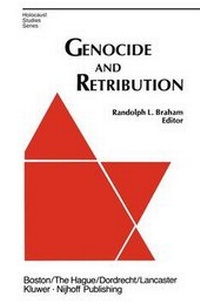
Genocide and Retribution
Holocaust in Hungarian-ruled Transylvania
Published on 31. October 1983
Book
Hardback
271 pages
978-0-89838-146-7 (ISBN)
Description
During the dark years of the Holocaust, many of the millions of labor and concentration camp victims were sustained in their struggle for survival by the hope that their tormentors would not escape retribution. This expectation was reinforced by the warnings issued by the statesmen of the anti-Axis coalition and the declarations of the United States, Great Britain, and the USSR. Shortly after the cessation of hostilities, war crimes trials were indeed initiated in all parts of liberated Europe. Many of the accused were indicted, among other things, for crimes committed against Jews. People's tribunals for the prosecution of war crimes and crimes against humanity were also estab- lished in Romania, a country that extricated itself from the Axis Alliance on 23 August 1944. The Romanian people's tribunals were set up and operated under the provi- sions of Law No. 312, issued by the Ministry ofJustice on 21 April 1945.
One ofthese tribunals was established in Cluj (Kolozsvar) and entrusted primarily with the prosecution of those involved in the violation of the rights of people living in Northern Transylvania, the part of the province that was transferred to Hungary under the terms of the Second Vienna Award (August 1940) and which remained under Hungarian rule from early September 1940 until its liberation by Soviet-Romanian forces in the fall of 1944. The crimes committed against the citizens of Northern Transylvania both within and outside the province were the subject of two major trials.
One ofthese tribunals was established in Cluj (Kolozsvar) and entrusted primarily with the prosecution of those involved in the violation of the rights of people living in Northern Transylvania, the part of the province that was transferred to Hungary under the terms of the Second Vienna Award (August 1940) and which remained under Hungarian rule from early September 1940 until its liberation by Soviet-Romanian forces in the fall of 1944. The crimes committed against the citizens of Northern Transylvania both within and outside the province were the subject of two major trials.
More details
Series
Language
English
Place of publication
United States
Target group
College/higher education
Professional and scholarly
Illustrations
biography
Dimensions
Height: 250 mm
Width: 190 mm
Weight
490 gr
ISBN-13
978-0-89838-146-7 (9780898381467)
Copyright in bibliographic data and cover images is held by Nielsen Book Services Limited or by the publishers or by their respective licensors: all rights reserved.
Schweitzer Classification
Other editions
Additional editions
Book
10/2011
Springer
€53.49
Shipment within 15-20 days
Content
I Introductory Essay.- The Jews of Transylvania: A Historical Overview.- The Post-World War I Era.- Northern Transylvania under Hungarian Rule.- The German Occupation and the Final Solution.- The Ghettoization in Northern Transylvania: An Overview.- Notes.- II Judgment of the People's Tribunal of Cluj (Kolozsvar); 31 May 1946, Judgment Number 8.- The Nagyvarad Ghetto.- The Ghetto of Szatmarnemeti.- The Ghetto of Kolozsvar.- The Ghettos in the Szekely Land.- The Ghetto of Marosvasarhely.- The Ghetto of Szaszregen.- The Ghetto of Sepsiszentgyorgy.- The Ghetto of Maramarossziget.- The Ghetto of Szilagysomlyo.- The Ghetto of Des.- The Beszterce Ghetto.- The Sentences.- Notes.- III Appendixes.- 1. Reference List of Selected Geographic Name Changes.- 2. Number of Jews Deported from the Major Entrainment Centers in Northern Transylvania by Transport and Date of Entrainment;.- 3. Law No. 312 of the Romanian Ministry of Justice, dated 21 April 1945.- 4. Statement of Laszlo Endre of 17 December, 1945.- 5. Statement of Laszlo Baky of 18 December, 1945.- Selected Bibliography.