

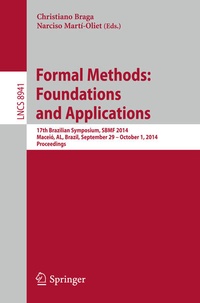
Formal Methods: Foundations and Applications
17th Brazilian Symposium, SBMF 2014, Maceió, AL, Brazil, September 29--October 1, 2014. Proceedings
Published on 27. January 2015
Book
Paperback/Softback
IX, 179 pages
978-3-319-15074-1 (ISBN)
Description
This book constitutes the thoroughly refereed post-conference proceedings of the 17th Brazilian Symposium on Formal Methods, SBMF 2014, held in Maceió, Brazil, in September/October 2014.
The 9 revised full papers presented together with 2 invited talks were carefully reviewed and selected from 34 submissions. SBMF is an event devoted to the dissemination of the development and use of formal methods for the construction of high quality computational systems, aiming to promote opportunities for researchers with interests in formal methods to discuss the recent advances in this area.
More details
Series
Edition
2015 ed.
Language
English
Place of publication
Cham
Switzerland
Publishing group
Springer International Publishing
Target group
Professional and scholarly
Research
Illustrations
39 s/w Abbildungen
IX, 179 p. 39 illus.
Dimensions
Height: 235 mm
Width: 155 mm
Thickness: 11 mm
Weight
300 gr
ISBN-13
978-3-319-15074-1 (9783319150741)
DOI
10.1007/978-3-319-15075-8
Schweitzer Classification
Other editions
Additional editions
Christiano Braga | Narciso Martí-Oliet
Formal Methods: Foundations and Applications
17th Brazilian Symposium, SBMF 2014, Maceió, AL, Brazil, September 29--October 1, 2014. Proceedings
E-Book
01/2015
Springer
€42.79
Available for download
Content
LLVM-based code generation for B.- Equational abstractions in rewriting logic and Maude.- Formalization of ZSyntax to reason about Molecular Pathways in HOL4.- Test Case Selection Criteria for Symbolic Models of Real-Time Systems.- Model-Driven Engineering in the Heterogeneous Tool Set.- A coinductive animation of Turing Machines.- Towards completeness in Bounded Model Checking through Automatic Recursion Depth Detection.- A Probabilistic Model Checking Analysis of a Realistic Vehicular Networks Mobility Model.- Dynamic logics for every season.- Completeness and decidability results for hybrid(ised) logics.- Parameterisation of Three-Valued Abstractions.