

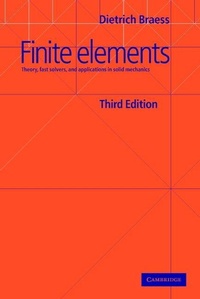
Finite Elements
Theory, Fast Solvers, and Applications in Solid Mechanics
3rd Edition
Published on 12. April 2007
Book
Paperback/Softback
384 pages
978-0-521-70518-9 (ISBN)
Description
This definitive introduction to finite element methods was thoroughly updated for this 2007 third edition, which features important material for both research and application of the finite element method. The discussion of saddle-point problems is a highlight of the book and has been elaborated to include many more nonstandard applications. The chapter on applications in elasticity now contains a complete discussion of locking phenomena. The numerical solution of elliptic partial differential equations is an important application of finite elements and the author discusses this subject comprehensively. These equations are treated as variational problems for which the Sobolev spaces are the right framework. Graduate students who do not necessarily have any particular background in differential equations, but require an introduction to finite element methods will find this text invaluable. Specifically, the chapter on finite elements in solid mechanics provides a bridge between mathematics and engineering.
Reviews / Votes
'This is a well written book on the mathematical foundation of the finite element method which should appeal to graduate mathematicians and researchers in numerical methods and theoretical mechanics. The coverage of the mathematical theories used in the finite element formulation is comprehensive.' A. A. Becker, Journal of Mechanical Engineering Science '... an excellent book on the subject, with respect to contents, readability as well as presentation ... highly recommended.' Michael Schaefer, Zentralblatt fuer Mathematik '... has advanced to be one of the most commonly used textbooks in this area.' Monatshefte fuer Mathematik 'Carefully written and remarkably error-free, Braess's book introduces partial differential equations (PDEs) and methods used to solve them numerically. It introduces PDEs and their classification, covers (briefly) finite-difference methods, and then offers a thorough treatment of finite-element methods, both conforming and nonconforming. After discussing the conjugate gradient method and multigrid methods, Braess concludes with a chapter on finite elements in solid mechanics. The book is written from a theoretical standpoint, and the standard convergence theorems and error estimates are provided and proved. Although a background in differential equations, analysis, and linear algebra is not necessary to read the book, it would be helpful. The level is that of a graduate course in a mathematics department. Practical considerations for coding the various methods are only occasionally discussed. There are exercises at the end of each section varying from two to six problems, about two-thirds of them theoretical in nature. The book can be used as a resource. Extensive and valuable bibliography. Recommended for graduate students.' J. H. Ellison, Grove City CollegeMore details
Edition
3rd Revised edition
Language
English
Place of publication
Cambridge
United Kingdom
Target group
Professional and scholarly
College/higher education
Edition type
Revised edition
Product notice
Paperback (trade)
Illustrations
Worked examples or Exercises; 9 Tables, unspecified; 64 Line drawings, unspecified
Dimensions
Height: 229 mm
Width: 152 mm
Thickness: 23 mm
Weight
622 gr
ISBN-13
978-0-521-70518-9 (9780521705189)
Copyright in bibliographic data and cover images is held by Nielsen Book Services Limited or by the publishers or by their respective licensors: all rights reserved.
Schweitzer Classification
Other editions
Additional editions
E-Book
05/2007
3rd Edition
Cambridge University Press
€55.99
Available for download
Previous edition
Book
04/2001
2nd Edition
Cambridge University Press
€37.13
Article exhausted; check for reprint
Person
Dietrich Braess is Professor of Mathematics at Ruhr University Bochum, Germany.
Content
Preface to the third English edition; Preface to the first English edition; Preface to the German edition; Notation; 1. Introduction; 2. Conforming finite elements; 3. Nonconforming and other methods; 4. The conjugate gradient method; 5. Multigrid methods; 6. Finite elements in solid mechanics; References; Index.