

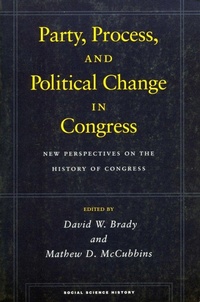
Party, Process, and Political Change in Congress, Volume 1
New Perspectives on the History of Congress
Published on 16. August 2002
Book
Paperback/Softback
576 pages
978-0-8047-4571-0 (ISBN)
Description
In recent decades, political scientists have produced an enormous body of scholarship dealing with the U.S. Congress, and in particular congressional organization. However, most of this research has focused on Congress in the twentieth century-especially the post-New Deal era-and the long history of Congress has been largely neglected. The contributors to this book demonstrate that this inattention to congressional history has denied us many rich opportunities to more fully understand the evolution and functioning of the modern Congress.
In striking contrast to the modern era, which is marked by only modest partisan realignment and institutional change, the period preceding the New Deal was a time of rapid and substantial change in Congress. During the nation's first 150 years, parties emerged, developed, and realigned; the standing rules of the House and Senate expanded and underwent profound changes; the workload of Congress increased dramatically; and both houses grew considerably in size.
Studying history is valuable in large part because it allows scholars to observe greater variation in many of the parameters of their theories, and to test their core assumptions. A historical approach pushes scholars to recognize and confront the limits of their theories, resulting in theories that have increased validity and broader applicability. Thus, incorporating history into political science gives us a more dynamic view of Congress than the relatively static picture that emerges from a strict focus on recent periods.
Each contributor engages one of three general questions that have animated the literature on congressional politics in recent years: What is the role of party organizations in policy making? In what ways have congressional process and procedure changed over the years? How does congressional process and procedure affect congressional politics and policy?
In striking contrast to the modern era, which is marked by only modest partisan realignment and institutional change, the period preceding the New Deal was a time of rapid and substantial change in Congress. During the nation's first 150 years, parties emerged, developed, and realigned; the standing rules of the House and Senate expanded and underwent profound changes; the workload of Congress increased dramatically; and both houses grew considerably in size.
Studying history is valuable in large part because it allows scholars to observe greater variation in many of the parameters of their theories, and to test their core assumptions. A historical approach pushes scholars to recognize and confront the limits of their theories, resulting in theories that have increased validity and broader applicability. Thus, incorporating history into political science gives us a more dynamic view of Congress than the relatively static picture that emerges from a strict focus on recent periods.
Each contributor engages one of three general questions that have animated the literature on congressional politics in recent years: What is the role of party organizations in policy making? In what ways have congressional process and procedure changed over the years? How does congressional process and procedure affect congressional politics and policy?
Reviews / Votes
"Policy, Process, and Political Change pulls together some of the leading scholars in partisanship and the historical development of congressional politics to offer an invaluable addition to the library of any student of Congress."-APSA Legislative Studies Section Newsletter "All of these essays constitute high-powered marriages between sophisticated quantitative methods and powerful analytical theory."-Kenneth A. Shepsle, Harvard UniversityMore details
Series
Edition
New edition
Language
English
Place of publication
Palo Alto
United States
Target group
College/higher education
Professional and scholarly
Edition type
New edition
Product notice
Paperback (trade)
Illustrations
78 tables, 67 figures
Dimensions
Height: 297 mm
Width: 77 mm
Thickness: 32 mm
Weight
757 gr
ISBN-13
978-0-8047-4571-0 (9780804745710)
Copyright in bibliographic data and cover images is held by Nielsen Book Services Limited or by the publishers or by their respective licensors: all rights reserved.
Schweitzer Classification
Other editions
Additional editions

David W. Brady | Mathew D. McCubbins
Party, Process, and Political Change in Congress, Volume 1
New Perspectives on the History of Congress
E-Book
08/2002
Stanford University Press
€108.99
Available for download
Persons
David W. Brady is Bowen H. and Janice Arthur McCoy Professor of Political Science in the Stanford Graduate School of Business. Among his books are Continuity and Change in House Elections (with John F. Cogan and Morris P. Fiorina, Stanford, 2000) and Critical Elections and Congressional Policy Making (Stanford, 1988). Mathew D. McCubbins is Professor of Political Science at the University of California, San Diego. His work on Congress includes Legislative Leviathan (with Gary W. Cox).
Content
1. Party, Process, and Political Change: New Perspectives on the History of Congress DAVID W. BRADY AND MATHEW D. MCCUBBINS PART I: PARTIES, COMMITTEES, AND POLITICAL CHANGE IN CONGRESS 2. The Historical Variability in Conditional Party Government, 1877-1994 JOHN H. ALDRICH, MARK M. BERGER, AND DAVID W. ROHDE 3. Do Parties Matter? BARBARA SINCLAIR 4. Party and Preference in Congressional Decision Making: Roll Call Voting in the House of Representatives, 1889-1999 JOSEPH COOPER AND GARRY YOUNG 5. Agenda Power in the U.S. House of Representatives, 1877-1986 GARY W. COX AND MATHEW D. MCCUBBINS 6. Agenda Power in the U.S. Senate, 1877-1986 ANDREA C. CAMPBELL, GARY W. COX, AND MATHEW D. MCCUBBINS 7. Party Loyalty and Committee Leadership in the House, 1921-40 BRIAN R. SALA PART II: THE EVOLUTION AND CHOICE OF CONGRESSIONAL INSTITUTIONS 8. Order from Chaos: The Transformation of the Committee System in the House, 1816-22 JEFFERY A. JENKINS AND CHARLES H. STEWART III 9. Leadership and Institutional Change in the Nineteenth- Century House RANDALL STRAHAN 10. Institutional Evolution and the Rise of the Tuesday-Thursday Club in the House of Representatives TIMOTHY P. NOKKEN AND BRIAN R. SALA 11. Policy Leadership and the Development of the Modern Senate GERALD GAMM AND STEVEN S. SMITH PART III: POLICY CHOICE AND CONGRESSIONAL INSTITUTIONS 12. Why Congress? What the Failure of the Confederation Congress and the Survival of the Federal Congress Tell Us About the New Institutionalism JOHN H. ALDRICH, CALVIN C. JILLSON, AND RICK K. WILSON 13. Agenda Manipulation, Strategic Voting, and Legislative Details in the Compromise of 1850 SEAN M. THERIAULT AND BARRY R. WEINGAST 14. Congress and the Territorial Expansion of the United States NOLAN MCCARTY, KEITH T. POOLE, AND HOWARD ROSENTHAL 15. Representation of the Antebellum South in the House of Representatives: Measuring the Impact of the Three-Fifths Clause BRIAN D. HUMES, ELAINE K. SWIFT, RICHARD M. VALELLY, KENNETH FINEGOLD, AND EVELYN C. FINK Afterword: History as a Laboratory DAVID W. BRADY AND MATHEW D. MCCUBBINS