

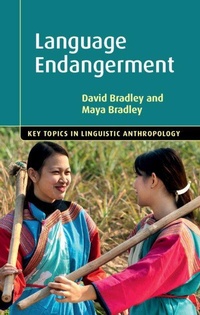
Language Endangerment
Published on 21. November 2019
Book
Hardback
274 pages
978-1-107-04113-4 (ISBN)
Description
Up to ninety percent of humanity's traditional languages and cultures are at risk and may disappear this century. While language endangerment has not achieved the publicity surrounding environmental change and biodiversity loss, it is just as serious, disastrously reducing the variety of human knowledge and thought. This book shows why it matters, why and how it happens, and what communities and scholars can do about it. David and Maya Bradley provide a new framework for investigating and documenting linguistic, social and other factors which contribute to languages shifting away from their cultural heritage. Illustrated with practical in-depth case studies and examples from the authors' own work in Asia and elsewhere, the book encourages communities to maintain or reclaim their traditional languages and cultures.
Reviews / Votes
'A masterpiece both because of its erudition and its coherent perspective.' David Olson, University of Toronto 'The authors address, among other things, endangerment stages and measures; research methods and ethics; linguistic ideology and attitudes that encourage speakers to maintain, or abandon, their language; factors (demographic, political, economic, etc.) that lead to language endangerment; language policy and planning; and strategies and resources for language reclamation.' L. Lindstrom, Choice 'The innovative approach of this book, its distinct style and structure as well as the wealth of information and illustration, make it an invaluable resource not only for scholars and students of cognitive and social sciences, but also for those members of the larger public interested in the latest advances in the field.' Radu Voica, Anthropos 'Both the formal features and the contents of this volume make it suitable and of potential interest for a diverse target audience, ranging from non-expert readers to researchers that may wish to obtain an up-to-date state of the issue.' Marc Gandarillas, Language in SocietyMore details
Series
Language
English
Place of publication
Cambridge
United Kingdom
Target group
Professional and scholarly
Illustrations
23 Tables, black and white
Dimensions
Height: 222 mm
Width: 145 mm
Thickness: 20 mm
Weight
511 gr
ISBN-13
978-1-107-04113-4 (9781107041134)
Copyright in bibliographic data and cover images is held by Nielsen Book Services Limited or by the publishers or by their respective licensors: all rights reserved.
Schweitzer Classification
Other editions
Additional editions
David Bradley | Maya Bradley
Language Endangerment
Book
11/2019
Cambridge University Press
€43.00
Shipment within 15-20 days
David Bradley | Maya Bradley
Language Endangerment
E-Book
11/2019
Cambridge University Press
€23.49
Available for download
Persons
Hello Friends!I grew up in Northbrook, Illinois and went to summer camp as a kid. One summer, I was kicked out for breaking the rules. Two years later they allowed me back as a counselor. I learned as much about forgiveness as I did redemption. I love meditation, sports, and coaching. In college I studied Recreation, Sport and Tourism at the University of Illinois. Then, I moved to Las Vegas to be with my oldest brother Neal. A year later my middle brother Bryan moved in with us and we had wonderful careers working in world class hotels and venues.In March 2020 Covid-19 affected the world with sickness and negativity. Shortly thereafter, Neal and Salud had baby Joaquín and I was inspired to bring to life a character that I've drawn since I was young. Bob's purpose is to unite people together with humor while teaching life lessons. Over $2,500 was donated from the proceeds of book & merchandise to Clark County School District in Nevada. With guidance from friends and mentors and my experience in entertainment, I was able to create the ecosystem located at www.bigheadbob.com. Oh and I love my mother Stellie!!!Thank you kindly,David Bradley
Content
1. Introduction; 2. Stages of language endangerment; 3. Working in a community; 4. Identity and attitudes; 5. Language knowledge and use; 6. The sociolinguistic setting; 7. Linguistic processes; 8. Policy and planning; 9. Language reclamation; 10. Methodology; 11. Conclusion.