

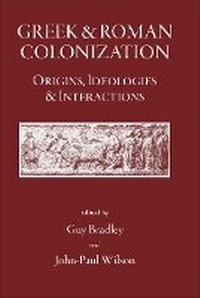
Greek and Roman Colonization
Origins, Ideologies and Interactions
Published on 1. December 2006
Book
Hardback
224 pages
978-1-905125-06-7 (ISBN)
Description
The term 'colonization' encompasses much diversity, from the settlement of the western Mediterranean and the Black sea by Greeks in the archaic period to the foundation of Roman colonies in mainland Italy during the Republic. Though very different in their motives and methods, both Greek and Roman colonisations are presented by our sources as organised and clearly defined processes, within which internal and external relations were firmly delineated. This volume contains six new studies, two Greek and four Roman. Contributors employ historiographical, comparative and post-colonial approaches to question ancient constructs. The book contains detailed case-studies as well as synoptic treatments. Contributors build on recent research in Greek and Roman history to show how ideologies of colonisation develop and come to dominate the historical record.
More details
Series
Language
English
Place of publication
Swansea
United Kingdom
Target group
College/higher education
Professional and scholarly
Dimensions
Height: 234 mm
Width: 156 mm
Weight
546 gr
ISBN-13
978-1-905125-06-7 (9781905125067)
Copyright in bibliographic data and cover images is held by Nielsen Book Services Limited or by the publishers or by their respective licensors: all rights reserved.
Schweitzer Classification
Other editions
Additional editions
E-Book
12/2005
The Classical Press of Wales
€76.49
Available for download
Content
Guy Bradley (Cardiff) and John-Paul Wilson (Lampeter), Introduction. John-Paul Wilson, '"Ideologies" of Greek colonisation'. Edward Bispham (Oxford), 'Coloniam deducere: not what it used to be'. Guy Bradley (Cardiff), 'Colonisation and identity in Republican Italy'. John Patterson (UCL), 'Colonisation and historiography: the Roman Republic'. David Gill (Swansea), 'Early colonisation at Euesperides: origins and interactions'. Michael Crawford (UCL), 'From Poseidonia to Paestum via the Lucanians'.