

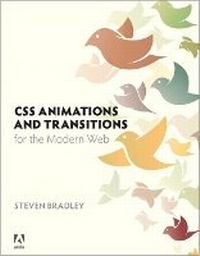
CSS Animations and Transitions for the Modern Web
Published on 27. November 2014
Book
Paperback/Softback
320 pages
978-0-13-398050-9 (ISBN)
Description
Modern websites use a variety of animated effects not only to improve usability but also to delight and surprise users. Some of these effects require complex scripting or programming skills, but many are within the grasp of designers who are already familiar with CSS and HTML. CSS Animations and Transitions for the Modern Web shows designers how to add movement to web pages over time using CSS3 style definitions.
Author Steven Bradley begins as simply as possible and uses elementary skills as the basis for more advanced techniques. Conceptual explanation is combined with specific examples to give designers a solid foundation in
the art of creating dynamic and appealing websites. Steven's examples are posted at peachpit.com so readers can see the animations in action and download the code files for further study. Instructions for access are in the "Getting Started" section.
With CSS Animations and Transitions for the Modern Web, you'll learn how to make your websites more vibrant and compelling with user interfaces that are functional, reliable, and usable, as well as beautiful.
Up-to-date information on current browser support for CSS animations and transitions
An introduction to manipulating web page objects in both 2D and 3D space
Techniques for creating smooth transitions between object states
An overview of Disney's principles for creating realistic animation and how they apply to web page designs
Author Steven Bradley begins as simply as possible and uses elementary skills as the basis for more advanced techniques. Conceptual explanation is combined with specific examples to give designers a solid foundation in
the art of creating dynamic and appealing websites. Steven's examples are posted at peachpit.com so readers can see the animations in action and download the code files for further study. Instructions for access are in the "Getting Started" section.
With CSS Animations and Transitions for the Modern Web, you'll learn how to make your websites more vibrant and compelling with user interfaces that are functional, reliable, and usable, as well as beautiful.
Up-to-date information on current browser support for CSS animations and transitions
An introduction to manipulating web page objects in both 2D and 3D space
Techniques for creating smooth transitions between object states
An overview of Disney's principles for creating realistic animation and how they apply to web page designs
More details
Other editions
Additional editions
Steven Bradley
CSS Animations and Transitions for the Modern Web
E-Book
11/2014
1st Edition
Adobe Press,U.S.
€44.49
Available for download
Person
STEVEN BRADLEY is a freelance web designer and WordPress developer who traded the hustle and bustle of his origins in New York for the blue skies and mountains of Boulder, Colorado. He's the author of Design Fundamentals: Elements, Attributes, & Principles, and he's written for sites like Smashing Magazine, the Tuts+ family of sites, and the Developer Connection section of adobe.com. Steven blogs regularly at Vanseo Design (www.vanseodesign.com/blog) and runs a small business forum (www.small-business-forum.net) that helps freelancers and entrepreneurs get started on their journey.
Content
Chapter 1: Introduction
* Why CSS Animation is Important
* Critical and Non-Critical Visual Experience
* Tools: What you need
Chapter 2: Transforms
* Browser Support
* Fallbacks and PolyFills
* CSS Visual Formatting Model
* The Transform Rendering Model
* 2-Dimensional Transforms
- transform property
- transform-origin property
* 3-Dimensional Transforms
- Perspective property
- Perspective-origin property
- Backface-visibility property
* Transform Functions
- 2-Dimensional Functions
matrix()
translate()
translateX()
translateY()
scale()
scaleX()
scaleY()
rotate()
skew()
skewX()
- 3-Dimensional Functions
matrix3d()
translate3d()
translateZ()
scale3d()
scaleZ()
rotate3d()
rotateX()
rotateY()
rotateZ()
perspective()
* Combining Transforms
Chapter 3: Transitions
* Browser Support
* Fallbacks and PolyFills
* Transition Properties
- Transition-property
- Transition-duration property
- Transition-timing-function property
ease
linear
ease-in
ease-out
ease-in-out
step-start
step-end
steps
cubic-bezier
- Transition-delay property
- Transition shorthand property
* Starting and Reversing Transitions
* CSS properties that can be transitioned
* Transition Events
Chapter 4: Animation
* Browser Support
* Fallbacks and PolyFills
* Keyframes
- @Keyframes rule
* Animation Behavior
- Differences between animation and transitions
* Animation Properties
- animation-name property
- animation-duration property
ease
linear
ease-in
ease-out
ease-in-out
step-start
step-end
steps
cubic-bezier
- animation-timing-function property
- animation-iteration-count property
- animation-direction property
- animation-play-state property
- animation-delay property
- animation-fill-mode property
- Animation shorthand property
* CSS Properties that can be animated
* Animation Events
- Animation-start
- Animation-end
- Animation-iteration
Chapter 5: Principles for More Realistic Animation
* When to use Transitions and when to use animation
* Disney's Twelve principles of animation
- Squash and stretch
- Anticipation
- Staging
- Straight Ahead Action and Pose to Pose
- Follow Through and Overlapping Action
- Slow In and Slow Out
- Arcs
- Secondary Action
- Timing
- Exaggeration
- Solid Drawing
- Appeal
Chapter 6: Examples
End Matter
* Resources
* About the Author
* Index
* Why CSS Animation is Important
* Critical and Non-Critical Visual Experience
* Tools: What you need
Chapter 2: Transforms
* Browser Support
* Fallbacks and PolyFills
* CSS Visual Formatting Model
* The Transform Rendering Model
* 2-Dimensional Transforms
- transform property
- transform-origin property
* 3-Dimensional Transforms
- Perspective property
- Perspective-origin property
- Backface-visibility property
* Transform Functions
- 2-Dimensional Functions
matrix()
translate()
translateX()
translateY()
scale()
scaleX()
scaleY()
rotate()
skew()
skewX()
- 3-Dimensional Functions
matrix3d()
translate3d()
translateZ()
scale3d()
scaleZ()
rotate3d()
rotateX()
rotateY()
rotateZ()
perspective()
* Combining Transforms
Chapter 3: Transitions
* Browser Support
* Fallbacks and PolyFills
* Transition Properties
- Transition-property
- Transition-duration property
- Transition-timing-function property
ease
linear
ease-in
ease-out
ease-in-out
step-start
step-end
steps
cubic-bezier
- Transition-delay property
- Transition shorthand property
* Starting and Reversing Transitions
* CSS properties that can be transitioned
* Transition Events
Chapter 4: Animation
* Browser Support
* Fallbacks and PolyFills
* Keyframes
- @Keyframes rule
* Animation Behavior
- Differences between animation and transitions
* Animation Properties
- animation-name property
- animation-duration property
ease
linear
ease-in
ease-out
ease-in-out
step-start
step-end
steps
cubic-bezier
- animation-timing-function property
- animation-iteration-count property
- animation-direction property
- animation-play-state property
- animation-delay property
- animation-fill-mode property
- Animation shorthand property
* CSS Properties that can be animated
* Animation Events
- Animation-start
- Animation-end
- Animation-iteration
Chapter 5: Principles for More Realistic Animation
* When to use Transitions and when to use animation
* Disney's Twelve principles of animation
- Squash and stretch
- Anticipation
- Staging
- Straight Ahead Action and Pose to Pose
- Follow Through and Overlapping Action
- Slow In and Slow Out
- Arcs
- Secondary Action
- Timing
- Exaggeration
- Solid Drawing
- Appeal
Chapter 6: Examples
End Matter
* Resources
* About the Author
* Index