

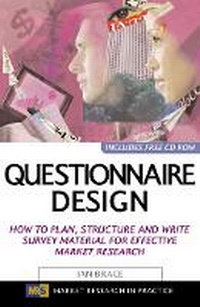
Questionnaire Design
How to Plan, Structure and Write Survey Material for Effective Market Research
1st Edition
Published on 30. June 2004
Book
Paperback/Softback
288 pages
978-0-7494-4181-4 (ISBN)
Description
Questionnaires are vital for the market researcher: they draw accurate information from respondents; give structure to interviews; provide a standard form on which facts, comments and attitudes can be recorded; and facilitate data processing.
Questionnaire Design explains the role of questionnaires in market research, and looks at different types of questionnaire and when and how they should be used. It explains how to plan, structure and compose the right questionnaire for the research you are running. Contents include:
objectives in writing questionnaires
differences between data collection media
planning your questionnaire
writing the questions
types of question
using prompt material
layout
piloting
ethical issues
social desirability bias and how to avoid it
issues in multi-national surveys
Part of the new Market Research in Practice series, published in association with The Market Research Society (MRS), Questionnaire Design is an invaluable guide for anyone studying or practising market research. Packed with expert advice, it also includes examples of the most common errors and how to avoid them.
Questionnaire Design explains the role of questionnaires in market research, and looks at different types of questionnaire and when and how they should be used. It explains how to plan, structure and compose the right questionnaire for the research you are running. Contents include:
objectives in writing questionnaires
differences between data collection media
planning your questionnaire
writing the questions
types of question
using prompt material
layout
piloting
ethical issues
social desirability bias and how to avoid it
issues in multi-national surveys
Part of the new Market Research in Practice series, published in association with The Market Research Society (MRS), Questionnaire Design is an invaluable guide for anyone studying or practising market research. Packed with expert advice, it also includes examples of the most common errors and how to avoid them.
Reviews / Votes
"Effectively illustrates the importance of the questionnaire as a decision-making tool... A useful reference for those in the market research industry and a comprehensive introduction for those interested in mastering the intricacies of questionnaire development. This highly informative volume would also serve as a valuable companion for advanced undergraduate and graduate students alike." Choice Magazine "Provides students and practitioners of market research with general rules and principles to be used in creating a questionnaire." Journal of Economic Literature "A craftsman's handbook on the inside art of drafting a questionnaire." www.getabstract.comMore details
Series
Language
English
Place of publication
London
United Kingdom
Target group
College/higher education
Professional and scholarly
Product notice
Paperback (trade)
Dimensions
Height: 234 mm
Width: 153 mm
ISBN-13
978-0-7494-4181-4 (9780749441814)
Copyright in bibliographic data and cover images is held by Nielsen Book Services Limited or by the publishers or by their respective licensors: all rights reserved.
Schweitzer Classification
Other editions
New editions
Ian Brace
Questionnaire Design
How to Plan, Structure and Write Survey Material for Effective Market Research
Book
08/2008
2nd Edition
Kogan Page Ltd
€50.95
Article exhausted; check for reprint
Additional editions
Ian Brace
Questionnaire Design
How to Plan, Structure and Write Survey Material for Effective Market Research
Book
01/2015
3rd Edition
Kogan Page Ltd
€129.23
Article exhausted; check for reprint
Person
Ian Brace is Research Director at TNS UK. He has been a market researcher for over 30 years, during which time he worked for MAS Survey Research, NOP, Esso Petroleum, BJM Research and NFO WorldGroup. Ian is a Visiting Fellow in market research at Bristol Business School, and currently vice chairman of the council of the Market Research Society and deputy chair of the MRS Professional Standards Committee.
Content
Introduction What is a questionnaire?; Obtaining the best answers; Why do we need a questionnaire?; What does it do?; Standardized surveys; A remote conversation 1. Objectives in writing a questionnaire Introduction; The questionnaire in the survey process; Stakeholders in the questionnaire; The objectives of the study; Recruitment questionnaires; Collecting unbiased and accurate data 2. The data collection media Introduction; Interviewer-administered interviews; Self-completion surveys 3. Planning the questionnaire Introduction; Defining the information required; Sequencing the sections; Exclusion question; Screening questions; Main questionnaire 4. Types of question and data Introduction; Question types; Open and closed questions; Spontaneous questions; Prompted questions; Open-ended questions; Pre-coded questions; Data types 5. Rating scales and attitude measurement Attitude measurement; Itemized rating scales; Attitudinal rating scales; Rating scales in customer satisfaction research; The dimensions; Comparative scaling techniques; Measuring brand image 6. Writing the questionnaire Introduction; Use of language; Avoiding ambiguity in the question; Determining the pre-codes; Using prompts; Order bias and prompts; Question order; Standardizing questions; Tracking studies; Omnibus studies 7. Laying out the questionnaire Introduction; Interviewer-administered paper questionnaires; Self-completion paper questionnaire; Electronic questionnaires 8. Piloting the questionnaire Introduction; Why pilot questionnaires?; Types of pilot surveys 9. Ethical issues Introduction; Responsibilities to respondents; Responsibilities to clients 10. Social desirability bias Response bias; Social desirability bias; Dealing with SDB; Determining whether SDB exists 11. International surveys Introduction; Client presence; Common or tailored approaches; Translating the questionnaire; Demographic data; Cultural response differences; Laying out the questionnaire
Introduction
What is a questionnaire?; Obtaining the best answers; Why do we need a questionnaire?; What does it do?; Standardized surveys; A remote conversation
1. Objectives in writing a questionnaire
Introduction; The questionnaire in the survey process; Stakeholders in the questionnaire; The objectives of the study; Recruitment questionnaires; Collecting unbiased and accurate data
2. The data collection media
Introduction; Interviewer-administered interviews; Self-completion surveys
3. Planning the questionnaire
Introduction; Defining the information required; Sequencing the sections; Exclusion question; Screening questions; Main questionnaire
4. Types of question and data
Introduction; Question types; Open and closed questions; Spontaneous questions; Prompted questions; Open-ended questions; Pre-coded questions; Data types
5. Rating scales and attitude measurement
Attitude measurement; Itemized rating scales; Attitudinal rating scales; Rating scales in customer satisfaction research; The dimensions; Comparative scaling techniques; Measuring brand image
6. Writing the questionnaire
Introduction; Use of language; Avoiding ambiguity in the question; Determining the pre-codes; Using prompts; Order bias and prompts; Question order; Standardizing questions; Tracking studies; Omnibus studies
7. Laying out the questionnaire
Introduction; Interviewer-administered paper questionnaires; Self-completion paper questionnaire; Electronic questionnaires
8. Piloting the questionnaire
Introduction; Why pilot questionnaires?; Types of pilot surveys
9. Ethical issues
Introduction; Responsibilities to respondents; Responsibilities to clients
10. Social desirability bias
Response bias; Social desirability bias; Dealing with SDB; Determining whether SDB exists
11. International surveys
Introduction; Client presence; Common or tailored approaches; Translating the questionnaire; Demographic data; Cultural response differences; Laying out the questionnaire
What is a questionnaire?; Obtaining the best answers; Why do we need a questionnaire?; What does it do?; Standardized surveys; A remote conversation
1. Objectives in writing a questionnaire
Introduction; The questionnaire in the survey process; Stakeholders in the questionnaire; The objectives of the study; Recruitment questionnaires; Collecting unbiased and accurate data
2. The data collection media
Introduction; Interviewer-administered interviews; Self-completion surveys
3. Planning the questionnaire
Introduction; Defining the information required; Sequencing the sections; Exclusion question; Screening questions; Main questionnaire
4. Types of question and data
Introduction; Question types; Open and closed questions; Spontaneous questions; Prompted questions; Open-ended questions; Pre-coded questions; Data types
5. Rating scales and attitude measurement
Attitude measurement; Itemized rating scales; Attitudinal rating scales; Rating scales in customer satisfaction research; The dimensions; Comparative scaling techniques; Measuring brand image
6. Writing the questionnaire
Introduction; Use of language; Avoiding ambiguity in the question; Determining the pre-codes; Using prompts; Order bias and prompts; Question order; Standardizing questions; Tracking studies; Omnibus studies
7. Laying out the questionnaire
Introduction; Interviewer-administered paper questionnaires; Self-completion paper questionnaire; Electronic questionnaires
8. Piloting the questionnaire
Introduction; Why pilot questionnaires?; Types of pilot surveys
9. Ethical issues
Introduction; Responsibilities to respondents; Responsibilities to clients
10. Social desirability bias
Response bias; Social desirability bias; Dealing with SDB; Determining whether SDB exists
11. International surveys
Introduction; Client presence; Common or tailored approaches; Translating the questionnaire; Demographic data; Cultural response differences; Laying out the questionnaire