

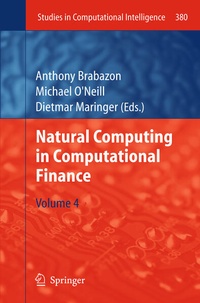
Natural Computing in Computational Finance
Volume 4
1st Edition
Published on 10. September 2011
Book
Hardback
X, 202 pages
978-3-642-23335-7 (ISBN)
Description
This book follows on from Natural Computing in Computational Finance Volumes I, II and III. As in the previous volumes of this series, the book consists of a series of chapters each of which was selected following a rigorous, peer-reviewed, selection process. The chapters illustrate the application of a range of cutting-edge natural computing and agent-based methodologies in computational finance and economics. The applications explored include option model calibration, financial trend reversal detection, enhanced indexation, algorithmic trading, corporate payout determination and agent-based modeling of liquidity costs, and trade strategy adaptation. While describing cutting edge applications, the chapters are written so that they are accessible to a wide audience. Hence, they should be of interest to academics, students and practitioners in the fields of computational finance and economics. which was selected following a rigorous, peer-reviewed, selection process. The chapters illustrate the application of a range of cutting-edge natural computing and agent-based methodologies in computational finance and economics. The applications explored include option model calibration, financial trend reversal detection, enhanced indexation, algorithmic trading, corporate payout determination and agent-based modeling of liquidity costs, and trade strategy adaptation. While describing cutting edge applications, the chapters are written so that they are accessible to a wide audience. Hence, they should be of interest to academics, students and practitioners in the fields of computational finance and economics. The applications explored include option model calibration, financial trend reversal detection, enhanced indexation, algorithmic trading, corporate payout determination and agent-based modeling of liquidity costs, and trade strategy adaptation. While describing cutting edge applications, the chapters are written so that they are accessible to a wide audience. Hence, they should be of interest to academics, students and practitioners in the fields of computational finance and economics. written so that they are accessible to a wide audience. Hence, they should be of interest to academics, students and practitioners in the fields of computational finance and economics.
More details
Series
Language
English
Place of publication
Berlin
Germany
Publishing group
Springer Berlin
Target group
Professional and scholarly
Research
Illustrations
37 s/w Abbildungen, 25 farbige Abbildungen
X, 202 p.
Dimensions
Height: 241 mm
Width: 160 mm
Thickness: 18 mm
Weight
527 gr
ISBN-13
978-3-642-23335-7 (9783642233357)
DOI
10.1007/978-3-642-23336-4
Schweitzer Classification
Other editions
Additional editions
Anthony Brabazon | Michael O'Neill | Dietmar Maringer
Natural Computing in Computational Finance
Volume 4
Book
08/2016
Springer
€160.49
Article exhausted; check different version
Anthony Brabazon | Michael O'Neill | Dietmar Maringer
Natural Computing in Computational Finance
Volume 4
E-Book
10/2011
Springer
€149.79
Available for download
Content
1 Natural Computing in Computational Finance (Volume 4): Introduction.- 2 Calibrating Option Pricing Models with Heuristics.- 3 A Comparison Between Nature-Inspired and Machine Learning Approaches to Detecting Trend Reversals in Financial Time Series.- 4 A soft computing approach to enhanced indexation.- 5 Parallel Evolutionary Algorithms for Stock Market Trading Rule Selection on Many-Core Graphics Processors.- 6 Regime-Switching Recurrent Reinforcement Learning in Automated Trading.- 7 An Evolutionary Algorithmic Investigation of US Corporate Payout Policy Determination.- 8 Tackling Overfitting in Evolutionary-driven Financial Model Induction.- 9 An Order-Driven Agent-Based Artificial Stock Market to Analyze Liquidity Costs of Market Orders in the Taiwan Stock Market.- 10 Market Microstructure: A Self-Organizing Map Approach to Investigate Behavior Dynamics under an Evolutionary Environment.