

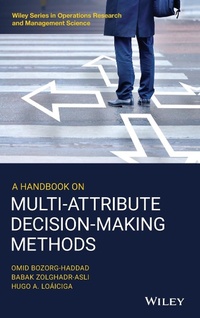
A Handbook on Multi-Attribute Decision-Making Methods
1st Edition
Published on 18. May 2021
Book
Hardback
192 pages
978-1-119-56349-5 (ISBN)
Description
This book describes multi-attribute decision-making (MADM) methods and provides stepwise guidelines in applying those methods. The authors describe the most important MADM methods, with an assessment of their performance in solving multiple problems encompassing several fields. This book contains 12 chapters, and an additional appendix on weight assignment methods. Chapter 1 provides an overview of decision-making and its fundamental concepts. Each of chapters 2 through 12 is devoted to a separate MADM method. In total, some 20 MADM methods are presented in the book. The chapters are arranged according to pedagogical purposes, so the audience can easily engage with the presented materials found in each chapter. The authors' intent is that each chapter can stand alone. To do this, they provide the audience with a brief description of the materials and methods required to cover every aspect and mathematical concepts pertinent to each presented method. Dedicated readers may go through the entire book to gain a deep understanding of MADM methods and their theoretical foundations. Others may choose specific chapters without facing any difficulty understanding their respective MADM methods. Each chapter, which describes a specific MADM method, or in some instances a family of methods, starts with a brief literature review of the methods' development, followed by a description of the its theoretical foundation. The philosophical basis of each method is reviewed and mapped to the mathematical framework of each MADM method. Lastly, a stepwise description of each method that serves as the guideline for its implementation to cope with real-world MADM problems is also presented.
More details
Other editions
Additional editions
Omid Bozorg-Haddad | Babak Zolghadr-Asli | Hugo A. Loáiciga
A Handbook on Multi-Attribute Decision-Making Methods
E-Book
03/2021
1st Edition
Wiley
€113.99
Available for download
Omid Bozorg-Haddad | Babak Zolghadr-Asli | Hugo A. Loáiciga
A Handbook on Multi-Attribute Decision-Making Methods
E-Book
03/2021
1st Edition
Wiley
€113.99
Available for download
Persons
Omid Bozorg-Haddad, PhD, is Professor in the Department of Irrigation & Reclamation Engineering at University of Tehran, Iran. Dr. Bozorg-Haddad is co-author of Meta-heuristic and Evolutionary Algorithms for Engineering Optimization (Wiley, 2017).
Babak Zolghadr-Asli, M.Sc., received M.Sc. in Irrigation Engineering, Water Resources Management, from Tehran University in Tehran, Iran. Dr. Aolghadr-Asli is a member of American Society of Civil Engineers (ASCE) and International Association of Hydrological Science (IAHS).
Hugo A. Loaiciga, PhD, is Professor of Geography in the Department of Geography at the University of California, Santa Barbara, CA, USA. Dr. Loaiciga is co-author of Meta-heuristic and Evolutionary Algorithms for Engineering Optimization (Wiley, 2017).
Babak Zolghadr-Asli, M.Sc., received M.Sc. in Irrigation Engineering, Water Resources Management, from Tehran University in Tehran, Iran. Dr. Aolghadr-Asli is a member of American Society of Civil Engineers (ASCE) and International Association of Hydrological Science (IAHS).
Hugo A. Loaiciga, PhD, is Professor of Geography in the Department of Geography at the University of California, Santa Barbara, CA, USA. Dr. Loaiciga is co-author of Meta-heuristic and Evolutionary Algorithms for Engineering Optimization (Wiley, 2017).
Content
Chapter 1: An overview of the art of decision-making
Summary
1.1. Introduction
1.2. Classification of MADM methods
1.2.1. Preference evaluation mechanism
1.2.2. Attributes' Interactions
1.2.3. The mathematical nature of attributes' values
1.2.3.1. Deterministic vs. non-deterministic
1.2.3.2. Fuzzy vs. crisp
1.2.4. Number of involved decision-makers
1.3. Brief chronicle of MADM methods
1.4. Conclusion
References
Chapter 2: Simple Weighting Methods: Weighted Sum and Weighted Product Methods
Summary
2.1. Introduction
2.2. The weighted sum method
2.3. The Weighted product method
2.4. Conclusion
References
Chapter 3: Analytic Hierarchy Process (AHP)
Summary
3.1. Introduction
3.2. The hierarchical structure
3.3. The pairwise comparison
3.4. Inconsistency
3.5. Quadruple axioms of the AHP
3.6. Stepwise description of the AHP method
3.7. Conclusion
Reference
Chapter 4: Analytic Network Process (ANP)
Summary
4.1. Introduction
4.2. Network vs. hierarchy structure
4.3. Stepwise instruction to the ANP method
4.4. Conclusion
References
Chapter 5: The Best-Worst Method (BWM)
Summary
5.1. Introduction
5.2. Basic principles of the BWM
5.3. Stepwise description of the BWM
5.4. Conclusion
References
Chapter 6: TOPSIS
Summary
6.1. Introduction
6.2. Stepwise instruction to the TOPSIS method
6.3. A common misinterpretation of TOPSIS results
6.4. Conclusion
Reference
Chapter 7: VIKOR
Summary
7.1. Introduction
7.2. Stepwise description of the VIKOR method
7.3. Conclusion
References
Chapter 8: ELECTRE
Summary
8.1. Introduction
8.2. A brief history of the ELECTRE family of methods
8.3. ELECTRE I
8.4. ELECTRE II
8.5. ELECTRE III
8.6. ELECTRE IV
8.7. Conclusion
References
Chapter 9: PROMETHEE
Summary
9.1. Introduction
9.2. Common ground of the PROMETHEE family
9.3. PROMETHEE I
9.4. PROMETHEE II
9.5. PROMETHEE III
9.6. PROMETHEE IV
9.7. Conclusion
Reference
Chapter 10: Superiority and Inferiority Ranking (SIR)
Summary
10.1. Introduction
10.2. Foundational bases of the SIR method
10.3. Stepwise instruction to SIR method
10.4. Conclusion
References
Chapter 11: PAPRIKA
Summary
11.1. Introduction
11.2. Stepwise description of PAPRIKA
11.3. Conclusion
References
Chapter 12: PAPRIKA
Summary
12.1. Introduction
12.2. Grey system theory: The foundation and basic principles
12.3. Gray relational modeling
12.4. Grey theory in relation to MADM
12.5. Conclusion
References
Appendix I: Weight assignment approaches
Appendix II: A benchmark example and a comparison between objective- and subjective-based MADM methods