

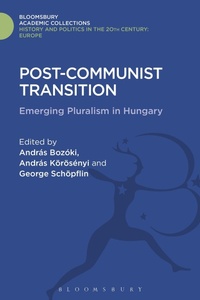
Post-Communist Transition
Emerging Pluralism in Hungary
Published on 6. October 2016
Book
Hardback
224 pages
978-1-4742-8780-7 (ISBN)
Description
The transition from communist dictatorship to multi-party democracy has proved a long and painful process for the countries of Eastern Europe, and has met with varying degrees of success. In Hungary, the radical opposition was uniquely successful in fighting off attempts by the old-guard communist elite to hijack reform programmes, by forcing free elections and creating a multi-party system. This volume focuses on the Hungarian experience, analysing in detail the process of transition from dictatorship to pluralist democracy. Some of Hungary's leading political scientists examine issues such as the legitimation crisis of communist rule, resulting struggles within the ruling elite and the forces behind transition. Constitutional reform, party formation and voting behaviour at the first free elections are also taken into account. The concluding section places the Hungarian experience in comparative perspective, within the context of other Central and Western European states.
More details
Series
Language
English
Place of publication
London
United Kingdom
Publishing group
Bloomsbury Publishing PLC
Target group
College/higher education
Dimensions
Height: 240 mm
Width: 161 mm
Thickness: 17 mm
Weight
505 gr
ISBN-13
978-1-4742-8780-7 (9781474287807)
Copyright in bibliographic data and cover images is held by Nielsen Book Services Limited or by the publishers or by their respective licensors: all rights reserved.
Schweitzer Classification
Other editions
Additional editions
Andras Bozoki | Andras Koeroesenyi | George Schoepflin
Post-Communist Transition
Emerging Pluralism in Hungary
E-Book
10/2016
1st Edition
Bloomsbury Academic
€133.99
Available for download
Persons
Andras Bozoki is Professor of Political Science at the Central European University in Budapest, Hungary.
Andras Koeroesenyi is the General Director of the Centre for Social Sciences at the Hungarian Academy of Sciences in Budapest, Hungary.
George Schoepflin is former Jean Monnet Professor of Politics at the School of Slavonic and East European Studies, University College London and current Member of the European Parliament.
Andras Koeroesenyi is the General Director of the Centre for Social Sciences at the Hungarian Academy of Sciences in Budapest, Hungary.
George Schoepflin is former Jean Monnet Professor of Politics at the School of Slavonic and East European Studies, University College London and current Member of the European Parliament.
Content
Preface George Schoepflin
1. The Decay of Communist Rule in Hungary Andras Koeroesenyi
2. Post-Communist Transition Andras Bozoki
3. The Character of the Political Parties in Hungary in Autumn 1989 Laszlo Lengyel
4. 1989: The Negotiated Revolution in Hungary Laszlo Bruszt
5. Political Transition and Constitutional Change in Hungary Andras Bozoki
6. The Hungarian Parliamentary Elections, 1990 Andras Koeroesenyi
7. Hungarian Transition from a Public Choice Perspective Laszlo Urban
8. From Communism to Democracy in Hungary George Schoepflin
9. Revival of the Past or New Beginning? The Nature of Post-Communist Politics Andras Koeroesenyi
10. The Making of Political Fields in Post-Communist Transition (Dynamics of Class and Party in Hungarian Politics, 1989-90) Tamas Kolosi, Ivan Szelenyi, Szonja Szelenyi and Bruce Western
11. The Hungarian Transition in a Comparative Perspective Andras Bozoki
Index
1. The Decay of Communist Rule in Hungary Andras Koeroesenyi
2. Post-Communist Transition Andras Bozoki
3. The Character of the Political Parties in Hungary in Autumn 1989 Laszlo Lengyel
4. 1989: The Negotiated Revolution in Hungary Laszlo Bruszt
5. Political Transition and Constitutional Change in Hungary Andras Bozoki
6. The Hungarian Parliamentary Elections, 1990 Andras Koeroesenyi
7. Hungarian Transition from a Public Choice Perspective Laszlo Urban
8. From Communism to Democracy in Hungary George Schoepflin
9. Revival of the Past or New Beginning? The Nature of Post-Communist Politics Andras Koeroesenyi
10. The Making of Political Fields in Post-Communist Transition (Dynamics of Class and Party in Hungarian Politics, 1989-90) Tamas Kolosi, Ivan Szelenyi, Szonja Szelenyi and Bruce Western
11. The Hungarian Transition in a Comparative Perspective Andras Bozoki
Index