

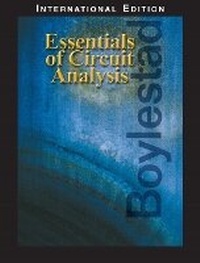
Essentials of Circuit Analysis
International Edition
Published on 23. October 2003
Book
Mixed media product
880 pages
978-0-13-191197-0 (ISBN)
Description
For courses in DC/AC Circuits: Conventional Flow.
Based on the concepts from his top-selling Introductory Circuit Analysis text, Robert Boylestad utilizes over 3 decades of writing experience to create a new approach to DC/AC circuits. Completely rewritten from the ground-up, this text gives the student the knowledge and skills they need to master for success in their circuit course. Its focus on salient points-and commitment to ensuring students understand them-places each topic in a new light, and provides learners with an extremely readable presentation and valuable contribution to the classroom experience.
Based on the concepts from his top-selling Introductory Circuit Analysis text, Robert Boylestad utilizes over 3 decades of writing experience to create a new approach to DC/AC circuits. Completely rewritten from the ground-up, this text gives the student the knowledge and skills they need to master for success in their circuit course. Its focus on salient points-and commitment to ensuring students understand them-places each topic in a new light, and provides learners with an extremely readable presentation and valuable contribution to the classroom experience.
More details
Language
English
Place of publication
United States
Publishing group
Pearson Education (US)
Target group
Professional and scholarly
Dimensions
Height: 208 mm
Width: 276 mm
Thickness: 29 mm
Weight
1722 gr
ISBN-13
978-0-13-191197-0 (9780131911970)
Copyright in bibliographic data and cover images is held by Nielsen Book Services Limited or by the publishers or by their respective licensors: all rights reserved.
Schweitzer Classification
Other editions
Previous edition
Book
10/2003
Pearson
€137.98
Article exhausted; check for reprint
Person
The inspiration for this one-of-a-kind text grew from Bob Boylestad's desire to provide students with a comprehensive learning tool that hones in on the most important circuit analysis concepts in an exciting and fresh manner. This same vision has resulted in a completely new publishing endeavor by the author and Prentice Hall-a text that delivers all of the essential knowledge a student should carry away from an introductory DC/AC circuits course in one concise, practical, engaging volume.
Ancillaries written for this text include:
Experiments in Circuit Analysis, a lab manual
Lab Solutions Manual
Text Solutions Manual
Prentice Hall TestGen, a computerized test bank
PowerPoint (R) Transparencies
Companion Website, http://www.prenhall.com/boylestad
Electronics Supersite, http://www.prenhall.com/electronics
Ancillaries written for this text include:
Experiments in Circuit Analysis, a lab manual
Lab Solutions Manual
Text Solutions Manual
Prentice Hall TestGen, a computerized test bank
PowerPoint (R) Transparencies
Companion Website, http://www.prenhall.com/boylestad
Electronics Supersite, http://www.prenhall.com/electronics
Content
1. Introduction.
2. Current and Voltage.
3. Resistance.
4. Ohms Law, Power, and Energy.
5. Series dc Circuits.
6. Parallel dc Circuits.
7. Series-Parallel Circuits.
8. Methods of Analysis and Selected Topics (dc).
9. Network Theorems.
10. Capacitors.
11. Inductors.
12. Sinusoidal Alternating Waveforms.
13. The Basic Elements and Phasors.
14. Series and Parallel ac Circuits.
15. Series-Parallel ac Networks and the Power Triangle.
16. ac Methods of Analysis and Theorems.
17. Resonance and Filters.
18. Transformers and Three-Phase Systems.
19. Pulse Waveforms and the Nonsinusoidal Response.
2. Current and Voltage.
3. Resistance.
4. Ohms Law, Power, and Energy.
5. Series dc Circuits.
6. Parallel dc Circuits.
7. Series-Parallel Circuits.
8. Methods of Analysis and Selected Topics (dc).
9. Network Theorems.
10. Capacitors.
11. Inductors.
12. Sinusoidal Alternating Waveforms.
13. The Basic Elements and Phasors.
14. Series and Parallel ac Circuits.
15. Series-Parallel ac Networks and the Power Triangle.
16. ac Methods of Analysis and Theorems.
17. Resonance and Filters.
18. Transformers and Three-Phase Systems.
19. Pulse Waveforms and the Nonsinusoidal Response.