

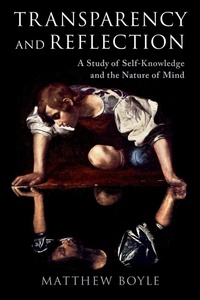
Transparency and Reflection
A Study of Self-Knowledge and the Nature of Mind
Published on 19. June 2024
Book
Hardback
304 pages
978-0-19-992629-9 (ISBN)
Description
The topic of self-knowledge has been central to philosophy since antiquity--but if self-knowledge deserves to be not just a goal that each of us should privately pursue, but a topic that philosophers should investigate in general terms, on what basis does it claim our attention? Much contemporary work in philosophy and cognitive science treats human cognition and perception as processes of representation manipulation, unaffected by our capacity for self-awareness. In Transparency and Reflection Matthew Boyle challenges this paradigm by urging a reconsideration of the classical idea that the capacity for reflective self-knowledge is an essential feature of human mindedness.
Boyle argues that our ability for reflective self-knowledge is a byproduct of the "first person perspective" on our own lives that all human beings possess, as rational animals, and he seeks to defend this perspective against influential forms of skepticism about its soundness. Once we appreciate the connection between having a first person perspective on our own minds and having the capacity for self-knowledge, Boyle suggests, we can see a link between debates about how we know our own minds and the dark but intriguing idea that Jean-Paul Sartre expressed in his remark that, for a human being, "to exist is always to assume its being" in a way that implies "an understanding of human reality by itself."
Boyle argues that our ability for reflective self-knowledge is a byproduct of the "first person perspective" on our own lives that all human beings possess, as rational animals, and he seeks to defend this perspective against influential forms of skepticism about its soundness. Once we appreciate the connection between having a first person perspective on our own minds and having the capacity for self-knowledge, Boyle suggests, we can see a link between debates about how we know our own minds and the dark but intriguing idea that Jean-Paul Sartre expressed in his remark that, for a human being, "to exist is always to assume its being" in a way that implies "an understanding of human reality by itself."
Reviews / Votes
While this "reflectivist" approach is a valuable study in and of itself, it is also suitable as an alternative approach to central topics in the philosophy of mind, including but not limited to perception, representation, and the role of the body and bodily awareness. Highly recommended. * Choice * This thoughtful book presents an overarching and unified conception of self-knowledge and the mind. * Christopher Peacocke, Mind *More details
Language
English
Place of publication
New York
United States
Product notice
sewn/stitched
Cloth over boards
Illustrations
1 line drawing
Dimensions
Height: 239 mm
Width: 162 mm
Thickness: 25 mm
Weight
570 gr
ISBN-13
978-0-19-992629-9 (9780199926299)
Copyright in bibliographic data and cover images is held by Nielsen Book Services Limited or by the publishers or by their respective licensors: all rights reserved.
Schweitzer Classification
Other editions
Additional editions
E-Book
02/2024
OUP eBook
€57.99
Available for download
E-Book
01/2024
OUP eBook
€57.99
Available for download
Person
Matthew Boyle is Emerson and Grace Wineland Pugh Professor and Chair of the Philosophy Department of the University of Chicago. Previously, he was Professor of Philosophy at Harvard University. He has written widely on topics on the philosophy of mind and also on various figures in the history of philosophy, especially Immanuel Kant and Jean-Paul Sartre.
Content
Preface
Introduction
Part I: Self-Knowledge and Transparency
1. Transparency and Other Problems
2. Contemporary Approaches
3. The Reflectivist Approach
Part II: Self-Consciousness and the First Person Perspective
4. Consciousness-as-Subject
5. Self-Consciousness
6. Bodily Awareness
Part III: Reflection and Self-Understanding
7. Reflection and Rationality
8. Armchair Psychology
9. Self-Understanding
10. The Examined Life
Bibliography
Index
Introduction
Part I: Self-Knowledge and Transparency
1. Transparency and Other Problems
2. Contemporary Approaches
3. The Reflectivist Approach
Part II: Self-Consciousness and the First Person Perspective
4. Consciousness-as-Subject
5. Self-Consciousness
6. Bodily Awareness
Part III: Reflection and Self-Understanding
7. Reflection and Rationality
8. Armchair Psychology
9. Self-Understanding
10. The Examined Life
Bibliography
Index