

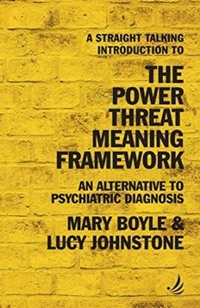
A Straight Talking Introduction to the Power Threat Meaning Framework
An alternative to psychiatric diagnosis
Published on 12. November 2020
Book
Paperback/Softback
144 pages
978-1-910919-71-2 (ISBN)
Description
The current mainstream way of describing psychological and emotional distress assumes it is the result of medical illnesses that need diagnosing and treating. This book summarises a powerful alternative to psychiatric diagnosis that asks not 'What's wrong with you?' but 'What's happened to you?' The Power Threat Meaning Framework (PTMF) was co-produced by a core group of psychologists and service users and launched in 2018, prompting considerable interest in the UK and worldwide. It argues that emotional distress, unusual experiences and many forms of troubled or troubling behaviour are understandable when viewed in the context of a person's life and circumstances, the cultural and social norms we are expected to live up to and the degree to which we are exposed to trauma, abuse, injustice and inequality. The PTMF offers all of us the tools to create new, hopeful narratives about the reasons for our distress that are not based on psychiatric diagnosis and to find ways forward as individuals, families, social groups and whole societies.
Reviews / Votes
'Our understanding of mental health has long been waiting for some fundamental rethinking. This book sets out a new framework that achieves the rare combination of being both revolutionary and eminently sensible. People have been complaining of 'the medical model' for years but have rarely had anything to replace it with. Now we have an approach carefully worked out over several years by a group of senior psychologists and users of psychiatric services. 'Chemical imbalances' have been replaced by a deeply social and experiential view. As the arguments about it go back and forth over the coming years, this book will be essential reading for anyone who takes a serious interest in the field.' - Richard Wilkinson, Emeritus Professor of Social Epidemiology, University of Nottingham, and co-author of The Spirit Level and The Inner Level. ---- 'We found the book to be self-explanatory, gripping and with good flow. The way in which it unravels is engaging and each paragraph leaves you wanting to know more. The added dimension of examples throughout makes this book relatable and also further supports learning. We believe that this book leaves people with no option but to think about change, not only within themselves, which in itself is empowering, but also within different cultures and the system as a whole. The knowledge it shares left us feeling empowered and we strongly believe it holds potential to have the same impact on others.' - SHIFT recovery community, PortsmouthMore details
Series
Language
English
Place of publication
Manchester
United Kingdom
Target group
Professional and scholarly
College/higher education
Adult education
Product notice
Paperback (UK-B)
Dimensions
Height: 190 mm
Width: 130 mm
Thickness: 15 mm
Weight
263 gr
ISBN-13
978-1-910919-71-2 (9781910919712)
Copyright in bibliographic data and cover images is held by Nielsen Book Services Limited or by the publishers or by their respective licensors: all rights reserved.
Schweitzer Classification
Other editions
Additional editions
Mary Boyle | Lucy Johnstone
A Straight Talking Introduction to the Power Threat Meaning Framework
An alternative to psychiatric diagnosis
E-Book
12/2020
PCCS Books
€18.49
Available for download
Persons
Mary Boyle has worked mainly in clinical psychology education and training and in clinical posts in adult mental health and women's health. She is a long-time critic of the medical/diagnostic approach and of individualistic approaches more generally in the health field. She is the author of Schizophrenia: A scientific delusion (2002) and Rethinking Abortion: Psychology, gender, power and the law (1997), as well as many articles and chapters on feminist approaches to women's health and on problems of and alternatives to diagnostic models. She is Emerita Professor of Clinical Psychology at the University of East London. / Lucy Johnstone is a consultant clinical psychologist. Her interest in critiques of and alternatives to current models of distress stems from her many years of working in adult mental health services, alternating with academic posts. She is the author of several books - Users and Abusers of Psychiatry (2000); Formulation in Psychology and Psychotherapy (2013), and A Straight Talking Introduction to Psychiatric Diagnosis (2014), and a number of chapters and articles taking a critical perspective on psychiatric theory and practice. She now works as an independent trainer.
Content
Series introduction - Richard Bentall and Pete Sanders, 1. What this book aims to do, 2. The problems with diagnosis and why we need a different approach, 3. Introducing the Power Threat Meaning Framework, 4. 'What has happened to you?' (How is power operating in your life?), 5. 'How did what happened affect you?' (What kind of threats does this pose?), 6. 'What sense did you make of it?' (What is the meaning of these situations and experiences to you?), 7. 'What did you have to do to survive?' (What kinds of threat response are you using?), 8. General patterns in distress, 9. What is your story?, 10. How did we get here? Questioning some basic assumptions, 11. Further implications of the Power Threat Meaning Framework, Further reading and resources, Appendix: General patterns, Plus a one-page Appendix containing the Guided Discussion template?