

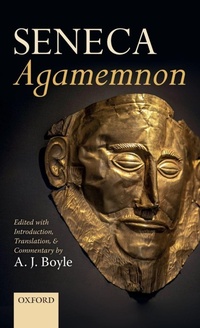
Seneca: Agamemnon
Edited with Introduction, Translation, and Commentary
Published on 12. November 2019
Book
Hardback
748 pages
978-0-19-881082-7 (ISBN)
Description
The tragic myth of Agamemnon, Mycenae's 'king of kings', who sacrificed his own daughter in order to sack the great city of Troy and returned home only to be assassinated by his wife and her lover, has been a constant source of fascination for writers and artists from classical Greece right up to the present day. The ancient Romans were drawn to the myth, but Seneca's tragedy is the only dramatic treatment from this tradition to have survived intact: often undervalued, it is in fact intellectually and poetically one of his richest plays - dramatically innovative, spectacular, and pervasively self-reflective. Its strong lyric and theatrical qualities - from polymetric choral odes to powerful meditative soliloquies-perfectly complement Seneca's complex presentation of the slaying of husband, father, and king and his exploration of such attendant issues as family, despotism, knowledge, gender, political order, freedom, vengeance, and death. Also containing extant Latin literature's most complex representation of two iconic women of classical myth (and occasional feminist paradigms), Clytemnestra and Cassandra, the tragedy ably transcends the narrow context of late Julio-Claudian Rome and contains much that speaks pointedly to our times.
This new full-scale edition of Seneca's Agamemnon offers a comprehensive introduction, newly edited Latin text, English verse translation designed for both performance and high-level academic study, and detailed exegetic, analytic, and interpretative commentary. The aim throughout has been to elucidate the text dramatically as well as philologically, and to locate the play firmly in its contemporary historical and theatrical context and in the ensuing literary and dramatic tradition. As such, its substantial influence on European drama, opera, and ballet from the sixteenth to the nineteenth centuries is given especial emphasis throughout; this and the accessible notes on the text make the edition of particular use not only to scholars and students of classics, but also of comparative literature and drama, and to anyone interested in the cultural dynamics of literary reception and in the interplay between theatre and history.
This new full-scale edition of Seneca's Agamemnon offers a comprehensive introduction, newly edited Latin text, English verse translation designed for both performance and high-level academic study, and detailed exegetic, analytic, and interpretative commentary. The aim throughout has been to elucidate the text dramatically as well as philologically, and to locate the play firmly in its contemporary historical and theatrical context and in the ensuing literary and dramatic tradition. As such, its substantial influence on European drama, opera, and ballet from the sixteenth to the nineteenth centuries is given especial emphasis throughout; this and the accessible notes on the text make the edition of particular use not only to scholars and students of classics, but also of comparative literature and drama, and to anyone interested in the cultural dynamics of literary reception and in the interplay between theatre and history.
Reviews / Votes
Boyle is particularly adept at situating Seneca's work within the rich tradition of Roman drama, and his overview of the play is as thrilling as it is insightful. * Erica Bexley, Durham University, ExClass * With this volume B. adds another magnificent beast to a stable already inhabited by six other handsome animals of a similar species: omnibus commentaries-cum-translations-cum-introductions, that of the present volume being tantamount to a slim but formidable (partly previously published) independent volume of 143 pages. * Alex Dressler, The Classical Review * The book is produced to high standards, and makes a handsome volume... this edition, like Boyle's other work on Seneca, is full of sharp perceptions, of lively and engaging material. It provides a rich feast not only for professional classicists but for the many different constituencies who are drawn to these fascinating dramas. * John Fitch, University of Victoria, Bryn Mawr Classical Review * It is hard to imagine this edition being superseded and (with introductory matter, at 745 pages) one cannot really demand any more from an editor. The level of detail is enormous but does not feel cumbersome, and the reader is guided in every aspect of this play by Boyle's friendly and enthusiastic authority. There are 48 pages of 'select' bibliography, an index of Latin words, an index of passages from other plays in the Senecan corpus and a general index. The book is superbly produced and edited * John Godwin, Classics for All *More details
Language
English
Place of publication
Oxford
United Kingdom
Target group
Professional and scholarly
College/higher education
Dimensions
Height: 222 mm
Width: 145 mm
Thickness: 43 mm
Weight
1056 gr
ISBN-13
978-0-19-881082-7 (9780198810827)
Copyright in bibliographic data and cover images is held by Nielsen Book Services Limited or by the publishers or by their respective licensors: all rights reserved.
Schweitzer Classification
Person
Anthony James Boyle was born in 1942 and educated at St Francis Xavier College in Liverpool, before attending Manchester University and Downing College, Cambridge, where he also taught. He held a teaching position at Monash University in Melbourne for twenty years before moving to the USA in 1989, where he is now Professor of Classics at the University of Southern California, Los Angeles. He has been editor of the Classical literary journal, Ramus, since its inception in 1972.
Content
INTRODUCTION
I. Seneca and Rome
II. Roman Theatre
III. The Declamatory Style
IV. Seneca's Theatre of Violence
V. Seneca on Anger
VI. The Myth before Seneca
VII. The Play
VIII. Reception of Seneca's Agamemnon
IX. Metre
X. The Translation
TEXT AND TRANSLATION
Selective Critical Apparatus
Differences from the 1986 Oxford Classical Text
COMMENTARY
Endmatter
Select Bibliography
Indexes:
I. Latin Words
II. Passages from Other Plays of the Senecan Tragic Corpus
III. General Index
I. Seneca and Rome
II. Roman Theatre
III. The Declamatory Style
IV. Seneca's Theatre of Violence
V. Seneca on Anger
VI. The Myth before Seneca
VII. The Play
VIII. Reception of Seneca's Agamemnon
IX. Metre
X. The Translation
TEXT AND TRANSLATION
Selective Critical Apparatus
Differences from the 1986 Oxford Classical Text
COMMENTARY
Endmatter
Select Bibliography
Indexes:
I. Latin Words
II. Passages from Other Plays of the Senecan Tragic Corpus
III. General Index