

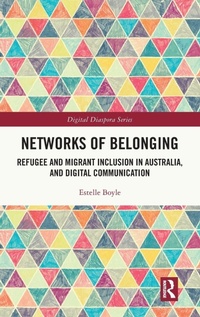
Networks of Belonging
Refugee and Migrant Inclusion in Australia, and Digital Communication
1st Edition
Published on 28. August 2025
Book
Hardback
206 pages
978-1-032-76716-1 (ISBN)
Description
Networks of Belonging examines how digitally networked communication technologies create spaces of belonging for people of refugee and migrant backgrounds in resettlement contexts, focusing on Australia.
The internet has become a primary facilitator for social connection, transforming how displaced and mobile people maintain relationships across distance. For communities facing significant barriers to connection, such as globally dispersed social networks and often the inability to return to their place of origin, digital technologies can offer vital pathways to belonging and social inclusion in new environments. The book begins by considering the history of refugee and migrant inclusion in Australia and the historical practice of migrant letter-writing, as a critical analogue reference point to today's digital ubiquity. By investigating how communication technologies enable access to social connection, particularly among those navigating resettlement, the research offers lived perspectives on the evolving nature of digital sociality and its importance for refugee and migrant communities. Three key dyadic relationships of interstitiality frame the analysis: Inclusion-exclusion, digital-physical, and local-global. This approach highlights the nuances of situated lives and personal narratives gathered through qualitative interviews and photo-elicitation with people of refugee and migrant backgrounds in Melbourne, Australia, while advocating for a relational understanding of social inclusion, exclusion, and belonging; digital and physical sociality; and a local and global sense of place. This book will be of value to students and researchers across multiple fields, including media and communications, refugee and migration studies, social inclusion, multiculturalism and belonging, and digital communication.
The internet has become a primary facilitator for social connection, transforming how displaced and mobile people maintain relationships across distance. For communities facing significant barriers to connection, such as globally dispersed social networks and often the inability to return to their place of origin, digital technologies can offer vital pathways to belonging and social inclusion in new environments. The book begins by considering the history of refugee and migrant inclusion in Australia and the historical practice of migrant letter-writing, as a critical analogue reference point to today's digital ubiquity. By investigating how communication technologies enable access to social connection, particularly among those navigating resettlement, the research offers lived perspectives on the evolving nature of digital sociality and its importance for refugee and migrant communities. Three key dyadic relationships of interstitiality frame the analysis: Inclusion-exclusion, digital-physical, and local-global. This approach highlights the nuances of situated lives and personal narratives gathered through qualitative interviews and photo-elicitation with people of refugee and migrant backgrounds in Melbourne, Australia, while advocating for a relational understanding of social inclusion, exclusion, and belonging; digital and physical sociality; and a local and global sense of place. This book will be of value to students and researchers across multiple fields, including media and communications, refugee and migration studies, social inclusion, multiculturalism and belonging, and digital communication.
Reviews / Votes
This book presents a nuanced and sensitive analysis of the complex relational dynamics of establishing and maintaining belonging and connection across local and global scales. Boyle's work combines a careful tracing of the historical roots of Australia's "enduring architecture" of inclusion and exclusion with a rich analysis of the words and photographs of refugees and migrants in Melbourne, making it a must-read for all scholars of migrant belonging, transnational relations and contemporary digital cultures.Leah Williams Veazey, Research Fellow, Sydney Centre for Healthy Societies, School of Social and Political Sciences, The University of Sydney
This book clearly outlines timely and concrete evidence as to the transformative dynamics of digital media in the experience of belonging and inclusion of migrants and refugees. It is a salient case study of the Australian social, cultural, political and historical context that involves both multicultural identities alongside dimensions of exclusion. It is a useful and very palatable read for anyone interested in digital migration studies and the multilayered and multiscalar fluxes of attachment.Dr. Colleen Boland, Posdoctoral Resarcher, Radboud University Centre for Migration Law, the Netherlands
More details
Series
Language
English
Place of publication
London
United Kingdom
Publishing group
Taylor & Francis Ltd
Target group
College/higher education
Professional and scholarly
Academic and Postgraduate
Illustrations
17 s/w Abbildungen, 17 s/w Photographien bzw. Rasterbilder, 1 s/w Tabelle
1 Tables, black and white; 17 Halftones, black and white; 17 Illustrations, black and white
Dimensions
Height: 240 mm
Width: 161 mm
Thickness: 17 mm
Weight
505 gr
ISBN-13
978-1-032-76716-1 (9781032767161)
Copyright in bibliographic data and cover images is held by Nielsen Book Services Limited or by the publishers or by their respective licensors: all rights reserved.
Schweitzer Classification
Other editions
Additional editions
Estelle Boyle
Networks of Belonging
Refugee and Migrant Inclusion in Australia, and Digital Communication
E-Book
08/2025
Routledge
€60.49
Available for download
Estelle Boyle
Networks of Belonging
Refugee and Migrant Inclusion in Australia, and Digital Communication
E-Book
08/2025
Routledge
€60.49
Available for download
Person
Estelle Boyle is a Research Associate at Monash University, Australia, and a Teaching Associate in Media and Communications at The University of Melbourne. Her research examines how contemporary digital communications technologies impact social inclusion and belonging for resettled refugees and migrants. Her work spans the intersections of digital communication and connectivity, digital and social inclusion, migration and refugee experiences, belonging, and multiculturalism.
Content
1. Introduction: Mobilities, Migrants and Media Part I: History of Refugee and Migrant Inclusion and Connection 2. Refugee and Migrant Inclusion from 'White Australia' to Post-Pandemic 3. Migrant Letters as Foundational Networks of Transnational Communication Part II: The Inclusion-Exclusion Dyad 4. Refugee and Migrant Social Inclusion and Belonging in Australia 5. Refugee and Migrant Social Exclusion in Australia Part III: The Digital-Physical and Local-Global Dyads 6. Digital Communication and Interstitial Spaces for Refugee and Migrant Connection 7. Place, Belonging and Home in Local-Global Settings 8. Conclusion: Communication and Belonging in Refugee and Migrant Lives