

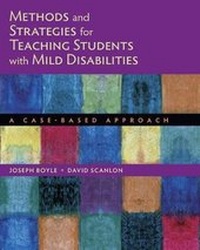
Methods and Strategies for Teaching Students with Mild Disabilities
A Case-Based Approach
Published on 2. March 2009
Book
Paperback/Softback
576 pages
978-0-618-39689-4 (ISBN)
Description
METHODS AND STRATEGIES FOR TEACHING STUDENTS WITH MILD DISABILITIES: A Case-Based Approach uses case studies and application activities for a more focused and integrated approach to teaching K-12 special education teaching methods. The case study approach is a distinctive feature of this program-with both text case studies and video case studies in each chapter. The text provides a special emphasis on teaching children with mild to moderate disabilities such as ADHD, learning disabilities, mild mental retardation, and emotional/behavioral disorders.
More details
Edition
New edition
Language
English
Place of publication
Belmont, CA
United States
Publishing group
Cengage Learning, Inc
Target group
College/higher education
Edition type
New edition
Dimensions
Height: 22 mm
Width: 203 mm
Thickness: 254 mm
Weight
998 gr
ISBN-13
978-0-618-39689-4 (9780618396894)
Copyright in bibliographic data and cover images is held by Nielsen Book Services Limited or by the publishers or by their respective licensors: all rights reserved.
Schweitzer Classification
Other editions
New editions
Joseph Boyle | David Scanlon
Methods and Strategies for Teaching Students with High Incidence Disabilities
Book
01/2018
2nd Edition
Wadsworth Publishing Co Inc
€149.50
Shipment within 10-15 days
Persons
Joseph R. Boyle (Ph.D., Special Education, University of Kansas) is an associate professor of special education at Temple University in Philadelphia, Pennsylvania. He has taught or currently teaches students in undergraduate to doctoral programs that include courses in: methods and materials for special education, collaboration and consultation, introduction to special education and special education law, assessment in special education, special education behavioral management, language disabilities, critical issues in special education, and technology in special education classrooms. Dr. Boyle is also a former special education teacher. In his classroom and other settings, he taught students with high incidence disabilities (e.g., learning disabilities, mild to moderate intellectual disabilities, traumatic brain injury, attention deficit/hyperactivity disorder, autism, and Asperger's syndrome). In addition, he collaborated and co-taught with general education teachers and other school professionals. Through research, he has developed a number of classroom interventions for students with high incidence disabilities in the areas of reading, writing, and note-taking. He has co-authored four special education casebooks and numerous journal articles. David Scanlon (Ph.D., Special Education and Rehabilitation, University of Arizona) is an associate professor of special education in the Lynch School of Education at Boston College. He teaches courses to undergraduate and doctoral students, including introductory special education, special education methods for regular education teachers, methods for special education teachers of students with mild disabilities, and investigations into scientific and social theories on the nature of learning disabilities and special education practice. Dr. Scanlon is a former high school and community college special education teacher. He has also worked as an assistant research scientist at the University of Kansas Center for Research on Learning (CRL), where he and his colleagues developed strategic interventions appropriate to the inclusive content-area classroom context. While at the CRL, Dr. Scanlon served as director of intervention research for the National Adult Literacy and Learning Disabilities Center. Today, he continues to research effective interventions for children and adolescents with mild disabilities, including focuses on content-area literacy and transition. He has co-authored several learning strategies, in addition to curricular materials and nearly 50 research publications and book chapters.
Content
1. Providing Special Education to Students with Mild Disabilities.
2. Planning, Teaching, and Monitoring Instruction.
3. Learning Theories: Past and Present.
4. Oral Language: Strategies and Techniques.
5. Early Reading: Strategies and Techniques.
6. Later Reading: Strategies and Techniques.
7. Written Language: Strategies and Techniques.
8. Math: Strategies and Techniques.
9. Content Areas: Strategies and Techniques.
10. Organization and Study Skills: Strategies and Techniques.
11. Technology and Teaching.
12. Transitions.
13. Collaboration and Co-Teaching to Enhance Instruction.
14. Working with Families.
2. Planning, Teaching, and Monitoring Instruction.
3. Learning Theories: Past and Present.
4. Oral Language: Strategies and Techniques.
5. Early Reading: Strategies and Techniques.
6. Later Reading: Strategies and Techniques.
7. Written Language: Strategies and Techniques.
8. Math: Strategies and Techniques.
9. Content Areas: Strategies and Techniques.
10. Organization and Study Skills: Strategies and Techniques.
11. Technology and Teaching.
12. Transitions.
13. Collaboration and Co-Teaching to Enhance Instruction.
14. Working with Families.