

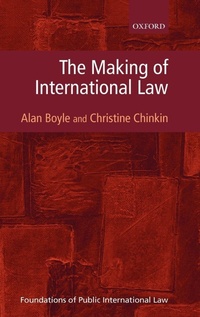
The Making of International Law
Published on 22. February 2007
Book
Hardback
368 pages
978-0-19-924819-3 (ISBN)
Description
This is a study of the principal negotiating processes and law-making tools through which contemporary international law is made. It does not seek to give an account of the traditional - and untraditional - sources and theories of international law, but rather to identify the processes, participants and instruments employed in the making of international law. It accordingly examines some of the mechanisms and procedures whereby new rules of law are created or old rules are amended or abrogated. It concentrates on the UN, other international organisations, diplomatic conferences, codification bodies, NGOs, and courts.
Every society perceives the need to differentiate between its legal norms and other norms controlling social, economic and political behaviour. But unlike domestic legal systems where this distinction is typically determined by constitutional provisions, the decentralised nature of the international legal system makes this a complex and contested issue. Moreover, contemporary international law is often the product of a subtle and evolving interplay of law-making instruments, both binding and non-binding, and of customary law and general principles. Only in this broader context can the significance of so-called 'soft law' and multilateral treaties be fully appreciated.
An important question posed by any examination of international law-making structures is the extent to which we can or should make judgments about their legitimacy and coherence, and if so in what terms. Put simply, a law-making process perceived to be illegitimate or incoherent is more likely to be an ineffective process. From this perspective, the assumption of law-making power by the UN Security Council offers unique advantages of speed and universality, but it also poses a particular challenge to the development of a more open and participatory process observable in other international law-making bodies.
Every society perceives the need to differentiate between its legal norms and other norms controlling social, economic and political behaviour. But unlike domestic legal systems where this distinction is typically determined by constitutional provisions, the decentralised nature of the international legal system makes this a complex and contested issue. Moreover, contemporary international law is often the product of a subtle and evolving interplay of law-making instruments, both binding and non-binding, and of customary law and general principles. Only in this broader context can the significance of so-called 'soft law' and multilateral treaties be fully appreciated.
An important question posed by any examination of international law-making structures is the extent to which we can or should make judgments about their legitimacy and coherence, and if so in what terms. Put simply, a law-making process perceived to be illegitimate or incoherent is more likely to be an ineffective process. From this perspective, the assumption of law-making power by the UN Security Council offers unique advantages of speed and universality, but it also poses a particular challenge to the development of a more open and participatory process observable in other international law-making bodies.
More details
Series
Language
English
Place of publication
Oxford
United Kingdom
Target group
College/higher education
Professional and scholarly
Dimensions
Height: 240 mm
Width: 161 mm
Thickness: 24 mm
Weight
719 gr
ISBN-13
978-0-19-924819-3 (9780199248193)
Copyright in bibliographic data and cover images is held by Nielsen Book Services Limited or by the publishers or by their respective licensors: all rights reserved.
Schweitzer Classification
Other editions
Additional editions
Alan Boyle | Christine Chinkin
The Making of International Law
Book
02/2007
Oxford University Press
€98.10
Shipment within 15-20 days
Alan Boyle | Christine Chinkin
The Making of International Law
E-Book
02/2007
1st Edition
OUP eBook
€57.99
Available for download
Persons
Alan Boyle is Professor of Public International Law at the University of Edinburgh. He is co-author of International Law and the Environment and was General Editor of the ICLQ from 1998 until 2006. He is a barrister and also practises in international courts and tribunals.
Christine Chinkin is Professor of International Law, LSE, Overseas Affiliated Faculty Member, University of Michigan and an academic member of Matrix Chambers. She is Director of Studies of the International Law association. Her co-authored work with Hilary Charlesworth, The Boundaries of International Law: A Feminist Analysis (2000) was awarded the American Society of International Law's Certificate of Merit for an 'outstanding contribution to scholarship.'
Christine Chinkin is Professor of International Law, LSE, Overseas Affiliated Faculty Member, University of Michigan and an academic member of Matrix Chambers. She is Director of Studies of the International Law association. Her co-authored work with Hilary Charlesworth, The Boundaries of International Law: A Feminist Analysis (2000) was awarded the American Society of International Law's Certificate of Merit for an 'outstanding contribution to scholarship.'
Content
1. Introduction ; 2. Participants in International Law-making ; 3. Multilateral Law-making Processes ; 4. Codification and Progressive Development of International law ; 5. Law-making Instruments ; 6. The Role of Courts