

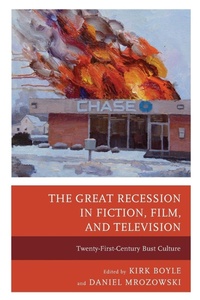
The Great Recession in Fiction, Film, and Television
Twenty-First-Century Bust Culture
Published on 26. August 2015
Book
Paperback/Softback
296 pages
978-1-4985-2062-1 (ISBN)
Description
The Great Recession in Fiction, Film, and Television: Twenty-First-Century Bust Culture sheds light on how imaginary works of fiction, film, and television reflect, refract, and respond to the recessionary times specific to the twenty-first century, a sustained period of economic crisis that has earned the title the "Great Recession." This collection takes as its focus "Bust Culture," a concept that refers to post-crash popular culture, specifically the kind mass produced by multinational corporations in the age of media conglomeration, which is inflected by diminishment, influenced by scarcity, and infused with anxiety.
The multidisciplinary contributors collected here examine mass culture not typically included in discussions of the financial meltdown, from disaster films to reality TV hoarders, the horror genre to reactionary representations of women, Christian right radio to Batman, television characters of color to graphic novels and literary fiction. The collected essays treat our busted culture as a seismograph that registers the traumas of collapse, and locate their pop artifacts along a spectrum of ideological fantasies, social erasures, and profound fears inspired by the Great Recession. What they discover from these unlikely indicators of the recession is a mix of regressive, progressive, and bemused texts in need of critical translation.
The multidisciplinary contributors collected here examine mass culture not typically included in discussions of the financial meltdown, from disaster films to reality TV hoarders, the horror genre to reactionary representations of women, Christian right radio to Batman, television characters of color to graphic novels and literary fiction. The collected essays treat our busted culture as a seismograph that registers the traumas of collapse, and locate their pop artifacts along a spectrum of ideological fantasies, social erasures, and profound fears inspired by the Great Recession. What they discover from these unlikely indicators of the recession is a mix of regressive, progressive, and bemused texts in need of critical translation.
Reviews / Votes
The Great Recession in Fiction, Film, and Television is a welcome addition the cultural analysis of the 2007 economic meltdown. It is an astutely edited volume that shows how "bust culture" became a textual emphasis in all manner of productions: film, fiction, television, and art. This is vital reading for those who are interested in how focal economic events become the material of textual expression. -- Stanley Corkin, University of CincinnatiMore details
Language
English
Place of publication
United States
Publishing group
Bloomsbury Publishing Plc
Target group
Professional and scholarly
Dimensions
Height: 229 mm
Width: 152 mm
Thickness: 18 mm
Weight
484 gr
ISBN-13
978-1-4985-2062-1 (9781498520621)
Copyright in bibliographic data and cover images is held by Nielsen Book Services Limited or by the publishers or by their respective licensors: all rights reserved.
Schweitzer Classification
Other editions
Additional editions
The Great Recession in Fiction, Film, and Television
Twenty-First-Century Bust Culture
E-Book
10/2013
1st Edition
Lexington Books
€61.99
Available for download
The Great Recession in Fiction, Film, and Television
Twenty-First-Century Bust Culture
E-Book
10/2013
1st Edition
Lexington Books
€61.99
Available for download
Persons
Kirk Boyle is a visiting assistant professor in the Department of Literature and Language at the University of North Carolina Asheville.
Dan Mrozowski is a visiting assistant professor in the English Department at Trinity College in Hartford, CT, where he teaches courses in American literature, critical theory, and crime fiction.
Dan Mrozowski is a visiting assistant professor in the English Department at Trinity College in Hartford, CT, where he teaches courses in American literature, critical theory, and crime fiction.
Content
Introduction: Creative Documentation of Creative Destruction
Kirk Boyle and Daniel Mrozowski
Section I: Film
Chapter 1: The Imagination of Economic Disaster: Eco-Catastrophe Films of the
Great Recession
Kirk Boyle
Chapter 2: Real-to-Reel Recessionary Horrors in Drag Me to Hell and Contagion
April Miller
Chapter 3: Horror at the Homestead: The (Re)possession of American Property in Paranormal Activity and Paranormal Activity II
James Stone
Section II: Fiction
Chapter 4: "We are the walking dead": Zombie Literature in Recession-Era America
Lance Rubin
Chapter 5: "Crash Fiction": American Literary Novels of the Global Financial Crisis
Daniel Mattingly
Chapter 6: Mommy Porn, More or Less: Fifty Shades of Grey and Conservative Feminism in the New Economy
Sarah Domet
Section III: Television
Chapter 7: And They Lived Happily Ever After...Or Not at All: (Un)Imagining African Americans in Recession-Era Popular Culture
Maryann Erigha
Chapter 8: Latino Liminality, Exclusion and Erasure in Great Recession Television: The Case of Treme and Friday Night Lights
Charli Valdez
Chapter 9: Masters, Servants, and the Effaced Middle Classes of Downton Abbey, The Dark Knight Rises, and Falling Skies
Jesseca Cornelson
Chapter 10: From Hoarders to Pickers: Salvage Aesthetics and Reality Television in The Great Recession
Daniel Mrozowski
Section IV: Multimedia
Chapter 11: Congress at the Kitchen Table: Religious Right Applications of Moral Home Economics to Federal Economic Policy
Rebecca Barrett-Fox
Chapter 12: Graphic Radicals: Understanding the Crash and the Art of Resistance
Sarah Hamblin
Kirk Boyle and Daniel Mrozowski
Section I: Film
Chapter 1: The Imagination of Economic Disaster: Eco-Catastrophe Films of the
Great Recession
Kirk Boyle
Chapter 2: Real-to-Reel Recessionary Horrors in Drag Me to Hell and Contagion
April Miller
Chapter 3: Horror at the Homestead: The (Re)possession of American Property in Paranormal Activity and Paranormal Activity II
James Stone
Section II: Fiction
Chapter 4: "We are the walking dead": Zombie Literature in Recession-Era America
Lance Rubin
Chapter 5: "Crash Fiction": American Literary Novels of the Global Financial Crisis
Daniel Mattingly
Chapter 6: Mommy Porn, More or Less: Fifty Shades of Grey and Conservative Feminism in the New Economy
Sarah Domet
Section III: Television
Chapter 7: And They Lived Happily Ever After...Or Not at All: (Un)Imagining African Americans in Recession-Era Popular Culture
Maryann Erigha
Chapter 8: Latino Liminality, Exclusion and Erasure in Great Recession Television: The Case of Treme and Friday Night Lights
Charli Valdez
Chapter 9: Masters, Servants, and the Effaced Middle Classes of Downton Abbey, The Dark Knight Rises, and Falling Skies
Jesseca Cornelson
Chapter 10: From Hoarders to Pickers: Salvage Aesthetics and Reality Television in The Great Recession
Daniel Mrozowski
Section IV: Multimedia
Chapter 11: Congress at the Kitchen Table: Religious Right Applications of Moral Home Economics to Federal Economic Policy
Rebecca Barrett-Fox
Chapter 12: Graphic Radicals: Understanding the Crash and the Art of Resistance
Sarah Hamblin