

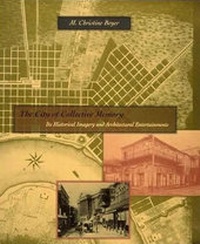
The City of Collective Memory
Its Historical Imagery and Architectural Entertainments
Published on 2. November 1994
Book
Hardback
572 pages
978-0-262-02371-9 (ISBN)
Description
Christine Boyer faces head-on the crisis of the city in the late twentieth century, taking us on a fascinating journey through theaters and museums, panoramas and maps, buildings and institutions that are used to construct a new reading of the city as a system of representation, a complex cultural entity. Boyer brings together elements and concepts from geography, critical theory, architecture, literature, and painting in a synthetic and readable work that is broad in its reach and original in its insights. What finally emerges is a sense of the city reinvigorated with richness and potential.
The City of Collective Memory describes a series of different visual and mental models by which the urban environment has been recognized, depicted, and planned. Boyer identifies three major 'maps': one common to the traditional city -- the city as a work of art; one characteristic of the modern city -- the city as panorama; and one appropriate to the contemporary city -- the city as spectacle. It is a richly illustrated and documented study that pays considerable attention to the normally hidden and unspoken codes that regulate the order imposed on and derived from the city. A wide range of secondary historical literature and theoretical work is considered, with evident debts to structuralist analysis of urban form represented by Aldo Rossi, as well to much post-structuralist criticism from Walter Benjamin to the present.
The City of Collective Memory describes a series of different visual and mental models by which the urban environment has been recognized, depicted, and planned. Boyer identifies three major 'maps': one common to the traditional city -- the city as a work of art; one characteristic of the modern city -- the city as panorama; and one appropriate to the contemporary city -- the city as spectacle. It is a richly illustrated and documented study that pays considerable attention to the normally hidden and unspoken codes that regulate the order imposed on and derived from the city. A wide range of secondary historical literature and theoretical work is considered, with evident debts to structuralist analysis of urban form represented by Aldo Rossi, as well to much post-structuralist criticism from Walter Benjamin to the present.
More details
Language
English
Place of publication
Cambridge, Mass.
United States
Publishing group
MIT Press Ltd
Target group
College/higher education
Professional and scholarly
Illustrations
65
Dimensions
Height: 236 mm
Width: 187 mm
Thickness: 38 mm
Weight
1384 gr
ISBN-13
978-0-262-02371-9 (9780262023719)
Copyright in bibliographic data and cover images is held by Nielsen Book Services Limited or by the publishers or by their respective licensors: all rights reserved.
Schweitzer Classification