

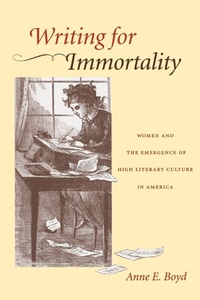
Writing for Immortality
Women and the Emergence of High Literary Culture in America
Published on 26. February 2010
Book
Paperback/Softback
326 pages
978-0-8018-9401-5 (ISBN)
Description
Before the Civil War, American writers such as Catharine Maria Sedgwick and Harriet Beecher Stowe had established authorship as a respectable profession for women. But though they had written some of the most popular and influential novels of the century, they accepted the taboo against female writers, regarding themselves as educators and businesswomen. During and after the Civil War, some women writers began to challenge this view, seeing themselves as artists writing for themselves and for posterity. Writing for Immortality studies the lives and works of four prominent members of the first generation of American women who strived for recognition as serious literary artists: Louisa May Alcott, Elizabeth Stuart Phelps, Elizabeth Stoddard, and Constance Fenimore Woolson. Combining literary criticism and cultural history, Anne E. Boyd examines how these authors negotiated the masculine connotation of "artist," imagining a space for themselves in the literary pantheon.
Redrawing the boundaries between male and female literary spheres, and between American and British literary traditions, Boyd shows how these writers rejected the didacticism of the previous generation of women writers and instead drew their inspiration from the most prominent "literary" writers of their day: Emerson, James, Barrett Browning, and Eliot. Placing the works and experiences of Alcott, Phelps, Stoddard, and Woolson within contemporary discussions about "genius" and the "American artist," Boyd reaches a sobering conclusion. Although these women were encouraged by the democratic ideals implicit in such concepts, they were equally discouraged by lingering prejudices about their applicability to women.
Redrawing the boundaries between male and female literary spheres, and between American and British literary traditions, Boyd shows how these writers rejected the didacticism of the previous generation of women writers and instead drew their inspiration from the most prominent "literary" writers of their day: Emerson, James, Barrett Browning, and Eliot. Placing the works and experiences of Alcott, Phelps, Stoddard, and Woolson within contemporary discussions about "genius" and the "American artist," Boyd reaches a sobering conclusion. Although these women were encouraged by the democratic ideals implicit in such concepts, they were equally discouraged by lingering prejudices about their applicability to women.
Reviews / Votes
Scholars interested in examining the contributions of 19th-century women writers to American literature will appreciate the fresh perspective offered here. Choice 2005 Radically expands the literary world of nineteenth-century American women, considering them in conversation with European women writers as well as male writers in Europe and America. -- Renee Bergland American Literature 2005 Boyd's close textual work gives the reader a valuable introduction to the work and lives of these four authors. -- Martha Saxton Journal of American History 2005 Boyd successfully reconstructs the era through an examination of the historical evidence, ranging from letters, diaries, reviews, essays, and literary social events, and close readings of the fiction of Alcott, Phelps, Stoddard, and Woolson to demonstrate that these pioneering artists took an active role in contemporary discussions on the nature of genius and art. -- Felicia L. Carr Legacy: Journal of American Women Writers 2005 A comprehensively researched and impressively detailed study. -- Annamaria Formichella Elsden Journal of the Midwest Modern Language Association 2005 A highly satisfying analysis of the contexts within which women's literary ambitions shifted and the sensibilities of the male literary elite were forcefully challenged. -- Mary Rigsby Tulsa Studies in Women's Literature 2005 Boyd offers a multi-layered thesis in this important book. -- Claire Brock Journal of American Studies 2006 Well written and appealingly produced, it is a thoughtful contribution to the field of late-nineteenth-century American literature and to the women, men, and above all institutions that produced it. -- Susan K. Harris American Literary Realism 2006More details
Language
English
Place of publication
Baltimore, MD
United States
Target group
Professional and scholarly
Product notice
Paperback (trade)
Illustrations
8 s/w Photographien bzw. Rasterbilder
8 Halftones, black and white
Dimensions
Height: 229 mm
Width: 152 mm
Thickness: 19 mm
Weight
531 gr
ISBN-13
978-0-8018-9401-5 (9780801894015)
DOI
10.1353/book.60155
Copyright in bibliographic data and cover images is held by Nielsen Book Services Limited or by the publishers or by their respective licensors: all rights reserved.
Schweitzer Classification
Other editions
Additional editions
E-Book
02/2010
Johns Hopkins University Press
€24.99
Available for download
Book
09/2004
Johns Hopkins University Press
€64.00
Article not available for order
Person
Anne E. Boyd is an associate professor of English and women's studies at the University of New Orleans and editor of Wielding the Pen: Writings on Authorship by American Women of the Nineteenth Century, also published by Johns Hopkins.
Content
Acknowledgments
Introduction: New Ambitions
1. Solving the ''old riddle of the Sphinx'': Discovering the Self as Artist
2. ''Prov[ing] Avis in the Wrong'': The Lives of Women Artists
3. ''The crown and the thorn of gifted life'': Imagining the Woman Artist
4. ''Recognition is the thing'': Seeking the Status of Artist
Conclusion: The Question of Immortality
Chronology
Notes
Bibliography Essay
Index
Introduction: New Ambitions
1. Solving the ''old riddle of the Sphinx'': Discovering the Self as Artist
2. ''Prov[ing] Avis in the Wrong'': The Lives of Women Artists
3. ''The crown and the thorn of gifted life'': Imagining the Woman Artist
4. ''Recognition is the thing'': Seeking the Status of Artist
Conclusion: The Question of Immortality
Chronology
Notes
Bibliography Essay
Index