

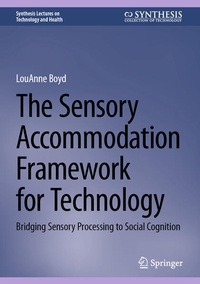
The Sensory Accommodation Framework for Technology
Bridging Sensory Processing to Social Cognition
Published on 3. January 2024
Book
Hardback
XII, 124 pages
978-3-031-48842-9 (ISBN)
Description
This book provides a thorough introduction to the many facets of designing technologies for autism, with a particular focus on optimizing visual attention frameworks. This book is designed to provide a detailed overview of several aspects of technology for autism. Each Chapter illustrates different parts of the Sensory Accommodation Framework and provides examples of relevant available technologies. The books first discusses a variety of skills that make up human development as well as a history of autism as a diagnosis and the birth of the neurodiversity movement. It goes on to detail individual types of therapy and how they interact with autism. The systems involved in sensory processing and their specific relation to autism are then explored, including through technologies that have addressed these areas and applications for designers. Readers will learn about designing sensory environments and sensory interactions, such as through virtual reality. This book places a needed emphasis on the hierarchy of information in technology development by exploring visual attention in neurodivergent conditions like autism, ADHD, and dyslexia. It also delves into the relationship between sensory perception and nonverbal communication, the bridge between sensory input and social behavior, and dynamic information. The discussion is rounded out with examinations of temporal processing as and multisensory integration as complicating factors that have existing technological solutions. Finally, the book closes with a summary of the sensory accommodation framework in respect to how each layer offers different user experience goals and specific mechanisms to promote those goals. Readers from a variety of research backgrounds will find this book informative and useful, while designers will learn essential skills for effectively designing autism technologies.
Reviews / Votes
"The book consists of eight chapters. Dr. Boyd uses multiple versions of a "learning cone" graphic organizer throughout the book to develop and depict the design guidelines for the sensory accommodation framework. Figures and mock-ups are sprinkled throughout to show what she means. References at the end of each chapter support what she knows. ... I appreciate this reframe." (Ernest Hughes, Computing Reviews, June 2, 2025)
More details
Series
Edition
2024 ed.
Language
English
Place of publication
Cham
Switzerland
Publishing group
Springer International Publishing
Target group
Professional and scholarly
Illustrations
4 s/w Abbildungen, 32 farbige Abbildungen
XII, 124 p. 36 illus., 32 illus. in color.
Dimensions
Height: 246 mm
Width: 173 mm
Thickness: 14 mm
Weight
417 gr
ISBN-13
978-3-031-48842-9 (9783031488429)
DOI
10.1007/978-3-031-48843-6
Schweitzer Classification
Other editions
Additional editions
LouAnne Boyd
The Sensory Accommodation Framework for Technology
Bridging Sensory Processing to Social Cognition
Book
01/2025
Springer
€42.79
Shipment within 15-20 days
LouAnne Boyd
The Sensory Accommodation Framework for Technology
Bridging Sensory Processing to Social Cognition
E-Book
01/2024
1st Edition
Springer
€42.79
Available for download
Person
Dr. LouAnne Boyd is an Assistant Professor of Computer Science at Chapman University, Her research interests center around the design, development, and evaluation of novel technologies to support neurodiverse populations. Her current projects investigate the efficacy of a new interaction design framework drawn from neuroscience theories to accommodation sensory processing impairments. Specific projects under investigation include the development of technologies to increase the accessibility of information for people with autism, ADHD, anxiety, bipolar, or dyslexia.
Content
Chapter 1: Introduction to Autism for Assistive Technologists.- Chapter 2: Technologies Across the Disciplines for Autistic Users.- Chapter 3: Sensory Processing in Autism.- Chapter 4: Designing Sensory Environments and Sensory Interactions in Virtual Reality.- Chapter 5: The Hierarchy of Visual Attention in Natural Scenes.- Chapter 6: From Sensory Perception to Realtime NonVerbal Communication.- Chapter 7: Timing is Everything: Temporal Processing and MultiSensory Integration.- Chapter 8: Neuro-Inclusive Design Considerations for Assistive and Accessible Technologies and Beyond.