

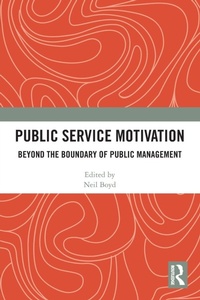
Public Service Motivation
Beyond the Boundary of Public Management
1st Edition
Published on 6. May 2025
Book
Paperback/Softback
204 pages
978-1-032-61768-8 (ISBN)
Description
This book evaluates public service motivation (PSM) within the milieu of a broader conceptual and theoretical landscape beyond public management with a primary focus in management and the social sciences.
As the literature around public management has evolved, scholars have suggested that PSM can direct applicants toward public service-oriented careers, and once hired, many have posited that PSM is linked to psychological outcomes and behavioral activity within public service-oriented organizations. Although some scholars have attempted to characterize and study PSM in relation to concepts outside of public management, the vast majority of scholarship has been grounded specifically in the public management literature. This is true when characterizing PSM as a factor that relates to career choice as well as a predictor of motivated states once one occupies a role within an organization. Given its continued vigor and its legitimacy, it could be argued that in recent decades, PSM has indeed become one of the most prominent concepts in public management. This book will be of interest to researchers and students in the fields of public management and public administration, as well as to policy makers and public service managers.
The chapters in this book were originally published in Public Management Review.
As the literature around public management has evolved, scholars have suggested that PSM can direct applicants toward public service-oriented careers, and once hired, many have posited that PSM is linked to psychological outcomes and behavioral activity within public service-oriented organizations. Although some scholars have attempted to characterize and study PSM in relation to concepts outside of public management, the vast majority of scholarship has been grounded specifically in the public management literature. This is true when characterizing PSM as a factor that relates to career choice as well as a predictor of motivated states once one occupies a role within an organization. Given its continued vigor and its legitimacy, it could be argued that in recent decades, PSM has indeed become one of the most prominent concepts in public management. This book will be of interest to researchers and students in the fields of public management and public administration, as well as to policy makers and public service managers.
The chapters in this book were originally published in Public Management Review.
More details
Language
English
Place of publication
London
United Kingdom
Publishing group
Taylor & Francis Ltd
Target group
College/higher education
Postgraduate and Undergraduate
Dimensions
Height: 234 mm
Width: 156 mm
Thickness: 12 mm
Weight
339 gr
ISBN-13
978-1-032-61768-8 (9781032617688)
Copyright in bibliographic data and cover images is held by Nielsen Book Services Limited or by the publishers or by their respective licensors: all rights reserved.
Schweitzer Classification
Other editions
Additional editions
E-Book
12/2023
1st Edition
Taylor & Francis
€60.49
Available for download
Book
12/2023
1st Edition
Routledge
€206.20
Shipment within 10-20 days
E-Book
12/2023
1st Edition
Taylor & Francis
€60.49
Available for download
Person
This book evaluates public service motivation (PSM) within the milieu of a broader conceptual and theoretical landscape beyond public management with a primary focus in management and the social sciences.
As the literature around public management has evolved, scholars have suggested that PSM can direct applicants toward public service-oriented careers, and once hired, many have posited that PSM is linked to psychological outcomes and behavioral activity within public service-oriented organizations. Although some scholars have attempted to characterize and study PSM in relation to concepts outside of public management, the vast majority of scholarship has been grounded specifically in the public management literature. This is true when characterizing PSM as a factor that relates to career choice as well as a predictor of motivated states once one occupies a role within an organization. Given its continued vigor and its legitimacy, it could be argued that in recent decades, PSM has indeed become one of the most prominent concepts in public management. This book will be of interest to researchers and students in the fields of public management and public administration, as well as to policy makers and public service managers.
The chapters in this book were originally published in Public Management Review.
As the literature around public management has evolved, scholars have suggested that PSM can direct applicants toward public service-oriented careers, and once hired, many have posited that PSM is linked to psychological outcomes and behavioral activity within public service-oriented organizations. Although some scholars have attempted to characterize and study PSM in relation to concepts outside of public management, the vast majority of scholarship has been grounded specifically in the public management literature. This is true when characterizing PSM as a factor that relates to career choice as well as a predictor of motivated states once one occupies a role within an organization. Given its continued vigor and its legitimacy, it could be argued that in recent decades, PSM has indeed become one of the most prominent concepts in public management. This book will be of interest to researchers and students in the fields of public management and public administration, as well as to policy makers and public service managers.
The chapters in this book were originally published in Public Management Review.
Content
1. Disentangling altruism and public service motivation: who exhibits organizational citizenship behaviour?2. Public service motivation and prosocial motivation: two sides of the same coin? 3. Motivated to act and take responsibility - integrating insights from community psychology in PSM research 4. Sense of community, sense of community responsibility, organizational commitment and identification, and public service motivation: a simultaneous test of affective states on employee well-being and engagement in a public service work context 5. Attraction and attrition under extreme conditions- integrating insights on PSM, SOC-R, SOC and excitement motivation 6. Crowding-in or crowding-out: the contribution of self-determination theory to public service motivation 7. A view into managers' subjective experiences of public service motivation and work engagement: a qualitative study 8. Does performance-related pay and public service motivation research treat state-owned enterprises like a neglected Cinderella? A systematic literature review and agenda for future research on performance effects