

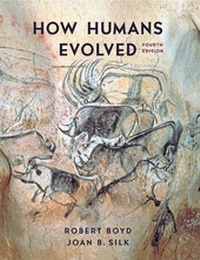
How Humans Evolved
Published on 11. November 2005
Book
Paperback/Softback
550 pages
978-0-393-92628-6 (ISBN)
Description
Robert Boyd and Joan B. Silk bring their respective specialties
to the groundbreaking Fourth Edition of How Humans
Evolved. Using the broad perspective of behavioral
ecology?how human behavior has been influenced by the
evolutionary process?the authors offer a balanced discussion,
drawing on updated coverage of the human fossil record. The
well-structured pedagogical framework of the text, with its
emphasis on overarching ideas, makes the material accessible to
introductory students.
New Science and Recent Discoveries
The Fourth Edition integrates discussions of new science and
recent discoveries into the narrative. Highlights of the Fourth
Edition include:
Updating of the fossil record to reflect the most current
scholarship.
Expanded coverage of gene regulation and cell differentiation
during development.
Discussion of life history theory linked with the evolution of
primates? cognitive abilities.
New data on the origin of primates, the New World primate
radiation, and Miocene apes.
New data on global paleoclimates; new research by McLarnon on
Homo ergaster?s lack of speech.
New discussion of recent works by Christopher Dean on rates of
development in extinct hominins.
New sections on the Herto fossils and what genetic sequence
data can tell us about human evolution.
Revised sections that provide a more integrated view of human
diversity and contemporary human behavior.
New examination of how evolution has shaped the psychology
underlying decisions about mating and parenting and new analysis of
human behavior toward mates and children.
Excellent Art Program
The art program in How Humans Evolved clearly
demonstrates the relationships between fossils. All of the
comparative drawings are pictured with the same orientation and
consistent scale throughout the book.
A Responsive Revision
For the Fourth Edition, the authors have responded to feedback
from the hundreds of instructors across the country already using
How Humans Evolved and have streamlined the text into 17
chapters.
to the groundbreaking Fourth Edition of How Humans
Evolved. Using the broad perspective of behavioral
ecology?how human behavior has been influenced by the
evolutionary process?the authors offer a balanced discussion,
drawing on updated coverage of the human fossil record. The
well-structured pedagogical framework of the text, with its
emphasis on overarching ideas, makes the material accessible to
introductory students.
New Science and Recent Discoveries
The Fourth Edition integrates discussions of new science and
recent discoveries into the narrative. Highlights of the Fourth
Edition include:
Updating of the fossil record to reflect the most current
scholarship.
Expanded coverage of gene regulation and cell differentiation
during development.
Discussion of life history theory linked with the evolution of
primates? cognitive abilities.
New data on the origin of primates, the New World primate
radiation, and Miocene apes.
New data on global paleoclimates; new research by McLarnon on
Homo ergaster?s lack of speech.
New discussion of recent works by Christopher Dean on rates of
development in extinct hominins.
New sections on the Herto fossils and what genetic sequence
data can tell us about human evolution.
Revised sections that provide a more integrated view of human
diversity and contemporary human behavior.
New examination of how evolution has shaped the psychology
underlying decisions about mating and parenting and new analysis of
human behavior toward mates and children.
Excellent Art Program
The art program in How Humans Evolved clearly
demonstrates the relationships between fossils. All of the
comparative drawings are pictured with the same orientation and
consistent scale throughout the book.
A Responsive Revision
For the Fourth Edition, the authors have responded to feedback
from the hundreds of instructors across the country already using
How Humans Evolved and have streamlined the text into 17
chapters.
More details
Language
English
Place of publication
New York
United States
Target group
College/higher education
Illustrations
Illustrations, ports.
Weight
1127 gr
ISBN-13
978-0-393-92628-6 (9780393926286)
Copyright in bibliographic data and cover images is held by Nielsen Book Services Limited or by the publishers or by their respective licensors: all rights reserved.
Schweitzer Classification