

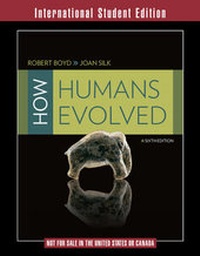
How Humans Evolved
6th Edition
Published on 17. January 2012
Book
Paperback/Softback
480 pages
978-0-393-91335-4 (ISBN)
Description
How Humans Evolved remains the most up-to-date, forward-looking book in physical anthropology. Through a unique and balanced blend of evolutionary theory, population genetics, and behavioral ecology, the authors move beyond merely describing anthropological "finds" to showing students the big picture about how humans lived in the past and why they have evolved into the people they are today. The fully revised and updated Sixth Edition offers the best of current research, including important new coverage of Ardipithecus, the Neanderthal genome, early complex tool-making and symbolic behavior, and much more.
More details
Edition
Sixth International Student Edition
Language
English
Place of publication
New York
United States
Target group
College/higher education
Edition type
Revised edition
Dimensions
Height: 277 mm
Width: 218 mm
Thickness: 18 mm
Weight
973 gr
ISBN-13
978-0-393-91335-4 (9780393913354)
Copyright in bibliographic data and cover images is held by Nielsen Book Services Limited or by the publishers or by their respective licensors: all rights reserved.
Schweitzer Classification
Other editions
Previous edition

Robert Boyd | Joan B. Silk
How Humans Evolved
Book
08/2010
WW Norton & Co
€69.51
Article exhausted; check for reprint
Persons
Robert Boyd has written widely on evolutionary theory, focusing especially on the evolution of cooperation and the role of culture in human evolution. His book Culture and the Evolutionary Process received the J. I. Staley Prize, and he has also published numerous articles in scientific journals and edited volumes. Boyd is currently the Origins Professor in the School of Evolution and Social Change at Arizona State University. Joan B. Silk has conducted extensive research on the social lives of monkeys and apes, including extended fieldwork on chimpanzees at Gombe Stream Reserve in Tanzania and on baboons in Kenya and Botswana. She is also interested in the application of evolutionary thinking to human behavior. She has published numerous articles in scientific journals and edited volumes. She is currently a professor in the School of Evolution and Social Change at Arizona State University.
Content
Part One - How Evolution Works
Chapter 1: Adaptation by Natural Selection
Chapter 2: Genetics
Chapter 3: the Modern Synthesis
Chapter 4: Speciation and Phylogeny
Part Two - Primate Ecology and Behavior
Chapter 5: Primate Diversity and Ecology
Chapter 6: Primate Mating Systems
Chapter 7: The Evolution of Cooperation
Chapter 8: Primate Life Histories and the Evolution of
Intelligence
Part Three - the History of the Human Lineage
Chapter 9: From Tree Shrew to Ape
Chapter 10: From Hominoid to Hominin
Chapter 11: Oldowan Toolmakers and the Origin of Human Life
History
Chapter 12: From Hominin to Homo
Chapter 13: Homo sapiens and the Evolution of Modern Human
Behavior
Part Four - Evolution and Modern Humans
Chapter 14: Human Genetic Variation
Chapter 15 - Evolution and Human Behavior
Chapter 16 - Human Mate Choice and Parenting
Chapter 1: Adaptation by Natural Selection
Chapter 2: Genetics
Chapter 3: the Modern Synthesis
Chapter 4: Speciation and Phylogeny
Part Two - Primate Ecology and Behavior
Chapter 5: Primate Diversity and Ecology
Chapter 6: Primate Mating Systems
Chapter 7: The Evolution of Cooperation
Chapter 8: Primate Life Histories and the Evolution of
Intelligence
Part Three - the History of the Human Lineage
Chapter 9: From Tree Shrew to Ape
Chapter 10: From Hominoid to Hominin
Chapter 11: Oldowan Toolmakers and the Origin of Human Life
History
Chapter 12: From Hominin to Homo
Chapter 13: Homo sapiens and the Evolution of Modern Human
Behavior
Part Four - Evolution and Modern Humans
Chapter 14: Human Genetic Variation
Chapter 15 - Evolution and Human Behavior
Chapter 16 - Human Mate Choice and Parenting