

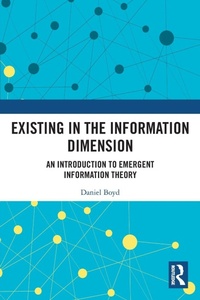
Existing in the Information Dimension
An Introduction to Emergent Information Theory
1st Edition
Published on 21. May 2026
Book
Paperback/Softback
272 pages
978-1-032-60784-9 (ISBN)
Description
This book presents new insights into the nature of the human mind as a product of the brain. It does so by discussing how biological and technological information systems differ from their counterparts with physical functions, presenting Emergent Information Theory as a solution to the mind-body problem and overarching framework for all biological and technological information systems.
Emergent Information Theory is a new theoretical approach to the specific type of information and emergence exploited by biological neural networks and digital systems. One of the conclusions of this theory is that these entities and processes are non-physical and exist in an information dimension connected to but distinct from the three dimensions of physical space. It is in this information dimension that our minds exist, making it ultimately more our home as sentient beings than the physical realm inhabited by our bodies. This book presents existing scientific and philosophical evidence that leads to this conclusion, followed by application of the theory to biological and technological information systems. The author concludes with a call to action for further research.
This fascinating text will be of interest to any researcher of consciousness, the mind-body problem, or AI, as well as those working in related areas such as physical neuroscience and systems theory.
Emergent Information Theory is a new theoretical approach to the specific type of information and emergence exploited by biological neural networks and digital systems. One of the conclusions of this theory is that these entities and processes are non-physical and exist in an information dimension connected to but distinct from the three dimensions of physical space. It is in this information dimension that our minds exist, making it ultimately more our home as sentient beings than the physical realm inhabited by our bodies. This book presents existing scientific and philosophical evidence that leads to this conclusion, followed by application of the theory to biological and technological information systems. The author concludes with a call to action for further research.
This fascinating text will be of interest to any researcher of consciousness, the mind-body problem, or AI, as well as those working in related areas such as physical neuroscience and systems theory.
More details
Language
English
Place of publication
London
United Kingdom
Publishing group
Taylor & Francis Ltd
Target group
College/higher education
Postgraduate
Illustrations
37 farbige Abbildungen, 37 farbige Zeichnungen
37 Line drawings, color; 37 Illustrations, color
Dimensions
Height: 234 mm
Width: 156 mm
Weight
500 gr
ISBN-13
978-1-032-60784-9 (9781032607849)
Copyright in bibliographic data and cover images is held by Nielsen Book Services Limited or by the publishers or by their respective licensors: all rights reserved.
Schweitzer Classification
Other editions
Additional editions
E-Book
09/2024
1st Edition
Routledge
€60.49
Available for download
Book
09/2024
1st Edition
Routledge
€196.10
Shipment within 10-20 days
E-Book
09/2024
1st Edition
Routledge
€60.49
Available for download
Person
Daniel Boyd is an independent researcher living in the Netherlands developing Emergent Information Theory as a theoretical approach to biological and technological information systems. He is currently a member of the Board of IS4SI (International Society for the Study of Information).
Content
Part 1: The evidence: Pieces of the puzzle 1.1 Information and the physical 1.2 Systems theory 1.3 Biological information systems 1.4 Philosophy and religion 1.5 Technological information systems Part 2: Conclusion: The origins and growth of the information dimension 2.1 Emergent Information Theory: an introduction 2.2 Biological information systems 2.3 Information technologies Part 3: Discussion: Living with the consequences 3.1 Existing in the information dimension 3.2 The gamble evolution took 3.3 Determinism and free will 3.4 From organism to superorganism 3.5 The communal mind 3.6 Cyber-social systems and artificial consciousness 3.7 Artificial consciousness Part 4: Epilogue 4.1. Towards a science of emergent information