

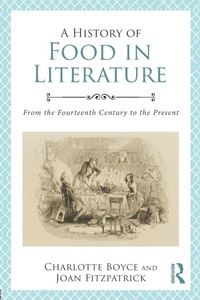
A History of Food in Literature
From the Fourteenth Century to the Present
1st Edition
Published on 23. May 2017
Book
Paperback/Softback
314 pages
978-0-415-84052-1 (ISBN)
Description
When novels, plays and poems refer to food, they are often doing much more than we might think. Recent critical thinking suggests that depictions of food in literary works can help to explain the complex relationship between the body, subjectivity and social structures. A History of Food in Literature provides a clear and comprehensive overview of significant episodes of food and its consumption in major canonical literary works from the medieval period to the twenty-first century. This volume contextualises these works with reference to pertinent historical and cultural materials such as cookery books, diaries and guides to good health, in order to engage with the critical debate on food and literature and how ideas of food have developed over the centuries.
Organised chronologically and examining certain key writers from every period, including Chaucer, Shakespeare, Austen and Dickens, this book's enlightening critical analysis makes it relevant for anyone interested in the study of food and literature.
Organised chronologically and examining certain key writers from every period, including Chaucer, Shakespeare, Austen and Dickens, this book's enlightening critical analysis makes it relevant for anyone interested in the study of food and literature.
More details
Language
English
Place of publication
London
United Kingdom
Publishing group
Taylor & Francis Ltd
Target group
College/higher education
Dimensions
Height: 234 mm
Width: 156 mm
Thickness: 17 mm
Weight
491 gr
ISBN-13
978-0-415-84052-1 (9780415840521)
Copyright in bibliographic data and cover images is held by Nielsen Book Services Limited or by the publishers or by their respective licensors: all rights reserved.
Schweitzer Classification
Other editions
Additional editions
Charlotte Boyce | Joan Fitzpatrick
A History of Food in Literature
From the Fourteenth Century to the Present
E-Book
05/2017
Routledge
€55.49
Available for download
Charlotte Boyce | Joan Fitzpatrick
A History of Food in Literature
From the Fourteenth Century to the Present
E-Book
05/2017
Routledge
€55.49
Available for download
Charlotte Boyce | Joan Fitzpatrick
A History of Food in Literature
From the Fourteenth Century to the Present
Book
05/2017
1st Edition
Routledge
€215.41
Shipment within 15-20 days
Persons
Charlotte Boyce is Senior Lecturer in English Literature at the University of Portsmouth, UK.
Joan Fitzpatrick is Senior Lecturer in English at Loughborough University, UK.
Joan Fitzpatrick is Senior Lecturer in English at Loughborough University, UK.
Content
Chapter 1: Pilgrims and partridges (1350-1550); William Langland, Piers Plowman (late 1300s); Anon., Gawain and the Green Knight (late 1300s); Geoffrey Chaucer, The Canterbury Tales (late 1300s); Margery Kempe, The Book of Margery Kempe (early 1400s); Chapter 2: Bodily health and spiritual wealth (1550-1640); Edmund Spenser, The Faerie Queene (1590 and 1596); Willliam Shakespeare, various works; Francis Beaumont and John Fletcher's The Woman Hater (1607); Ben Jonson, Valpone (1605), The Alchemist (1616) and Bartholomew Fair (1631); Chapter 3: Adventures in England and beyond its shores (1650-1750); John Milton, Paradise Lost (1667); John Milton, Paradise Regained (1671); Daniel Defoe, Robinson Crusoe (1719); Jonathan Swift, Gulliver's Travels (1729); Henry Fielding, Joseph Andrews (1742) and Tom Jones (1749); Chapter 4: Luxuxy, gluttony, domestic economy and ethical eating (1750-1830); Anon., The Tryal of the Lady Allurea Luxury (1757); Tobias Smollett, The Expedition of Humphry Clinker (1771); Robert Ferguson, 'The Farmer's Ingle' and 'To the Principal and Professors of the University of St Andrews, on Their Superb Treat to Dr Samuel Johnson' (1773); Robert Burns, 'Address to a Haggis' and 'The Cotter's Saturday Night' (1786); Charlotte Smith, Desmond (1792); Hannah More, The Way to Plenty (1795) and The Cottage Cook (1797); Mary Birkett, A Poem on the African Slave Trade (1792); Jane Austen, Sense and Sensibility (1811), Mansfield Park (1814) and Emma (1815); Percy Bysshe Shelley, Queen Mab; A Philosophical Poem with Notes and A Vindication of Natural Diet (1813); Mary Shelley, Frankenstein, or the Modern Prometheus (1818); George Gordon, Lord Byron, The Corsair (1814) and Don Juan (c. 1819-1824); John Keats, Endymion (1818), The Fall of Hyperion (written c. 1819-1821), The Eve of St. Agnes and 'La Belle Dame sans Merci' (1820); Chapter 5: 'Come buy, come buy . . . I have no copper in my purse': hunger, indulgence desire and adulteration (1830-1898); Charles Dickens, various works; William Makepeace Thackeray, Vanity Fair (1847-1848); Anne Bronte, The Tenant of Wildfell Hall (1848); Charlotte Bronte, Jane Eyre (1847) and Shirley (1849); Emily Bronte, Wuthering Heights (1847); Christina Rossetti, 'Goblin Market' (1862); George Eliot, 'Brother Jacob'; Lewis Carroll, Alice's Adventures in Wonderland (1865) and Through the Looking Glass, and Whaht Alice Found There (1871); Sarah Grand, The Beth Book, Being a Study of the Life of Elizabeth Caldwell Maclure, a Woman of Genius (1897); Chapter 6: You are what you eat?: Food and the politics of identity (1899-2003); Joseph Conrad, Heart of Darkness (1899) and 'Falk: A Reminiscence' (1903); James Joyce, Ulysses (1922); Virginia Woolf, To the Lighthouse (1927) and The Waves (1931); Angela Carter, The Magic Toyshop (1967) and Margaret Atwood, The Edible Woman (1969); Salman Rushdie, Midnight's Children (1981); Andrea Levy, Fruit of the Lemon (1999), Zadie Smith, White Teeth (2000) and Monica Ali, Brick Lane (2003); Conclusion