

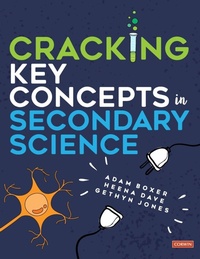
Cracking Key Concepts in Secondary Science
1st Edition
Published on 27. July 2021
Book
Hardback
336 pages
978-1-5297-1645-0 (ISBN)
Description
The perfect companion to help you crack some of secondary science's most challenging concepts in your teaching.
Secondary science teaching is a heroic task, taking some of humanity's greatest discoveries and explaining them to the next generation of students. Cracking some of the trickiest concepts in biology, chemistry and physics, with walkthrough explanations and examples inspired by direct instruction, this book will bring a fresh perspective to your teaching.
? 30 key concepts explored in depth
? Understand what students should know before and after the lesson
? Tips and tricks offer detailed advice on each topic
? Checks for understanding so you can test your students' knowledge
Adam Boxer is Head of Science at The Totteridge Academy in North London.
Heena Dave was Head of Science at Bedford Free School.
Gethyn Jones is a teacher of physics at an independent school in London
Secondary science teaching is a heroic task, taking some of humanity's greatest discoveries and explaining them to the next generation of students. Cracking some of the trickiest concepts in biology, chemistry and physics, with walkthrough explanations and examples inspired by direct instruction, this book will bring a fresh perspective to your teaching.
? 30 key concepts explored in depth
? Understand what students should know before and after the lesson
? Tips and tricks offer detailed advice on each topic
? Checks for understanding so you can test your students' knowledge
Adam Boxer is Head of Science at The Totteridge Academy in North London.
Heena Dave was Head of Science at Bedford Free School.
Gethyn Jones is a teacher of physics at an independent school in London
More details
Language
English
Place of publication
London
United Kingdom
Target group
Professional and scholarly
Primary & secondary/elementary & high school
Dimensions
Height: 241 mm
Width: 196 mm
Thickness: 23 mm
Weight
826 gr
ISBN-13
978-1-5297-1645-0 (9781529716450)
Copyright in bibliographic data and cover images is held by Nielsen Book Services Limited or by the publishers or by their respective licensors: all rights reserved.
Schweitzer Classification
Other editions
Additional editions
Adam Boxer | Heena Dave | Gethyn Jones
Cracking Key Concepts in Secondary Science
Book
07/2021
1st Edition
SAGE Publications Ltd
€56.60
Shipment within 15-20 days
Adam Boxer | Heena Dave | Gethyn Jones
Cracking Key Concepts in Secondary Science
E-Book
06/2021
1st Edition
Corwin UK
€47.99
Available for download
Adam Boxer | Heena Dave | Gethyn Jones
Cracking Key Concepts in Secondary Science
E-Book
06/2021
1st Edition
Corwin UK
€47.99
Available for download
Persons
Adam Boxer is the Head of Science at a secondary comprehensive in North London. Somewhat obsessed with educational research, he has lectured and delivered CPD nationally and internationally on evidence-based practice. Adam co-founded CogSciSci - the world's largest grassroots collective of science teachers interested in evidence based practice and was its first Managing Editor. Adam has a blog 'A chemical Orthodoxy' and tweets at @adamboxer1.
Heena Dave began her teaching career in 2011 as a teaching assistant and became Head of Science at Bedford Free School in 2015. She is passionate about putting evidence into action and built a department that put powerful science explanations at the centre of its teaching. Prior to 2011, she drove forward an agenda of evidence informed environmental decision making as a Research Manager for the Environment Agency. She is currently Head of Programmes and Partnerships at the charity Learning through Landscapes, where she is utilising her expertise of learning to influence the future of environmental education and outdoor learning.
Gethyn Jones has been a physics teacher and Head of Physics at a number of comprehensive schools and academies in Wales and England over the course of the last twenty nine years. He is a member of the Chartered College of Teaching and served on the College's council from 2018-2020. Gethyn blogs and tweets as @emc2andthat and lives and teaches in London.
Heena Dave began her teaching career in 2011 as a teaching assistant and became Head of Science at Bedford Free School in 2015. She is passionate about putting evidence into action and built a department that put powerful science explanations at the centre of its teaching. Prior to 2011, she drove forward an agenda of evidence informed environmental decision making as a Research Manager for the Environment Agency. She is currently Head of Programmes and Partnerships at the charity Learning through Landscapes, where she is utilising her expertise of learning to influence the future of environmental education and outdoor learning.
Gethyn Jones has been a physics teacher and Head of Physics at a number of comprehensive schools and academies in Wales and England over the course of the last twenty nine years. He is a member of the Chartered College of Teaching and served on the College's council from 2018-2020. Gethyn blogs and tweets as @emc2andthat and lives and teaches in London.
Content
Chapter 1: Cracking the Concepts: the components of an effective explanation
Part 1: Biology
Chapter 2: Understanding Cellular Structure and Function
Chapter 3: Biological Organisation within Complex Multicellular Organisms
Chapter 4: Magnification
Chapter 5: Enzyme Function
Chapter 6: Cellular Respiration
Chapter 7: Photosynthesis
Chapter 8: Immunity and the Immune System
Chapter 9: The heart
Chapter 10: Evolution by Natural Selection
Part 2: Chemistry
Chapter 11: Balancing equations
Chapter 12: The development of the periodic table
Chapter 13: Bonding, structure and properties
Chapter 14: The mole
Chapter 15: Electrolysis
Chapter 16: Energy changes
Chapter 17: Rates of reaction
Chapter 18: Dynamic Equilibrium
Chapter 19: Fractional distillation
Chapter 20: Life Cycle Assessment (LCA)
Part 3: Physics
Chapter 21: Introducing Energy Stores and Pathways
Chapter 22: Electric current
Chapter 23: Introduction to Forces
Chapter 24: Current and Potential Difference
Chapter 25: Waves
Chapter 26: Vectors and Compnents
Chapter 27: Pressure
Chapter 28: Forces and Newton's Laws of Motion
Chapter 29: Internal Energy and Heat Capacity
Chapter 30: Magnetism and Electromagnetism
Part 1: Biology
Chapter 2: Understanding Cellular Structure and Function
Chapter 3: Biological Organisation within Complex Multicellular Organisms
Chapter 4: Magnification
Chapter 5: Enzyme Function
Chapter 6: Cellular Respiration
Chapter 7: Photosynthesis
Chapter 8: Immunity and the Immune System
Chapter 9: The heart
Chapter 10: Evolution by Natural Selection
Part 2: Chemistry
Chapter 11: Balancing equations
Chapter 12: The development of the periodic table
Chapter 13: Bonding, structure and properties
Chapter 14: The mole
Chapter 15: Electrolysis
Chapter 16: Energy changes
Chapter 17: Rates of reaction
Chapter 18: Dynamic Equilibrium
Chapter 19: Fractional distillation
Chapter 20: Life Cycle Assessment (LCA)
Part 3: Physics
Chapter 21: Introducing Energy Stores and Pathways
Chapter 22: Electric current
Chapter 23: Introduction to Forces
Chapter 24: Current and Potential Difference
Chapter 25: Waves
Chapter 26: Vectors and Compnents
Chapter 27: Pressure
Chapter 28: Forces and Newton's Laws of Motion
Chapter 29: Internal Energy and Heat Capacity
Chapter 30: Magnetism and Electromagnetism