

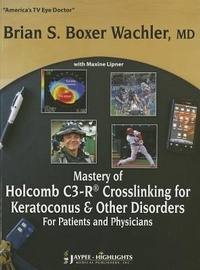
Mastery of Holcomb C3-R (R) Crosslinking for Keratoconus & Other Disorders: For Patients and Physicians
For Patients and Physicians
Published on 31. March 2013
Book
Paperback/Softback
132 pages
978-93-5090-327-8 (ISBN)
Description
Keratoconus is degeneration of the structure of the cornea. The cornea is the clear tissue covering the front of the eye. In keratoconus, the shape of the cornea slowly changes from round to conical (PubMed Health). In the early stages, keratoconus can be corrected with the use of lenses, but in the later stages, surgery is the only option.
Holcomb C3-R (R) is a non-surgical technique that involves placing drops of the vitamin Riboflavin into the eye and using a UV light to activate them. The drops strengthen the fibres of the cornea and over time, preserve sight (American Keratoconus Association).
This book is a concise guide to the technique of Holcomb C3-R (R) to treat keratoconus. Authored by the inventor of the procedure, Brian S Boxer Wachler, the text is based on his first hand clinical experience and explains the history and basic science of cross linking, the development and naming of the technique, its uses and complications, and first patient results.
Key points
Concise guide to technique of Holcomb C3-R (R) to treat keratoconus
Authored by inventor of the technique and based on clinical experience
Includes more than 60 full colour images and illustrations
Holcomb C3-R (R) is a non-surgical technique that involves placing drops of the vitamin Riboflavin into the eye and using a UV light to activate them. The drops strengthen the fibres of the cornea and over time, preserve sight (American Keratoconus Association).
This book is a concise guide to the technique of Holcomb C3-R (R) to treat keratoconus. Authored by the inventor of the procedure, Brian S Boxer Wachler, the text is based on his first hand clinical experience and explains the history and basic science of cross linking, the development and naming of the technique, its uses and complications, and first patient results.
Key points
Concise guide to technique of Holcomb C3-R (R) to treat keratoconus
Authored by inventor of the technique and based on clinical experience
Includes more than 60 full colour images and illustrations
More details
Language
English
Place of publication
New Delhi
India
Target group
College/higher education
Product notice
Paperback (trade)
Illustrations
63 Farbfotos bzw. farbige Rasterbilder
63 Halftones, color
Dimensions
Height: 241 mm
Width: 184 mm
Thickness: 5 mm
Weight
353 gr
ISBN-13
978-93-5090-327-8 (9789350903278)
Copyright in bibliographic data and cover images is held by Nielsen Book Services Limited or by the publishers or by their respective licensors: all rights reserved.
Schweitzer Classification
Persons
Brian S Boxer Wachler MD
Boxer Wachler Vision Institute, Beverly Hills, California, USA
Maxine Lipner
Medical Writer, Nyack, New York, USA
Boxer Wachler Vision Institute, Beverly Hills, California, USA
Maxine Lipner
Medical Writer, Nyack, New York, USA
Content
Introduction: The Holcomb C3-R (R) at the Starting Gate
Going for the Gold: Steven Holcomb's Olympic Story and Putting C3-R (R) on the Map
History of Crosslinking in Industry, Medicine, and Aging
Basic Science of Corneal Crosslinking
First Patient Results: The Dresden Experience
Development and Naming of Holcomb C3-R (R)
First Presentation of Results of Holcomb C3-R (R) and Holcomb C3-R (R) Combined with Intacs (R)
Why it's Not Glamorous to be a Pioneer in the Beginning
Techniques of Holcomb C3-R (R) Crosslinking System (Epithelium-On) and CXL (Epithelium-Off)
Complications of CXL (Epithelium Off)
Results and Complications of Holcomb C3-R (R) (Epithelium On)
Combining the Holcomb C3-R (R) Crosslinking System with Intacs (R)
Use of Holcomb C3-R (R) for Improving Stability in Radial Keratotomy Patients
Holcomb C3-R (R) with PRK
Use of Crosslinking for Corneal Infections and Autoimmune Corneal Melts
Use of the Holcomb C3-R (R) for Trampolining Corneas after LASIK
Combining use of the Holcomb C3-R (R) with Conductive Keratoplasty and Phakic ICLs
Looking into the Crystal Ball: What Lies Ahead for Corneal Collagen Crosslinking
Going for the Gold: Steven Holcomb's Olympic Story and Putting C3-R (R) on the Map
History of Crosslinking in Industry, Medicine, and Aging
Basic Science of Corneal Crosslinking
First Patient Results: The Dresden Experience
Development and Naming of Holcomb C3-R (R)
First Presentation of Results of Holcomb C3-R (R) and Holcomb C3-R (R) Combined with Intacs (R)
Why it's Not Glamorous to be a Pioneer in the Beginning
Techniques of Holcomb C3-R (R) Crosslinking System (Epithelium-On) and CXL (Epithelium-Off)
Complications of CXL (Epithelium Off)
Results and Complications of Holcomb C3-R (R) (Epithelium On)
Combining the Holcomb C3-R (R) Crosslinking System with Intacs (R)
Use of Holcomb C3-R (R) for Improving Stability in Radial Keratotomy Patients
Holcomb C3-R (R) with PRK
Use of Crosslinking for Corneal Infections and Autoimmune Corneal Melts
Use of the Holcomb C3-R (R) for Trampolining Corneas after LASIK
Combining use of the Holcomb C3-R (R) with Conductive Keratoplasty and Phakic ICLs
Looking into the Crystal Ball: What Lies Ahead for Corneal Collagen Crosslinking